9‘minutes reading
Cristina Kirchner has been locked up, symbolically, for exactly one year, when the Supreme Court confirmed his conviction for the Road Traffic case. Since June 10, 2025, the former president lost ground as leader of the peronism and also capacity for representation on an individual basis, since cannot be a candidate. However, it continues to influence the main opposition party and remains, according to the latest polls, in the top 5 of the Argentine political leadership.
Confirmed the conviction in the Roads case, Cristina Kirchner began her house arrest a week after the Court’s ruling, on June 17 of last year. The department of San José 1111 It became his prison and, also, his party bunker. The former president opposes a iron resistance to exile. He does not want the fate of Carlos Menem or Eduardo Duhalde for her. Embodies a political drama no resolution in sight.
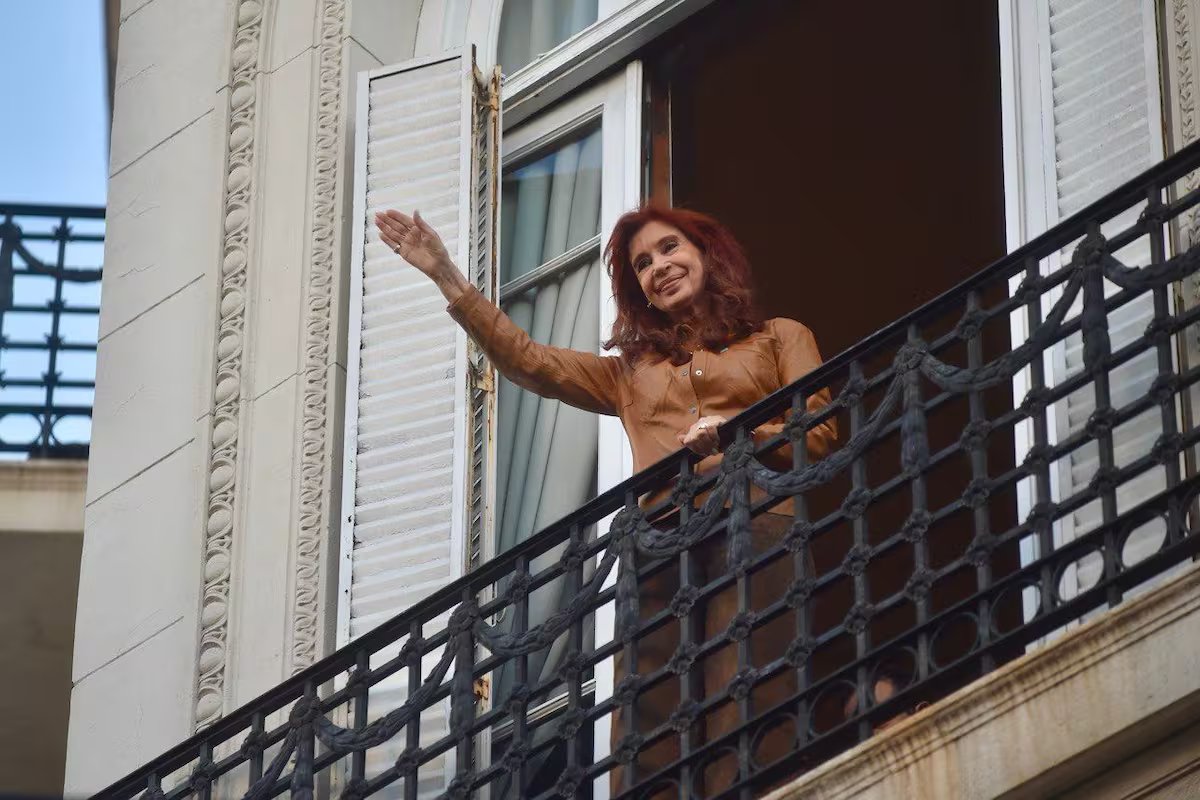
Out of impulse, she did not accept to spend her sentence in her “place in the world”, Patagonia, as friends and strangers suggested, to get her out of the court national center, which is the city of Buenos Aires. And now every time goes out to the balconyhis followers celebrate it, but his adversaries from outside and inside also suffer from it. Leave a latent message like this: the reordering of Peronism will be with her, or it will not be. He who faces that challenge, more than any other, is Axel Kicillof.
The governor of Buenos Aires seeks to position himself as the “natural candidate” of the PJ in the face of the 2027 elections. But she encounters an obstacle that is currently insurmountable: all quantitative and qualitative studies reflect that her potential electorate is “tangled” with that of the former president. “They overlap by more than 95%”explained a pollster frequently consulted in Peronism. That’s why Kicillof cannot openly break with his mentor.
In fact, one reserved survey that circulates between La Plata and Buenos Aires gives the governor 31% of voting intention for president, but If Cristina sponsored another candidate, Kicillof would lose at least 17 percentage points along the waymore than half of its flow. That is precisely the power to harm that the president of the PJ retains, despite her confinement in San José 1111. In the last two months, furthermore, lowered its high negative image.

According to specialists, this phenomenon is recorded at the same time as the drop in support for the president. Javier Milei. Although in her own tribe they question Cristina the constant fight with Kicillof -which was put on pause to organize the farewell of Indio Solari- and the mayors who no longer agree with his leadership. In the “word clouds” that are created in the focus group with Kirchnerist opinions, the former president no longer described as a “stateswoman”.
Maybe that’s why the campaign was reactivated. “Cristina free”with daily militancy activities under the Constitution department, and the former president’s messages on social networks were noticeably spaced out. The limitations imposed by house arrest on her political leadership wore down the head of the PJwho does not trust telephone conversations and prefers hand-to-hand conversations, but deals with judicial restrictions.
The rules that the Justice set for him since last November, when it tightened the conditions of detention, are clear: he can receive visits outside the prison. authorized list – which is made up of his children, a secretary, his lawyers and a doctor – only twice a weektwo hours maximum on each occasion, and with a limit of three people per encounter. “The lady is imprisoned and is being persecuted”they affirmed in their surroundings, before a query from LA NACION.
Power factors
Even so, the former president controls the national PJdespite not being able to attend meetings in person. And it retains various levels of power, in which it is verified that its influence fell, but at the same time it was consolidated in a third of Peronism:
- Congress: Cristina brings together a dozen legislators in the Senate, mostly members of La Cámpora. The vice president of the bench responds to that group, Anabel Fernandez Sagasti (Mendoza), Mariano Recalde (Capital), María Celeste Giménez (San Juan) and Eduardo De Pedro (Buenos Aires). They are joined by the head of the block, Jose Mayans (Formosa), Juliana Di Tullio (Buenos Aires), Lucía Corpacci (Catamarca), Carlos Linares (Chubut), the Rio Negros Ana Marks and Martín Soria, Florencia López (La Rioja) and Alicia Kirchner (Santa Cruz). In the Senate, Cristina has 12 supporters, over the 25 that the Peronist bloc has. On the block DeputiesCristina’s pure followers are 27 legislators, out of 93 in total of Homeland Force.

- The provinces: When the Court confirmed the sentence, Kicillof was at the national headquarters of the PJ, but he did not have a good time due to the reproaches of Christianity. There was also an emergency meeting for zoom with the Peronist leaders Sergio Ziliotto (The Pampa), Ricardo Quintela (Rioja), Gustavo Melella (Land of Fire), Gildo Insfran (Formosa) and, the then governor of Santiago del Estero, Gerardo Zamora. Absent were Raúl Jalil from Catamarca and Osvaldo Jaldo from Tucumán, who had already distanced themselves and were part of the group of “dialoguists” with the Casa Rosada. Quintela, who failed in his intention to compete with Cristina for the presidency of the national PJ, visited her for the last time last November. Insfrán remains a unconditional ally for the former president.

- The CGT and the unions: Those who still remain aligned behind the figure of Cristina occupy seats in Congress. They are the cases of Sergio Palazzo (The Bank), Mario Manrique (SMATA) and Vanesa Siley (SITRAJU). They add up Victor Santa Maria (Suther), with weight in the Buenos Aires PJ and media businessman, as well as the metallurgist Abel Furlanmentor of United Trade Unions Front (FreSU), which brings together wayward cegetistas, such as Aceiteros or Luz y Fuerza. The space also integrates alternative workers’ centers, such as the CTA and the Autonomous CTAwith a strong presence among ATE officials and teachers. Although these sectors grew in the heat of the Kirchnerist governments, today they are also territories of internal dispute. Hugo YaskyCristina’s historic hillside, now promotes the Axelist Right to the Future Movement (MDF). Pablo Moyanofor his part, maintains a bond with Cristina and visited her in 1111, ignoring both his father, Hugo Moyanolike the leadership of the CGT.

- Province of Buenos Aires: the hard core of Kirchnerism moved, over the years, from its original Santa Cruz to Buenos Aires territory. There some 17 mayorssome representatives such as Mayra Mendoza (Quilmes) align themselves with Cristina and Máximo Kirchner, while eight other community leaders – from the so-called AFA Group – are related to them. However, Kicillof’s MDF brings together 38 mayors, while another 18 mayors report to Sergio Massa in the Renewal Front. Furthermore, Máximo Kirchner has just lost the presidency of the Buenos Aires PJ at the hands of Kicillof. However, in the Legislature The weight of Kirchnerism is evident: in the Senate there is 13 legislators of that space, plus some like-minded people, against only five Axelistas and three Massistas. and in DeputiesKirchnerism adds 18 seatsagainst 10 from the MDF, another 10 from the Renewal Front and three from the AFA group. Kicillof must have the agreement of this space.

- Holy Cross: in the province where he was born, Kirchnerism has five mayors out of 15 possible, three national deputies out of 5 total, a national senator about three and nine legislators out of 24. In the last two years it lost legislative representation and was defeated in the legal dispute for control of the Santacruceña courtbut in the midterm elections he notified the governor Claudio Vidal -emerged from the internal Peronist-union- that is still in a position to challenge him for power.
Visits and anklet
Despite the fact that in recent months she restricted her political meetings, Cristina Kirchner had half a year of great activity in 2025 at San José 1111. There she received foreign presidents and former presidents, such as Lula Silva (Brazil) and Ernesto Samper (Colombia); to new Peronist allies such as Juan Manuel Urtubey and leaders who seek to return to the party, such as Miguel Pichetto; also to governors like Kicillof and Quintela from Rioja, among others.
The famous Cuban singer also stopped by Cristina Kirchner’s apartment. Silvio Rodriguez; the owner of Grandmothers, Carlotto’s Stele; the liberal Carlos Maslaton and the reference on the left Myriam Bregman. But the former president is still waiting for a visit that is considered key for the future of Peronism: that of Kicillof. “Axel is one of the few people with whom he always had a good dialogue, he even called him Axelito”they slipped into La Cámpora.

From there they added: “He has to give the initial kick to go see her”. Among the leaders who remain loyal to Cristina, despite the fact that a year has passed since the sentence and they had little contact with her, they highlight that His name appears among the most valued politicians in the country –along with Milei, Patricia Bullrich, Kicillof and Bregman- and they complain about the treatment meted out to them by Justice: “The anklet, as a human being, denigrates her”they emphasize.
In a recent report, Kirchnerism maintained that “more than half of the people detained for crimes against humanity “In our country they do not use electronic anklets and they receive unrestricted visits in their homes,” which they compare with Cristina’s more restricted current situation. That is why today they will make a “symbolic hug” to Saint Joseph 1111 and on June 20 they call for an event in Parque Lezama, where the main speaker could be Maximo Kirchner.
The son of the former president and Kicillof represent, despite themselves, the impossible succession dilemma. The deputy could be the clearest representative of the space in case of breaking ground with axelism, but he would not be a competitive candidate. In turn, the governor faces the ghost of Alberto Fernández and exposes oneself to a demonstrably harmful disapproval. The future of the main opposition party depends, paradoxically, on someone who cannot decide his own freely.