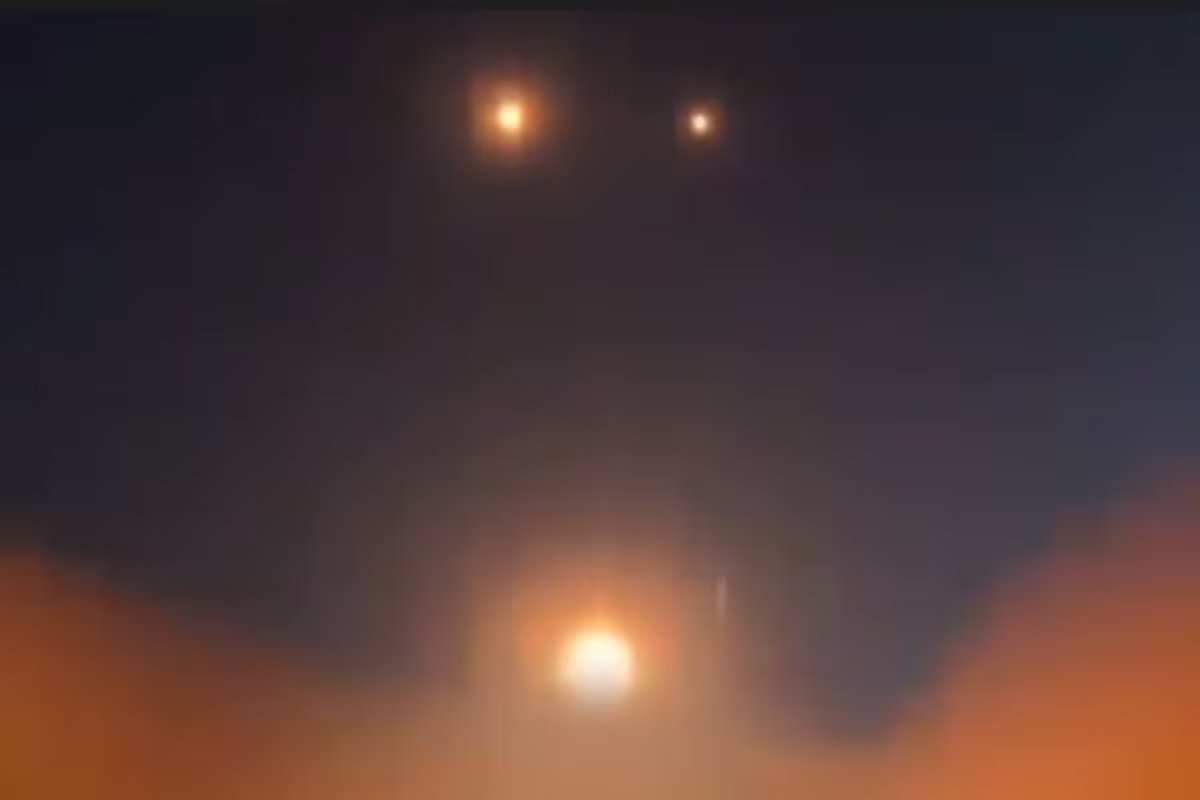
DUBAI.- The Islamic Revolutionary Guard of Iran announced this Wednesday that its Aerospace Force launched drones and missiles long range against different military installations that house US personnel in Kuwait, Bahrain and Jordan.
The counteroffensive took place after the attacks ordered by the United States against Iranian territory as a result of helicopter shooting down in it Strait of Hormuz. It was the second time this week that the back-and-forth attacks tested the cease-fire after Iran and Israel attacked each other on Monday, and once again raised the question of how much pressure the deal can withstand before it breaks down.
According to the Islamic Revolutionary Guard, its missiles reached and destroyed “four critical targets at the Jordan base”including F-35 fighter jet hangars and a main command and control center.

While the force presented the missile attack as the “culmination” of an operation reprisal wider. It included the attack on 21 targets at several US air and naval bases throughout the region.as well as the downing of an American MQ-9 drone over Iranian airspace.
From the Islamic regime they also warned that they remain prepared to give a response “overwhelming and decisive” to any subsequent US military action and that the White House will have to take full responsibility for the consequences of further escalation.
In contrast, the Jordanian Army reported that its air defense systems intercepted and They shot down five missiles launched from Iran which targeted the Al-Azraq area, in the province of Zarqa.
These air blockades caused the fall of debrisbut they did not cause fatalities or significant material damage. On the other hand, military engineering teams were deployed to secure the remains of the missile and remove any possible explosive.
The crossfire between Iran and the United States crept into Bahraina country where the Ministry of the Interior recommended to citizens “keep calm and go to the nearest safe place”.
Given this situation, also the air defense systems of Kuwait are “currently intercepting hostile air targets“, according to the General Staff of the Army of that country.
In a publication in xresidents were urged to “comply with the safety instructions and guidelines issued by the competent authorities and to obtain information from authorized official sources”.
Jordan said Wednesday it shot down five incoming missiles targeting the Muwaffaq Salti Air Base. That air base housed American F-35 fighter jets and other aircraft. The state news agency petra released the statement, which added that there were no injuries in the attack and that explosives experts had examined the debris from the interceptions.
The war
Since United States and Israel They began to attack Iran On February 28, the war shook the global economy, boosted energy prices around the world and made many commodities, including food, more expensive.
Officials from the countries involved in the conflict failed to convert the April ceasefire into an agreement to permanently end the conflict, particularly as Israel intensified its military campaign in Lebanon.
The demolition of helicopter of Apache attack and the US attacks on Tuesday further strained the truce, a day after Iran and Israel exchanged fire for the first time since the truce went into effect.
Although the president of the United States, Donald Trump, insists that negotiations with Iran to end the war are moving forward, repeatedly alternated between expressing that optimism and warning that he was ready to return to a total war. Iran, for its part, is demonstrating resilience despite having faced weeks of intense bombing, betting that its ability to effectively close the Strait of Hormuz – a crucial step for the world’s oil and natural gas – gives him a strong negotiating card.
AP and Reuters Agencies