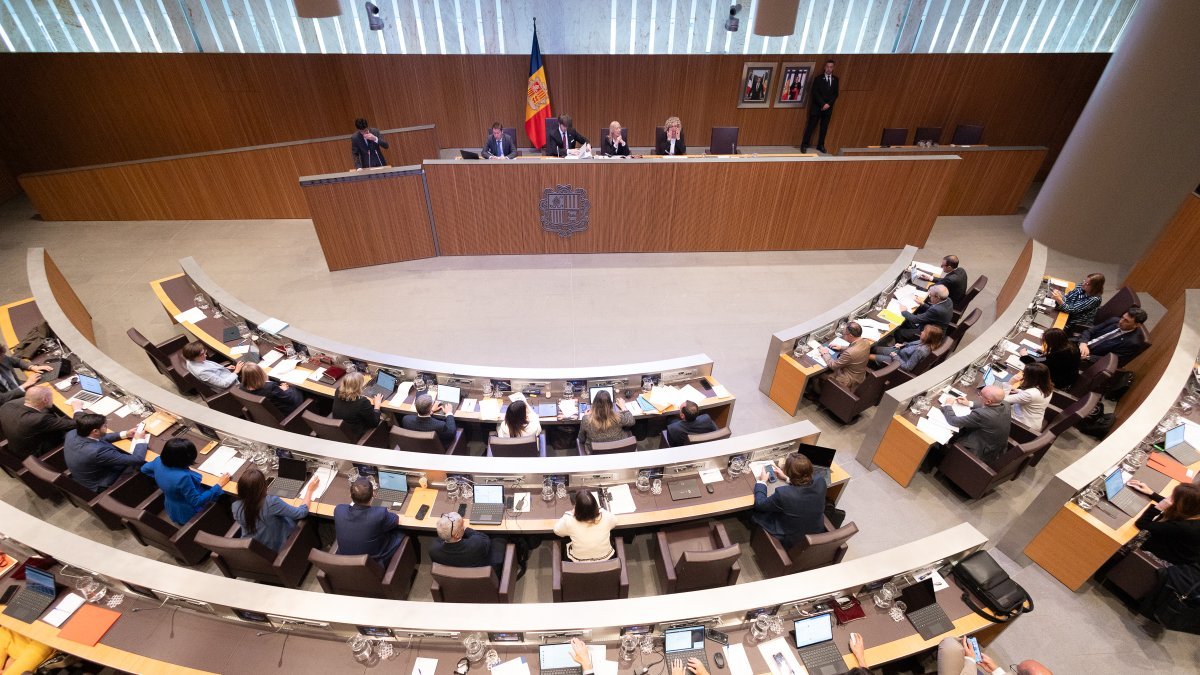

The majority’s proposal to set the age of consent at 18 has not been well received by the opposition groups, which they consider that it does not correspond to the reality of young people and which gives the feeling that it is being legislated from a parallel reality.
Concordia, the PS and Andorra Endavant made it clear that they do not share the measure promoted by the majority – and endorsed by the Government– and warn that it can generate unwanted effects. The co-president of Concordia, Núria Segués, questioned “what is the motivation for such a sudden increase – from 14 to 18 years old–, especially after the majority rejected our proposal to set the age at 16.” Furthermore, he remarked that this change – which in Europe is only applied by the Vatican and Turkey – runs the risk of “infantilizing teenagers aged 16 to 18 and criminalizing relationships typical of these ages”.
“There is a risk of infantilizing teenagers aged 16 to 18 and of criminalizing their relationships”
The president of the Social Democratic parliamentary group, Susanna Vela, defended that setting the age at 16 “is prudent enough if it is compared with the data from when the relationships start”, and criticized that placing it at 18 “is going to happen”. “Relationships must always be consensual, but you cannot legislate against the current reality”he remarked. Vela also advanced that they will ask what is the basis for this abrupt change of opinionespecially considering that the starting point was 14 years.

“Raising it to 18 is a proposal disconnected from social reality”
Andorra Endavant does not buy the proposal either. Carine Montaner said that “we are totally against raising the age of consent to 18since it is a proposal disconnected from social reality”. Montaner called for common sense and pointed out that “to protect minors, yes, but without falling into extremes that do not reflect reality”. The General Counsel ended by emphasizing that from their group they defend the principle of responsibility and “live and let live”.
“Relationships must always be consensual, but you cannot legislate against reality”
And education?
Beyond the legal debate, too the focus has been placed on the need to accompany any reform with educational measures. Susanna Vela pointed out that legislation must be accompanied by complementary actions, such as the reinforcement of sex-affective education, and warned that only the law can be changed not be enough, as several organizations that work with young people have already warned.
Segués fully agreed with this vision. He argued that amendments to the Penal Code are essential to protect groups, but he insisted that a parallel cultural change is neededwith more pedagogy and sexual education. As he explained, it is necessary to strengthen this area in the sociocultural and educational aspect to address issues such as referents, behaviors and the normalization of certain behaviors.