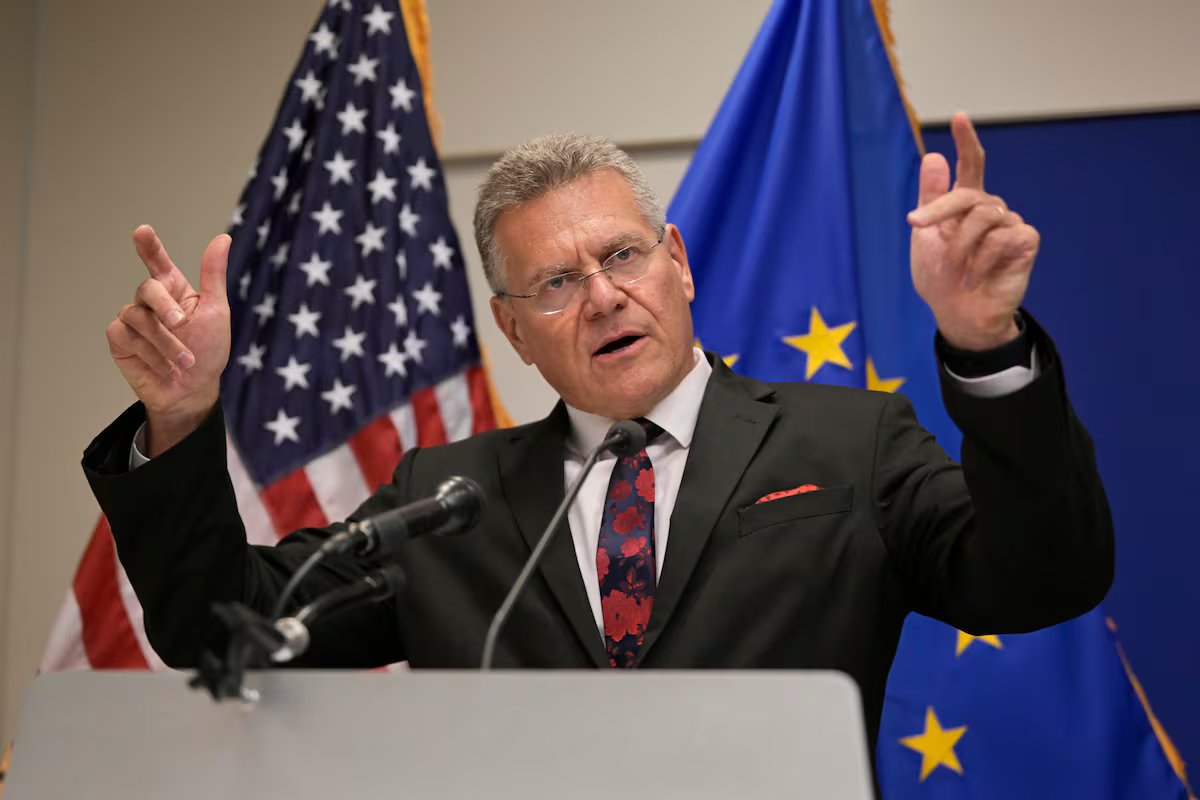
The European Commission this Friday denied the accusations of the President of the United States, Donald Trump, about the EU’s failure to comply with the trade pact negotiated with Washington, and warned about the “options” it keeps open to protect its interests in the face of the new tariff measures.
“The EU is implementing its Joint Declaration commitments in accordance with standard legislative practice, keeping the US administration fully informed at all times,” said a spokesperson for the EU Executive.
“We maintain close contact with our counterparts, while seeking clarity on the US commitments,” added the spokesperson a few hours after the latest tariff threat launched by Trump against the Twenty-Seven, in particular, to raise the tariff on cars and trucks manufactured by the community bloc to 25% starting Monday.
“We remain fully committed to a predictable and mutually beneficial transatlantic relationship. In the event that the United States adopts measures incompatible with the Joint Declaration, we will keep all our options open to protect the interests of the EU,” warned the same source.
Brussels spoke like this after Trump wrote on his Truth Social network that the European Union “is not complying with our trade agreement, which was fully agreed upon,” which is why he announced that he will apply the aforementioned tariff measure next week.
Trump insisted that “it is fully understood and agreed that if they manufacture the cars and trucks in plants located in the United States, no tariffs will be applied.”
It is unclear under what authority Trump will raise tariffs on the EU, after the Supreme Court in February invalidated much of what he had already set, thereby dismantling the tariff scheme used in his trade war against the United States’ partners.
Following this setback, the US president imposed a new temporary global tariff of 10% under a new legal framework, which theoretically should be extended by Congress in July.
In mid-2025, both parties reached an agreement whereby the EU accepted a 15% tariff on most European products in exchange for the US exporting most of its products at 0%.
But the approval of the trade pact was paralyzed at the beginning of the year by the European Parliament in the context of new tensions between Brussels and Washington due to Trump’s desire to gain control of Greenland.
The European Parliament finally decided to resume the pact and give it the green light in March, although it introduced safeguards that allow the agreement to be suspended if Washington imposes new tariffs, threatens to do so or questions the territorial integrity of the bloc, in addition to introducing an entry into force clause that prevents its application until compliance with all the elements of the agreement is confirmed.
This decision opened the door for Brussels to begin implementing its part of the pact, although for its final ratification the final design still had to be negotiated with the Member States.