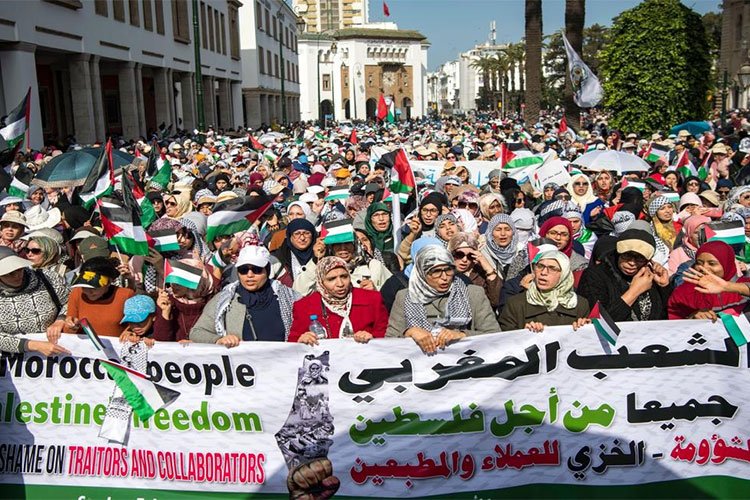
Two bodies demand stopping the lifting of representation and severing ties with the occupation
father-in-law
Expressiveness
The announcement of upgrading Moroccan relations with the Zionist entity from the level of the liaison office to the level of embassies, with the exchange of ambassadors and the expansion of economic cooperation and official visits, faced explicit rejection from the Moroccan Authority for Supporting the Nation’s Issues and the National Action Group for Palestine, which considered the step an escalation of the path of normalization and an expansion of relations with the occupation in a very sensitive regional circumstance, coinciding with the continuation of the war on the Gaza Strip and the escalation of attacks and incursions targeting Al-Aqsa Mosque.
The position of the two bodies came after what was announced regarding the tripartite meeting that brought together Moroccan Foreign Minister Nasser Bourita with Israeli Foreign Minister Gideon Saar and US Ambassador to the United Nations Mike Waltz, where, according to what was reported by media outlets citing Israeli sources, they discussed and agreed to raise the level of diplomatic representation between Morocco and Israel to the level of embassies, with the exchange of ambassadors, the strengthening of economic cooperation and the exchange of official visits, according to the allegations.
The Moroccan Authority for Supporting the Nation’s Issues considered that the new development cannot be separated from the gradual path of Moroccan-Israeli relations, considering that the move from a liaison office to an embassy represents an additional step in consolidating and expanding the Israeli presence inside Morocco, and not just a protocol procedure related to the level of diplomatic representation.
The Commission said that this path comes at a time when the Palestinian people continue to face occupation, war, displacement and settlement, and at a time when, according to its statement, the repeated raids on Al-Aqsa Mosque and the violations affecting its sanctity and sanctities continue, considering that the timing increases the seriousness of the step and makes it a subject of political and moral rejection for it.
The authority stressed that transforming relations with the occupation into advanced diplomatic and economic partnerships, in addition to agreements related to protecting investment, preventing double taxation, and exchanging visits, means expanding the scope of normalization to include multiple areas, considering that this opens more areas for the Israeli presence inside Morocco.
The Commission stressed that normalization, from its point of view, does not represent merely economic cooperation or a normal diplomatic relationship, but rather a political and economic path that contributes to expanding the Israeli presence, which it rejects and calls for confronting it through peaceful civil action.
In the same context, the National Action Group for Palestine expressed its absolute rejection of what it described as a dangerous step, stressing that moving relations from a liaison office to the embassy level represents a qualitative shift in the nature of the relationship with Israel.
The group focused in particular on the timing of the decision, considering that raising the level of representation comes while the war on the Gaza Strip continues and the suffering of the Palestinians continues, and at a time when international reports and investigations address violations committed against the Palestinian people. She said that the priority at this stage should be to stop the war, ensure the entry of humanitarian aid, protect civilians, and hold those responsible for violations accountable, rather than expanding diplomatic relations with Israel.
The group wondered, in a critical tone, about the implications of taking a step of this magnitude in this circumstance, considering that its timing raises questions about the nature of official priorities, and stressed that its position on the step comes within the framework of its declared rejection of the path of normalization in its various forms.
The National Action Group also criticized what it considered to be a disregard for the position of the Moroccan people and the political, trade union, human rights and civil forces that reject normalization, calling on these various components to assume their responsibility and work jointly to confront what they consider to be the dangers of expanding the Israeli presence inside the country. The Commission and the group agree in rejecting the transfer of Moroccan-Israeli relations to the level of embassies, and in considering the step as a new link in the path of normalization. They also agree that the Palestinian issue must remain at the heart of the Moroccan position, and on the necessity of continuing pressure to stop the war on Gaza and defend the rights of the Palestinians.
However, every statement has an additional angle; The Moroccan Authority for Supporting the Nation’s Issues gave a large space to what is happening in Jerusalem and Al-Aqsa Mosque, considering that the incursions and attempts to change the existing reality in the mosque require Arab, Islamic and international action to protect it and preserve its sanctity, and linked the escalation of normalization to what it described as the continued desecration of Palestinian sanctities.
As for the National Action Group, it focused more on the repercussions of the move on the Moroccan position on the Palestinian issue, and on the necessity of dropping normalization and severing relations. It also devoted part of its statement to rejecting the use of the Western Sahara issue in the context of relations with the United States and Israel.
Ultimately, the two bodies called for stopping the process of improving relations with the occupying state, and ending various forms of cooperation and coordination with it, while the Moroccan Authority for Supporting the Nation’s Issues explicitly called for the closure of the Zionist Liaison Office, while the National Action Group renewed its call to drop normalization in all its forms.
They also called for continuing civil and peaceful action, organizing initiatives and events that reject normalization, and mobilizing political, union, human rights, and civil forces to confront what they consider to be an expansion of relations with Israel.
The two bodies consider the move to embassies instead of liaison offices that should not be seen as mere diplomatic arrangements, but rather as a new station in the path of normalization. Therefore, they made the demand to reverse the step and sever relations with the occupation at the forefront of their positions, while emphasizing that the continuation of the war on Gaza and the attacks on Al-Aqsa Mosque increases, according to their vision, the intensity of popular and civil rejection of this path.