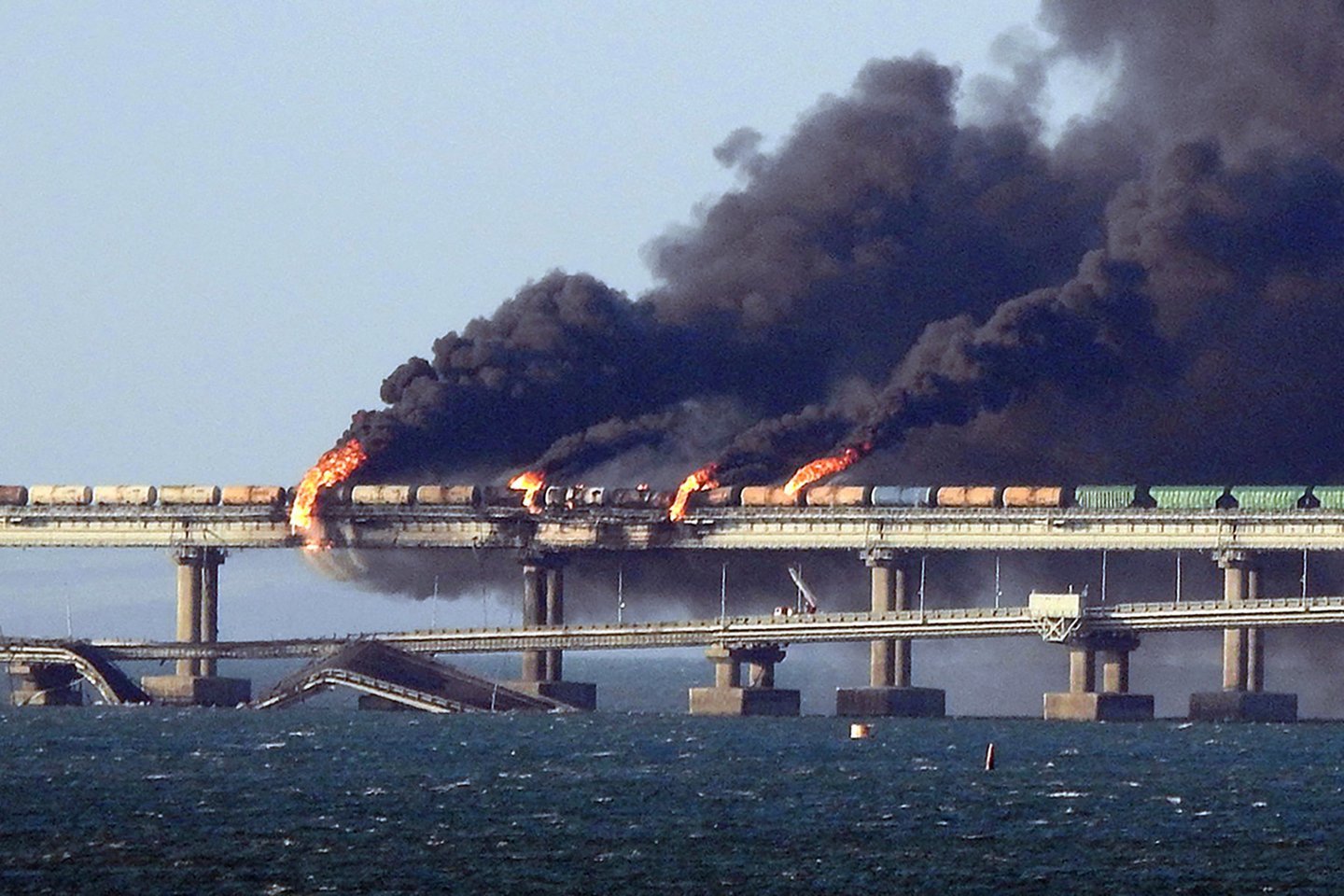
The authors of the publication claim that most of Crimea has actually turned into a war zone. The exception remains Yalta, which is protected by mountains and has no significant military facilities.
In other areas of the peninsula, military units, railway junctions, energy facilities and other infrastructure are regularly attacked. As a result, the conditions of everyday life become more and more difficult.
On the night of June 20 Ukrainian drones damaged power lines, attacked an oil terminal in Kerch, and hit a ferry carrying cargo. After a series of such attacks, ferry services were suspended.
The publication notes that this has become a serious blow to Crimean logistics. The peninsula is increasingly dependent on a land corridor through the occupied territories of Donetsk, Zaporizhia and Kherson regions.
Against the backdrop of supply problems, power outages have become more frequent. June 21 administration of occupied Crimea announced a temporary suspension of fuel sales at gas stations.
Similar restrictions were introduced in Sevastopol. This further increased the population’s anxiety about the situation on the peninsula.
Experts note that Crimea has a special significance for Russia both as a military base and as a symbol of Russian power after the 2014 annexation. Therefore, the current strikes have not only military, but also political effects.
Despite this, the Russian government and state media have mostly avoided publicly discussing the recent attacks. At that time, local residents increasingly talk about the declining trust in the state’s ability to ensure security.
A Crimean Tatar woman told reporters about her 14-year-old son’s reaction to the constant shelling. According to her, the boy would like to leave Crimea, but the family does not intend to leave the peninsula.
“This is our only homeland,” said the woman.
The article notes that if earlier part of the population associated the annexation with expectations of economic development, now the mood has changed. More and more people are questioning their future in the region.
Nikolay Chestyakov, a resident of Sevastopol, admitted that “people no longer see any prospects for the future.” According to him, wealthy residents of Crimea are trying to buy real estate in other regions of Russia and move their families there.
The author of the publication notes that fatigue and a desire to return to normal life prevail among the population. Many of them no longer talk about big political goals or ambitions.
“We don’t need any grand ambitions, we don’t need someone to try to improve something. We just want the sun to rise in the mornings, so that tourists come in the summer. We are so tired of everything else,” said Tatiana, a guide in Feodosia.
Prepared by Unian inf.