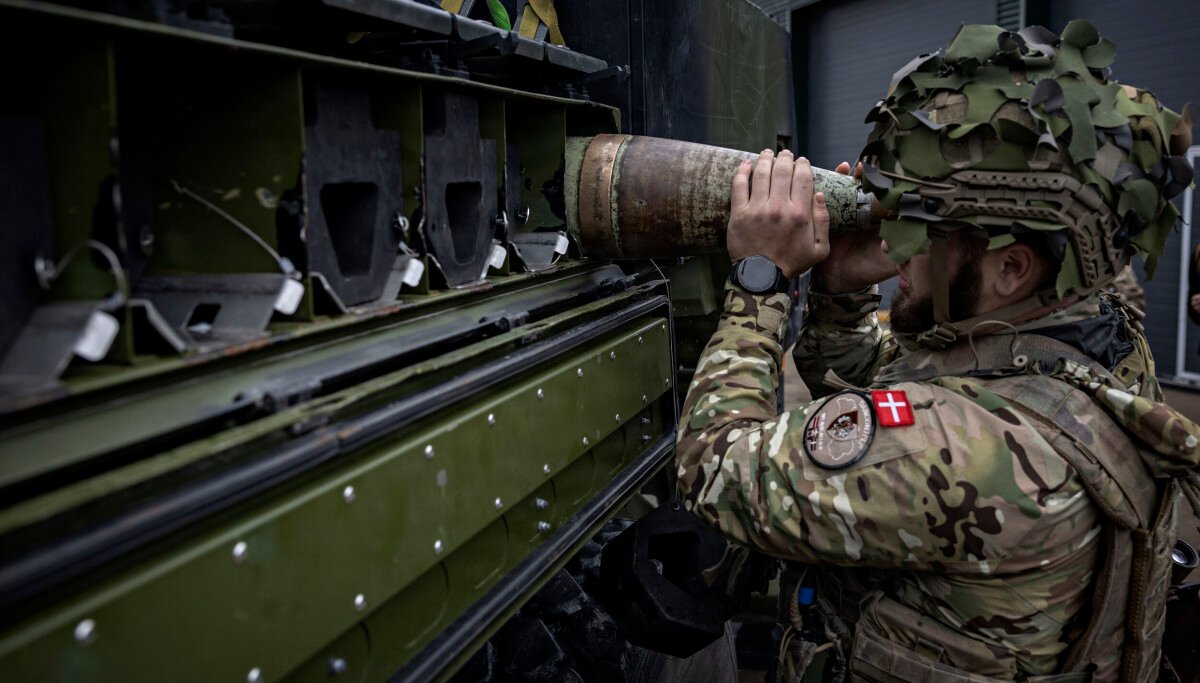
Denmark must use several hundred billion kroner on fighter planes, warships and other military equipment.
But the money doesn’t do it alone.
Denmark must use several hundred billion kroner on fighter planes, warships and other military equipment.
But the money doesn’t do it alone.
While the government invests massively in rearmament, the Armed Forces and the defense industry must also find thousands of new employees.
And they have to compete with the rest of Danish business for them.
In Denmark alone, the upgrade is expected to create a need for around 18,000 jobs by 2035.
The figure covers the Armed Forces, the defense industry and other companies that receive tasks as a result of the rearmament.
But there is already a shortage of specialists who must convert the billion-dollar investments into real defense capacity.
This is shown by a new Nordic study from the auditing and consulting company EY.
According to the survey, it is particularly difficult to obtain employees with skills in artificial intelligence, data and software.
However, the 18,000 jobs do not necessarily all have to be found through new hires.
This is explained by Christoffer Husted Rasmussen, who is a partner in EY-Parthenon.
– This is a combination of new jobs and changes in existing roles and jobs, he says.
Part of the need arises because companies that have so far delivered to other industries are expected to get more tasks within the defense industry.
But the lack of qualified labor can become a bottleneck for the rearmament.
That’s the opinion of Søren Kryhlmand, deputy managing director of Dansk Industri (DI).
– You don’t get a strong defense with more grants alone. It is also about having people to develop the technology that will equip the Armed Forces.
– That is why defense policy and labor market policy must be thought of together, he says.
Bottlenecks are getting bigger
According to DI, the Armed Forces and the defense industry must find employees in a labor market where many companies find it difficult to recruit.
The upgrade thus risks simply moving employees from one part of the labor market to another without increasing the total workforce.
The demographic development is expected to make the challenge greater.
– There are already bottlenecks in the labor market, and they are only getting bigger. Partly because of the demographic development, and partly because the demand for labor is increasing, among other things as a result of the rearmament, says Søren Kryhlmand.
However, he does not believe that the rearmament needs to be at the expense of Danish business.
– We do not see a stronger defense as opposed to a strong business community.
– On the contrary, they can strengthen each other in many ways. But no matter how we turn it around, the lack of employees will be a challenge, he says.
The challenge is not just about getting more employees.
Interest in working with defense has increased, but this in itself does not solve the lack of experienced specialists.
The armed forces need experienced people who cannot be trained overnight.
Even if the Armed Forces gets more conscripts, it may take many years before they can solve the most demanding tasks.
The armed forces also find it difficult to retain experienced employees. According to EY, private companies can often offer higher wages without the risk of redundancies.
More money is not enough
It is also important for the Armed Forces to keep the experienced employees and get former employees back. This is the assessment of Christina Burgwald, partner in EY and co-author of the report.
– When you have such great ambitions and goals for the Armed Forces, it is not enough to have more money and more equipment. You also need the people to take up the task. That is our most important message, she says.
It can also take a long time to bring in new employees. Security clearances can last from a few weeks to more than a year.
EY recommends clearer career paths, continuing education and closer cooperation with educational institutions and private companies.
DI highlights more foreign labour, upskilling and more seniors on the labor market as possible solutions.
Ritzau has asked the Armed Forces Personnel Command how the Armed Forces will obtain the employees, and whether the lack of qualified labor can slow down the rearmament.
The personnel command has not managed to respond before the deadline.