The making of a political cult
Duterte did not build his movement through ideology alone. He built it through storytelling.
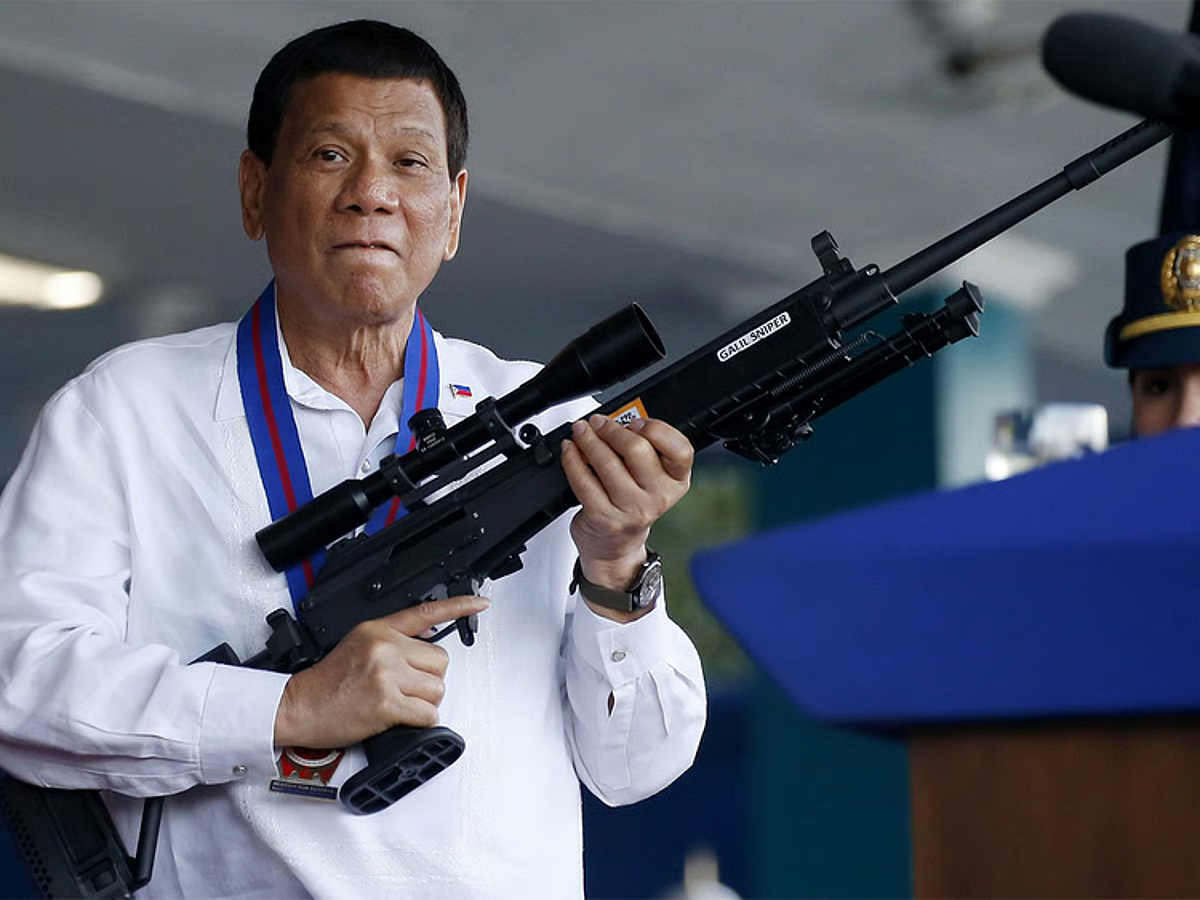
Unlike traditional politicians who spoke in rehearsed bureaucratic language, Duterte sounded like a neighbourhood elder telling stories over San Miguel.
His speeches wandered between jokes, profanity, anecdotes and dark humour. Supporters rarely minded that many stories were exaggerated, unverifiable or contradictory.
What mattered was authenticity — or the perception of it.
His crass language broke political convention. His insults became entertainment.
His profanity became a symbol of rebellion against Manila’s elite. He trashed the Malacanang, the principal workplace and residence of the president, saying it’s full or rats.
The authoritarian temptation
Political scientists have long observed that authoritarian leaders rarely begin by abolishing democracy outright.
Instead, they redefine democracy. Elections continue.
Institutions formally remain.
But independent institutions weaken, critics become “enemies”, and loyalty increasingly outweighs competence.
Duterte displayed many characteristics commonly associated with authoritarian populism.
He portrayed himself as the embodiment of “the people” against corrupt elites.
He frequently attacked independent media, human rights groups, churches, political opponents. He denigrated even his own children.
His difficult relationship with son Sebastian (also known as “Baste”) is well-documented. “My youngest son is a jerk. He’s not been going home to his house anymore,” Duterte was quoted by BBC as saying in a mixt of Tagalog, English and the Visayan dialect in a February 2017 speech.
Why the divide refuses to heal
The Duterte phenomenon survives because it speaks to two different Philippine realities.
One Philippines remembers insecurity, crime and governmental paralysis before 2016.
Another remembers grieving families, shrinking civic space and democratic erosion afterward.
Both experiences are real to those who lived them.
The result is not merely political disagreement.
It is competing historical memory.
Several scenarios are plausible
If Rodrigo Duterte is convicted, supporters may interpret the verdict as international injustice, strengthening the family’s political narrative.
If proceedings drag on without resolution, the trial itself could remain a rallying point throughout the campaign.
If Sara wins the presidency, Philippine politics may again shift toward the brand of populist strongman governance associated with her father, although the precise direction would depend on institutions, coalition partners and the political environment at the time.
Conversely, if an opposing coalition successfully frames the election around democratic accountability, human rights and institutional reform, the Duterte era could gradually recede into history.