Azim Ahmadkhojayev, head of Ozatom, said that the cost of the integrated nuclear power plant to be built in Uzbekistan may reach 9.5 billion dollars. Total amount does not include localization costs. It is planned to increase the level of localization to 30 percent. In construction, the format of placing two small and two large reactors on one site was chosen.
The cost of the integrated nuclear power plant to be built in Uzbekistan may reach 9.5 billion dollars. About this, referring to the director of the Atomic Energy Agency (“Ozatom”) Azim Ahmadkhojayev, Spot reported.
The head of “Uzatom” said that the format of placing two small and two large reactors on one site was chosen, using the same infrastructure. This approach allows for cost optimization.
“According to the contract we signed (on March 24, 2026), our base price is 9.5 billion dollars. This is the total, maximum amount,” Ahmadkhojayev said.
The head of “Ozatom” added that the level of localization was not taken into account in the total cost, and it is planned to increase it to 30%. This implies the involvement of local manufacturers and should reduce the cost of the project.
“We want to attract 85-90 percent (in the form of loans). According to our calculations together with our international partners from the “Big Four”, if this amount of funds are invested in the project, its effect on the budget will exceed 165 billion dollars. Related services will appear, and tax deductions will also begin to fall. In this respect, the project is considered very effective,” Ahmadkhojayev said.
Chronology of the NPP project
Talks about building a nuclear power plant in Uzbekistan did not appear yesterday or today. This issue has been discussed in various circles since 2017. In particular, in July 2018, in cooperation with the Russian company Rosatom, an agreement was reached on the construction of a nuclear power plant consisting of 2 power units with a capacity of 1200 megawatts each. was informed. At that time, it was planned to put the station into operation until 2028.
In October 2018, news that the Todakol reservoir area on the border of Navoi and Bukhara regions was selected for NPP came out. After some time, the assistant of the Russian president, Yuriy Ushakov, announced that the estimated cost of the NPP project in Uzbekistan is estimated at 11 billion dollars. If the Uzatom project is fully operational, it will cover up to 15 percent of the country’s energy needs said.
Between 2020 and 2023, against the background of the pandemic and the war in Ukraine, the issue of building a nuclear power plant in Uzbekistan was not on the active agenda. By 2024, this topic was back on the negotiating table. An agreement was signed on the construction of a low-power plant with a capacity of 6 reactors of 330 megawatts at a selected site in Jizzakh. Later, the configuration of the project changed again: the capacity of the substation will be 110 MW instead of 330 MW. That is, the NPP will have not six, but two RITM-200N reactors, each with a capacity of 55 MW.
In addition, in the summer of 2025, there is an agreement on the matter of the large NPP signed. The agreement envisages the construction of a large NPP of conventional size next to the small station. The large plant includes two power units with a capacity of 1 GW each, with the possibility of increasing the number of power units to four later.
In this way, both low-power and traditional high-power nuclear power plants will be built by Russia in Jizzakh region. This makes Uzbekistan the first country in the world to place two different station projects on one site. The total capacity of the complex of integrated nuclear power plants is planned to be 2.1 GW.
By 2035, the combined plant on an area of about 525 hectares will produce 15.2 billion kWh of electricity per year. This is equal to about 15% of the total consumption in Uzbekistan today informed Deputy Prime Minister Jamshid Khojayev.
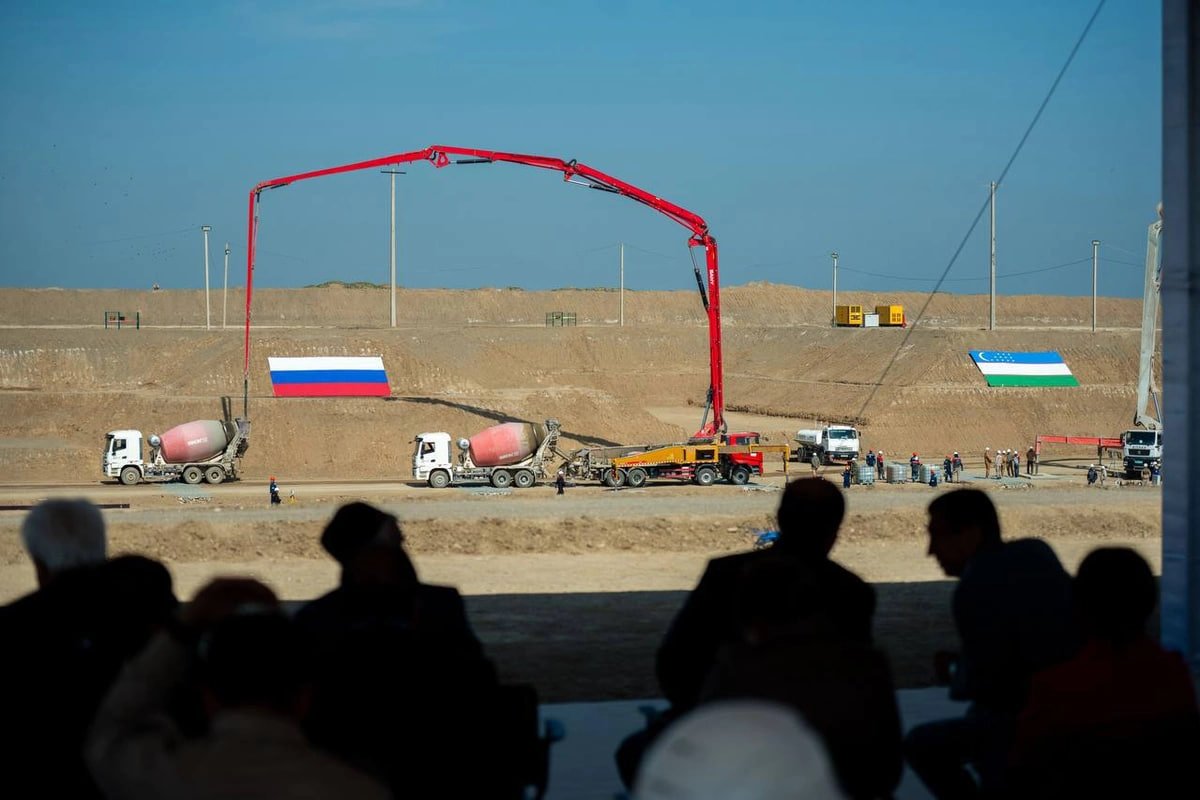
On March 24, 2026, the concrete pouring stage of the nuclear power plant construction began. On the same day, at the event held in Tashkent, “Ozatom” and “Rosatom” concluded two more agreements on this project. Based on one of them, the updated unique configuration of the station was confirmed. According to it, the integrated NPP complex will consist of two low-power units with a capacity of 55 MW each, and two conventional power units with a capacity of 1 GW each.