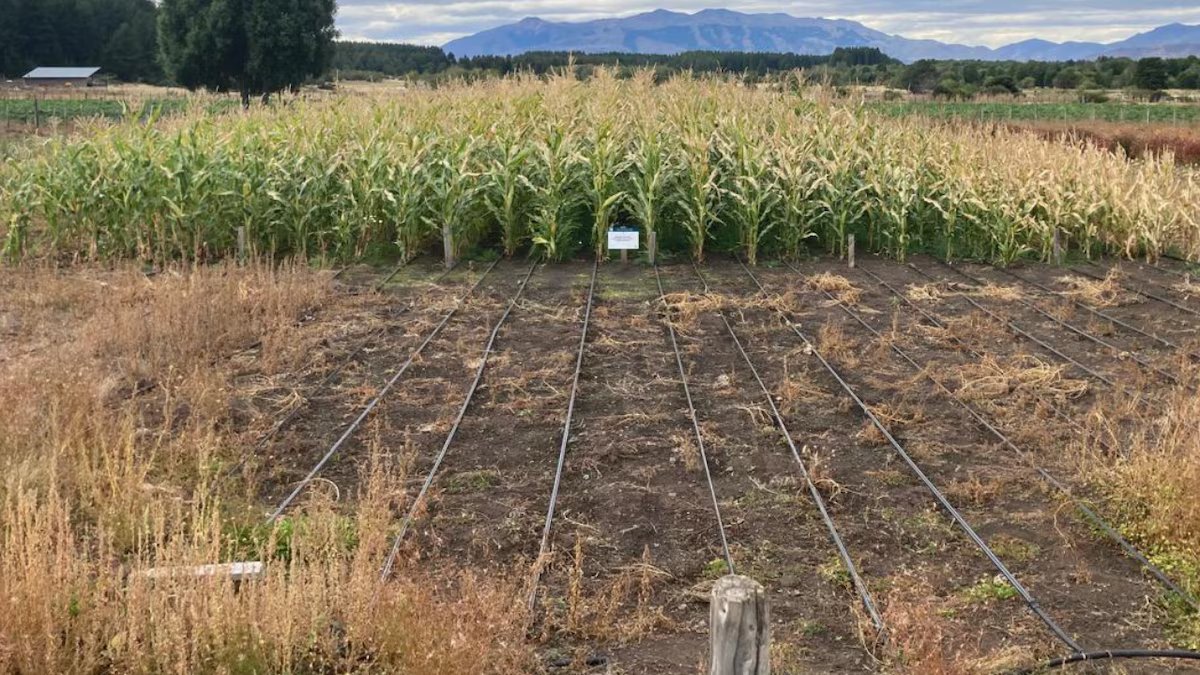
Until a few years ago, producing corn in Siberia, Russia, or in the north of Europe It was not part of any productive plan. Extreme cold, frost and too short growing windows they left to farming directly outside the map. Over time, that limit began to slip. And it was genetics that made it possible. From that development arose hybrids capable of adapting to extreme conditions and opening up areas where corn did not exist before. That same journey, which was consolidated in places like Russia or Finland, today begins to add a new chapter in Argentina. In the last campaign, this genetics landed in Patagonia with the help of Lilab SAwhere the first tests already show results that They begin to change the productive scenario.
In dialogue with THE NATION, Max Bunk Bedsone of the founders of the firm, said that they have already made 19 tests at different points, from the north of Neuquén to Tierra del Fuegoabout some 40 hectareswith a specific objective: that the crop can be completed and reach harvest in a region where today that does not usually happen.
“The returns are being very good,” he assured. bunk beds, who detailed that in the lots already harvested the yields are between 8000 and 10,000 kilos per hectarewhile the company advances with the registration of the materials and plans to begin its marketing in the next campaign. To produce, they use drip irrigation in some places and in others by blanket. Crops need 700 mm during the cycle.
To understand how we got here we have to go back a few years. The link with the French seed company Laboulet Semencesled by Patrice Labouletbegan in the early 2000s. At that time they were working together in Argentina, but the project stopped when The import and export operations were complicatedsomething central in the seed business. Far from being cut off, development continued in Europe, but with a different focus. “In this interim they were developing corn for extreme areas”Bunk beds said.
This work was done in Russia, Finland and areas near the extreme north of the hemisphere. “They are corn that is made even at 400 kilometers from the polar circle“He explained. These are environments where cultivation did not exist before.
From there came different genetics. As described, they are non-genetically modified materials, developed from type selections flintthat is, harder grain corn, better adapted to cold and shorter cycles. One of the keys is that they can start at lower temperatures than conventional corn. “They have a base temperature of 6 degrees”, he noted.
Added to this was another key advantage: the rapid drying of the grain. In environments where time is limited, the crop has to complete its development and reach harvest before extreme temperatures return: “They are productive windows of three or four months“It is the margin available before the climate conditions it again.
With this development already proven in the Northern Hemisphere, Literas highlighted that They saw an opportunity in Patagonia. The growth of livestock farming, the advance of irrigation and the need to intensify production systems generated a context where these materials could make sense. “It occurred to us to try, with the hypothesis that this would also have to work very well here,” said. The trials aimed precisely at that: validating whether the crop could complete its cycle under real conditions. In many areas of the south, corn can be planted, but it does not reach harvest. “The main characteristic we went to look for was to ensure that the crop is completed and can be harvested,” he said.
So they did the first tests in the north of Neuquén, Río Negro, Chubut, Santa Cruz and to the extreme south in Tierra del Fuego. In the ultra-early materials, the yields were between 8000 and 10,000 kilos per hectare.
These are values that, according to Literas, may seem moderate in other regions, but in Patagonia they imply a concrete change: going from a crop that is not harvested to one that can enter the production scheme. Furthermore, the behavior was repeated in different environments, which reinforces that genetic adaptation does not depend on a specific case.
Regarding management, no major complications appear. The trials were done with moderate fertilization – between 180 and 200 kilos of urea—, low pest pressure and weed control with regular herbicides.
One of the key points, he highlighted, was the sowing date. Experience showed that implementing between mid-September and mid-October It allows you to take better advantage of the climatic window and ensure that the crop reaches harvest. That opens up another possibility. By harvesting between February and March, the batch is released earlier and the chance to intensify begins to appear. “That would allow them to release the lots in February-March,” Literas said. He added that “In some areas you can start to consider a double annual crop.”
With these results, he explained that they decided to enroll four materials this year, with the idea of starting to market them in the next campaign. Are two ultra-early and two early hybridsdesigned mainly for grain production. In a first stage, the seeds will be imported from France, while moving towards local production is evaluated.
Beyond the specific development, what is beginning to change is the way of thinking about the productive system in Patagonia. In a region where livestock farming is central, the possibility of producing corn—both for grain and silage—can improve the food supply and give more stability to the system. The process is just beginning, but for Literas “It’s going to be something very interesting.”