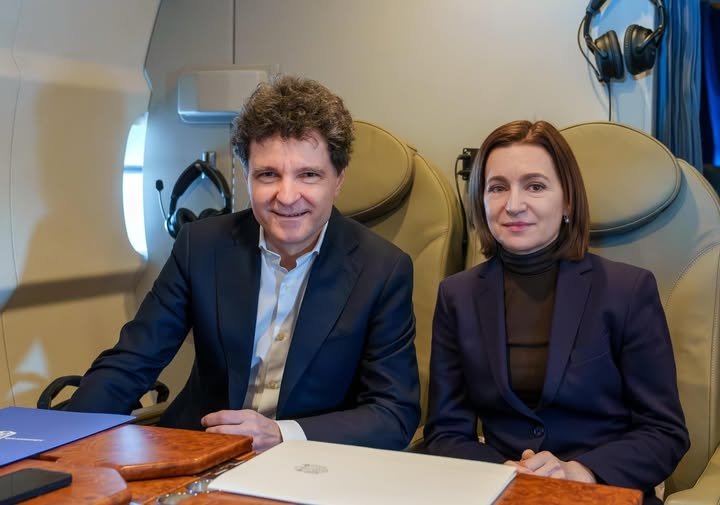
President of the Republic of Moldova, Maia Sanduis currently on a European tour that includes visits to Strasbourg, the Netherlands and the Czech Republic, with the aim of promoting Chisinau’s European journey. In an interview granted to Deutsche Welle, the head of state spoke openly about the strategy to accelerate European integration, about strengthening national security and strengthening ties with the West, in a regional context marked by Russian aggression.
“We can join the EU together with Romania and we believe that, and it’s not just what we think. In Moldova today there are more and more people who support EU integration. We also have people who support unification with Romania. Now we are working hard for Moldova to become part of the EU and we hope that this scenario will work. If this does not work for one reason or another of course we will consider other options. The main objective is to maintain peace in Moldova and to keep Moldova part of the world free”, he stated Maia Sandu.
The declaration brought back to public attention the debate regarding the feasibility of a possible union between Romania and the Republic of Moldova. publication Newspapers.com requested the opinion of three specialists – political scientist George Jiglău, economic analyst Adrian Negrescu and infrastructure expert Ionuț Ciurea – to evaluate the implications of such designboth from the perspective of geopolitical challenges, as well as economic and institutional ones.
How would Moscow react to the Union?
George Jiglău draws attention to the absence of a precedent in the current world order for such a union, especially between an EU member state and a non-member state, in a region where another state actor could retaliate violently.
“There are no precedents of this kind in the current world order. And especially not in Europe, not between a country that is in the EU and one that is not. And not in an area where the reaction that another state actor might have would be violent. Russia could go on the attack under the presumption that it is defending the Russian speakers of the Republic of Moldova, demonizing the democratic process that would lead to this eventual union. Under these conditions, it remains to be seen whether Europe really assumes all the consequences or it will back down, although now she seems open to the idea”, explained the political scientist.
He believes that the current discourse on union, promoted especially by GOLDis “largely populist and mainly serves the interests of Moscow, which is looking for reasons to justify its aggressions”.
Infrastructure, a major obstacle
Ionuț Ciurea, the leader of the Pro Infrastructure association, summarizes the challenges related to physical connectivity between the two states.
He emphasizes that Romania’s current problems in the field of transport will not be solved by a union, but on the contrary, they will become more acute.
“The problems we have at the moment with transport infrastructure, for example, will not be solved if Romania unites with the Republic of Moldova, on the contrary. An administrative reform would divide the country into regions, then the problem of infrastructure will become obvious, we still do not have a highway to law the Romanian part of Moldova from the rest of the country. And after the A8 will be ready, it would be necessary at least for the Republic of Moldova to build a highway from Chisinau to Iași. And it is preferable not to wait for this construction until the Union is achieved, in the hope that Bucharest will finance it, because there is no money. Our only solution in that situation would be to increase European funds, which we already know we are not absorbing optimally”, warned the expert.
Ciurea recommends Chisinau “to invest from now on in its transport infrastructure”, so that a possible union becomes economically acceptable for Romania as well.
Demographic advantages, combined with economic challenges
Analyst Adrian Negrescu takes a more nuanced position, acknowledging both the difficulties and the potential benefits of the union.
He admits that Romania is not even able to carry out its own reforms, but emphasizes that the main gain would be the attraction of significant European funds for the development of the Republic of Moldova through EU accession.
“Let’s be serious, we are not capable of making our own reforms in the country, let alone the Republic of Moldova! From this perspective, I think that the main advantage would be the fact that the accession, practically, of the Republic of Moldova to the European Union through Romania, would attract significant funds from European money for development, especially in the area of infrastructure”, he explained.
However, Negrescu also sees major opportunities on the labor market and demographically. The union could increase the country’s population to more than 24 million inhabitants, and the Republic of Moldova has a higher natural increase, which could alleviate Romania’s pension crisis and reduce dependence on labor from Asia.
Also, agriculture, especially the wine industry, would gain, and the future reconstruction of Ukraine, estimated at more than 500 billion dollars, could turn the Moldova region (both the Romanian and Bessarabian parts) into an “attractive industrial and logistics platform for investors”.
“Integration would not happen quickly, but would require at least five years to economically and socially harmonize the area. In the first years, there would be difficulties, but when it comes to a national ideal and the union with a historical province, the minuses are secondary. The authorities in Bucharest should lobby Brussels to attract European funds to cover the infrastructure problems generated by the integration, building on other people’s money, because Romania’s budgetary situation is already extremely difficult”. concluded Adrian Negrescu.
INSCOP poll: 7 out of 10 Romanians would vote for union with the Republic of Moldova
The overwhelming majority of Romanian citizens would support an eventual referendum for the union with the Republic of Moldova, shows the tenth edition of the “Informat.ro Barometer – INSCOP Research”. According to the study carried out in April 2026, 71.9% of respondents say they would vote “YES” in such an election, while 21.4% would say no. Only 2.1% of participants have not yet decided, 3.2% would not vote, and 1.4% do not know or do not answer.
The survey also shows that two thirds of Romanians (67.6%) believe that the union with the Republic of Moldova represents a historical duty, while 26.4% do not share this vision. The voters PSD and PNLas well as people over 45 are the ones who support this idea the most. Instead, the voters USR30- to 44-year-olds and those with higher education believe a higher-than-average percentage that union is not a historical duty.
As to the time horizon in which this union could be achieved, opinions are divided. Almost a third of Romanians (29.3%) believe that unification will occur in the next 10 years or more, while 13.3% estimate an interval of 5 years, and 8.4% believe that it will happen in the next 3 years. On the other hand, 34.7% of respondents are of the opinion that this will never happen. Significant differences emerge by political affiliation: voters PNL and USRmen, people aged between 30 and 44, those with higher education, as well as residents of Bucharest and big cities believe in a higher proportion than average that the union will be achieved in the next 10 years or more. In contrast, AUR voters, women, people aged 45 to 59 and government employees are the most likely to think such a union will never happen.
Support for union with Romania is growing in the Republic of Moldova: over 42% of citizens would vote “YES” in a referendum
A POLL carried out at the beginning of March by the IData institute shows a considerable increase in the number of those who support the union of the Republic of Moldova with Romania. According to the data, 42% of respondents would be in favor of the union, while 48% are against it, and 10% do not have a clearly formed opinion. Although society remains divided, the evolution is significant: last September, just over 32% of Moldovans were in favor of the union, over 60% were against it, and around 7% were undecided. Thus, in an interval of only six months, support increased by almost ten percentage points.
Another survey, carried out in February, however, showed a lower level of support: around 30% of Moldovans were in favor of the union, and 52% were against it. In Romania, polls indicate that 53% of citizens would support the union, while 37% are against it.
The director of the IData polling house, Mihai Bologan, offers a possible explanation for this sudden increase, linking it to the position expressed by the president of the Republic of Moldova.
At the beginning of this year, Maia Sandu stated that she would vote for union with Romania if a referendum were held, but she emphasized that there is currently no clear majority in society for this option and that the country’s priority remains accession to the European Union.