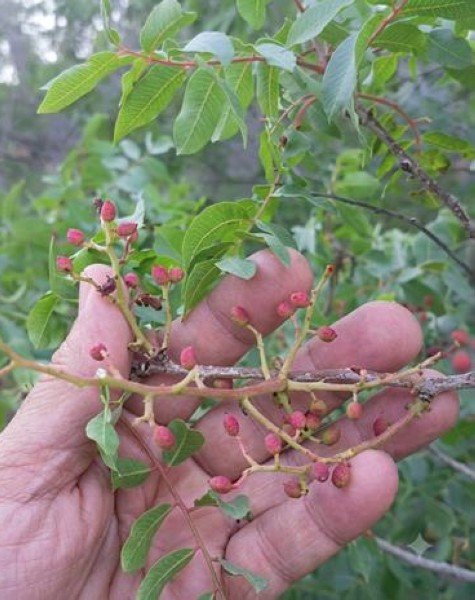
The areas of Irbid Governorate, especially the Koura District, are famous for their unique plant cover and rich biodiversity, as their historical forests such as the “Barqash Forest” and Wadi Bireh contain rare types of perennial trees. Among these trees, the “Atlantic” (or Palestinian) terebinth tree stands out, which forms an essential part of the region’s environmental identity.
It is known for its high ability to adapt, and its large size as a towering tree exceeding six meters in height and not just a small shrub, in addition to its high nutritional and medicinal value, and its fruits, which turn from red to bluish-green when ripe in November.
The President of the Society for Development for Man and Environment and a researcher in agricultural heritage, Dr. Ahmed Mahmoud Al-Sharida, says that the “Atlantic Pistachio” tree was given this name in reference to the Atlas Mountains in the Maghreb, which are the original homeland and primary origin of this historical tree.
Dr. Al-Shraideh explained that the tree later spread from its first stronghold in the Atlas Mountains to colonize the regions of the Mediterranean basin and the Arab Levant, all the way to the Levant, where it found an ideal and humid environment for growth and continuity throughout the ages. He stressed his environmental vision that “there are no forest trees in a rigid sense, but rather they are all fruit trees that excel in their benefits to humans and the environment.”
Dr. Al-Shraideh expanded on the economic and therapeutic advantages of this tree, pointing out that its fruits are used as an essential ingredient in the manufacture of local spices and condiments after they ripen. “Petem coffee” is also made from it, which is classified as one of the most expensive and finest types of natural coffee in the world.
On the medical level, Al-Shraideh confirmed that pistachio fruits have proven therapeutic properties. It works as a powerful anti-oxidant in the body, and enhances the efficiency of the immune system, in addition to its effective role in fighting irritable bowel syndrome and alleviating its symptoms as a general tonic and tonic for the body.
At the end of his speech, Al-Shraideh called on citizens and those interested in eco-tourism to intensify their visits to the Barqash forests and Wadi Bireh Al-Wada’ in northern Jordan, to enjoy this charming natural landscape, learn closely about this ancient environmental heritage, and benefit from its bounties.