by our correspondent
Gianluca Biccini
«Patria de todos»: in the verses of the great Spanish poet Lope de Vega the idea of Madrid as “everyone’s homeland” is reflected, since everyone finds their home in it. And it is precisely this atmosphere of family hospitality that Leo
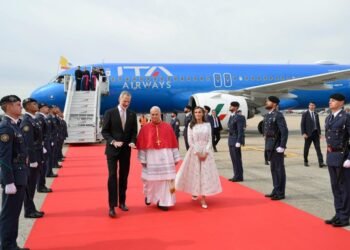
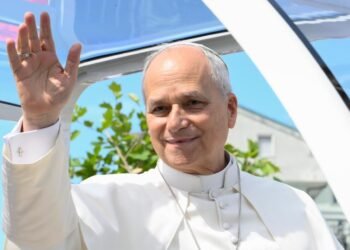
The Pope arrived in the capital of the Iberian Peninsula veiled by some clouds this morning, after about two hours of flight, during which he greeted the eighty journalists who are accompanying him on this trip, recalling that he had already been there numerous times before being elected Successor of Peter. On the Airbus A320 neo of the ITA Airways company, there is also an image of the Mother of Good Counsel.
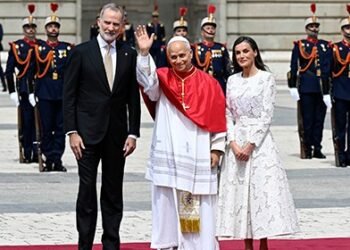
Having taken off from Rome/Fiumicino airport, the plane with the Pontiff on board landed at the “Adolfo Suárez” international airport in Madrid/Barajas, where the official welcome took place under a slightly overcast sky, while the bells of the archdiocese, starting with that of the Almudena cathedral, rang out loudly. In the airport area reserved for the Ceremonial, the apostolic nuncio Pioppo and the head of the Spanish Protocol went up to greet the Holy Father, who was welcomed at the foot of the front steps of the aircraft by King Felipe VI and Queen Letizia. After attending the Guard of Honour, followed by the presentation of the respective delegations, the Pope headed together with the Spanish Royal Family to the Hall of Honour, for a short private meeting.
By car, the Pontiff then reached the Royal Palace in the city center for the welcome ceremony, followed by a courtesy visit to the sovereigns. Along the route of approximately 25 kilometres, there was no lack of warmth from the people of Madrid who greeted him, flocking in large numbers into the streets decorated with one hundred thousand white and yellow flowers, the colors of the Vatican, and ornamental and decorative elements on the balconies of the houses. Banners and posters with welcome messages were displayed in some of the most significant places in what, with its over three million inhabitants – seven if we consider the metropolitan area – is also the most populous city in the country. From the Puerta de Alcalá to the Plaza de España, from the Paseo del Prado to the Plaza de Oriente, from the Retiro to the main public gardens, these days there is a succession of flowerbeds and flower pots as well as 1,500 flags bearing the motto of the visit Raise your gazedistributed along the main streets of the papal itinerary, together with over 300 LED screens with the smiling face of Leo XIV and animations of the logo. In short, Madrid, which despite having modern infrastructures has preserved the original appearance of several historic districts almost unchanged, “wore” its festive dress for the occasion also because last May 26, the Government approved a law to declare the papal visit an “exceptional event of special public interest”.
After all, fifteen years have passed since the last presence of a Pope in the country. Before Leo XIV, Benedict XVI had come three times and Saint John Paul II even five times. Ratzinger had been in Madrid from 18 to 21 August 2011, for World Youth Day which brought over 2 million young people here; and, previously, on 6 and 7 November 2010 in Santiago de Compostela and Barcelona respectively for the Compostela Holy Year and for the consecration of the Sagrada Família basilica; and twenty years ago, on 8 and 9 July 2006, in Valencia on the occasion of the V World Meeting of Families. Wojtyła just three years earlier, on 3 and 4 May 2003, had come for a great meeting with young people in Madrid and the canonization of the blessed and, proceeding backwards, from 12 to 17 June 1993 for celebrations in various dioceses, from 19 to 20 August 1989 on the occasion of the IV World Youth Day in Santiago de Compostela, on 10 October 1984 for a brief visit to Zaragoza before continuing the itinerary towards Santo Domingo and Puerto Rico; and again from 31 October to 9 November 1982 for ten days with various stages.
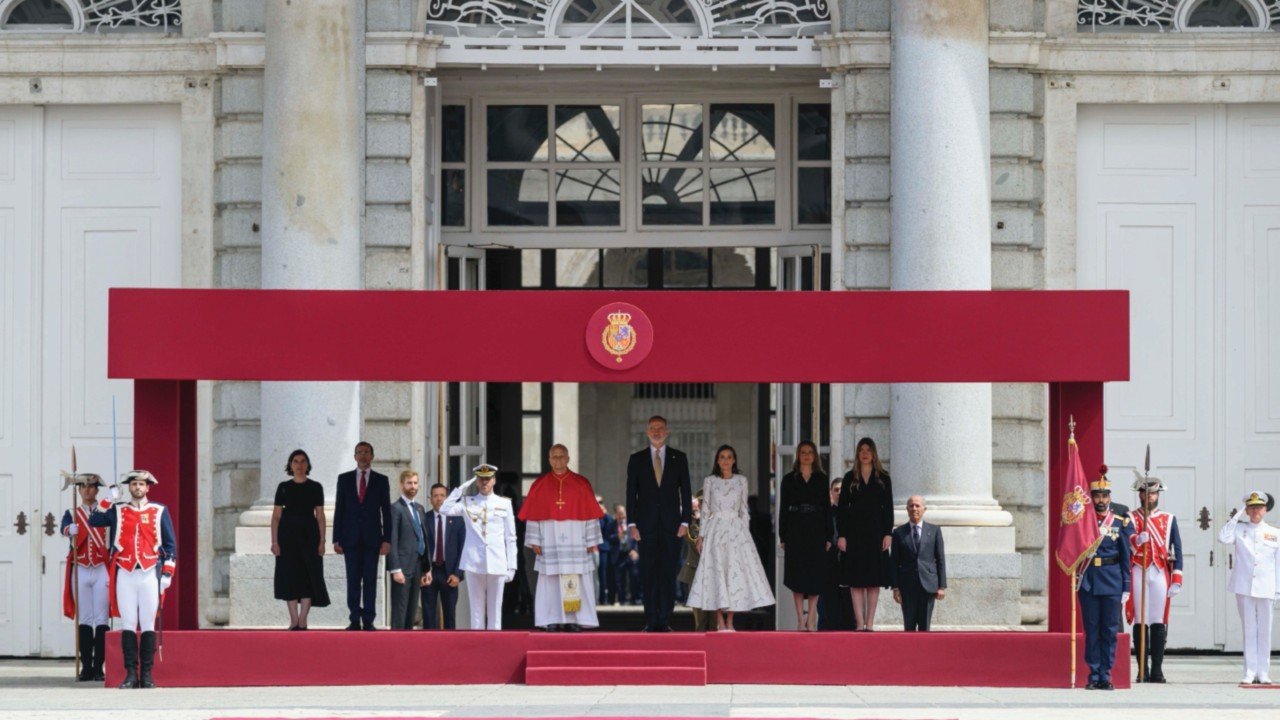
Today is therefore the turn of Pope Prevost, awaited first and foremost by the half million people registered for the various events in this initial Madrid stage. He came to experience firsthand the “multifaceted richness of a great country which has received the Word of the Gospel for almost two millennia”, as he explained in the opening speech of this visit, delivered in Column Hall of the Royal Palace itself, where he concluded the morning by meeting the authorities, starting with the Head of Government Pedro Sánchez, civil society and the diplomatic corps. This is the place where on 12 June 1985 – a marble plaque commemorates it – the Treaty of Accession of Spain to the then European Economic Community, now the EU, was signed. Shortly before, in the courtyard of the same majestic building built in the 18th century on the site where the ancient Alcazar, formerly a Muslim fortress, stood, the Pope had attended the welcome ceremony: welcomed by the king and queen, together they reached the podium for the military honours. Afterwards, still together, they entered the Palace through the Grand Staircase, reaching the official rooms for the courtesy visit, punctuated by the souvenir photo, the exchange of gifts and the private meeting.
At the end, on the journey in the popemobile to the nunciature, his residence here in Madrid, the Bishop of Rome received a new tribute of that welcome hot that this city can offer, with museums open until late at night and rest areas for the many pilgrims who have come to the capital from other parts of Spain. A country with ancient and fruitful Christian roots, but today marked by a strong secularization: among its almost fifty million inhabitants, distributed above all in urban centres, over 93 percent are baptized Catholics, and whose care of souls is divided into around seventy ecclesiastical districts, with eighteen thousand priests and almost 33 thousand nuns; but unfortunately, at the same time, there is a crisis in vocations, as evidenced by the just 1300 major seminarians, just as the participation of the lay faithful in the life of the Church is decreasing, although glimmers of hope seem to come from the new generations. This is confirmed by the many young people who animate the solidarity initiatives promoted by Catholic organisations, in a land with one of the highest average ages in the Old Continent. Like those that the Pope meets in the evening in Plaza de Lima – he himself spoke about it on the plane – in a sort of new WYD in Madrid, and like those active among the volunteers of the “Cedia 24 horas” reception center that Leo XIV visits in the afternoon, the first pastoral appointment, after the institutional ones in the morning, of this trip.