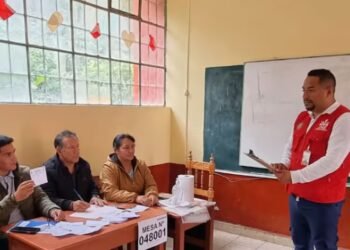

According to ONPE figures as of April 25, the participation of voters abroad has been 29.28%, almost seven percent more than in the 2021 elections, which was 22%. In 2016 they were 55 percent and in 2011 they were 65%. 2011 was the last year in which there were fines for those who did not dump abroad. Starting in 2011, the fine decreased to zero soles. It could not be eliminated because it is established in the Constitution that voting is mandatory and the Congress of that time could not carry out the constitutional reform. In other words, in theory voting abroad is mandatory, in practice it is not, because the fine is zero soles.
In the 2021 elections, USD 4,500,000 were invested in the first round and USD 4,000,000 in the second). This time they will have been more expensive, because the voting cards used at each table are forced to be folded. So much expense for such poor results, which are not the fault of the Chancellery, but of the ONPE for not allowing voting by mail for Peruvians abroad, which is strictly established in the Organic Law of Elections and because the JNE has not allowed electronic voting in these last elections because it considers them unsafe, despite the fact that since 2011 the law that authorizes the ONPE and the JNE to use electronic voting has been in force.
This analysis brings to the table a fundamental contradiction in the Peruvian electoral system: the gap between constitutional obligation and the real logistical capacity of a citizen abroad to exercise their right.
The drastic drop in participation—going from a 65% in 2011 still 29.28% in 2026— fully coincides with the factual elimination of the economic penalty. However, beyond the fine, the management of the ONPE and the JNE reveal important structural barriers:
1. The economic factor vs. absenteeism
It is notable that, although the investment exceeds the 9 million dollars Americans (considering both rounds and the increase due to the physical withdrawal of minutes), the return in participation is so low. The cost per vote cast abroad is significantly higher than in national territory, which generates a debate about the efficiency of public spending in the face of regulations that seem designed to provide disincentives.
2. Postal Vote: An unexecuted law
The Organic Law of Elections contemplates modalities that would facilitate the process. The fact that voting by mail is not implemented forces thousands of Peruvians to travel enormous distances (sometimes between different cities or states) to the consulates. In practice, the cost of the trip acts as a “private fine” that the citizen must pay to vote.
In Spain, voting by mail has been implemented for many years and works perfectly, both for voters who are within Spain and those who are abroad, without generating complaints from political parties about its use. In the last General elections, almost two and a half million people voted by mail, without any accusations of fraud or irregularities.
It is not understood how something so simple and repeatedly proven in practice by other Governments has never been executed by the ONPE as required by law.
3. The JNE’s distrust in Electronic Voting
The JNE’s resistance to implementing electronic voting, citing security reasons, contrasts with the global trend of digitalization. Since neither postal nor electronic voting exists, the system remains anchored in a model of physical presence which is not compatible with the geographical reality of the Peruvian diaspora.
Summary of participation evolution
| Year | Foreign Participation | Fine Context |
|---|---|---|
| 2011 | 65% | Last year with effective fine. |
| 2016 | 55% | Beginning of the downward trend (fine S/ 0). |
| 2021 | 22% | Record low (aggravated by pandemic). |
| 2026 | 29.28% | Stagnation despite the increase in logistics costs. |
It is evident that as long as the legal framework continues to require the presence of voters at the polling station, the physical deployment and withdrawal of ballots and records and remote channels are not enabled, investment will continue to be high and the representation of Peruvians abroad will continue to be low.
The solution is to implement postal voting, which has already been provided for in the Organic Law of Elections since its original version in 1997.