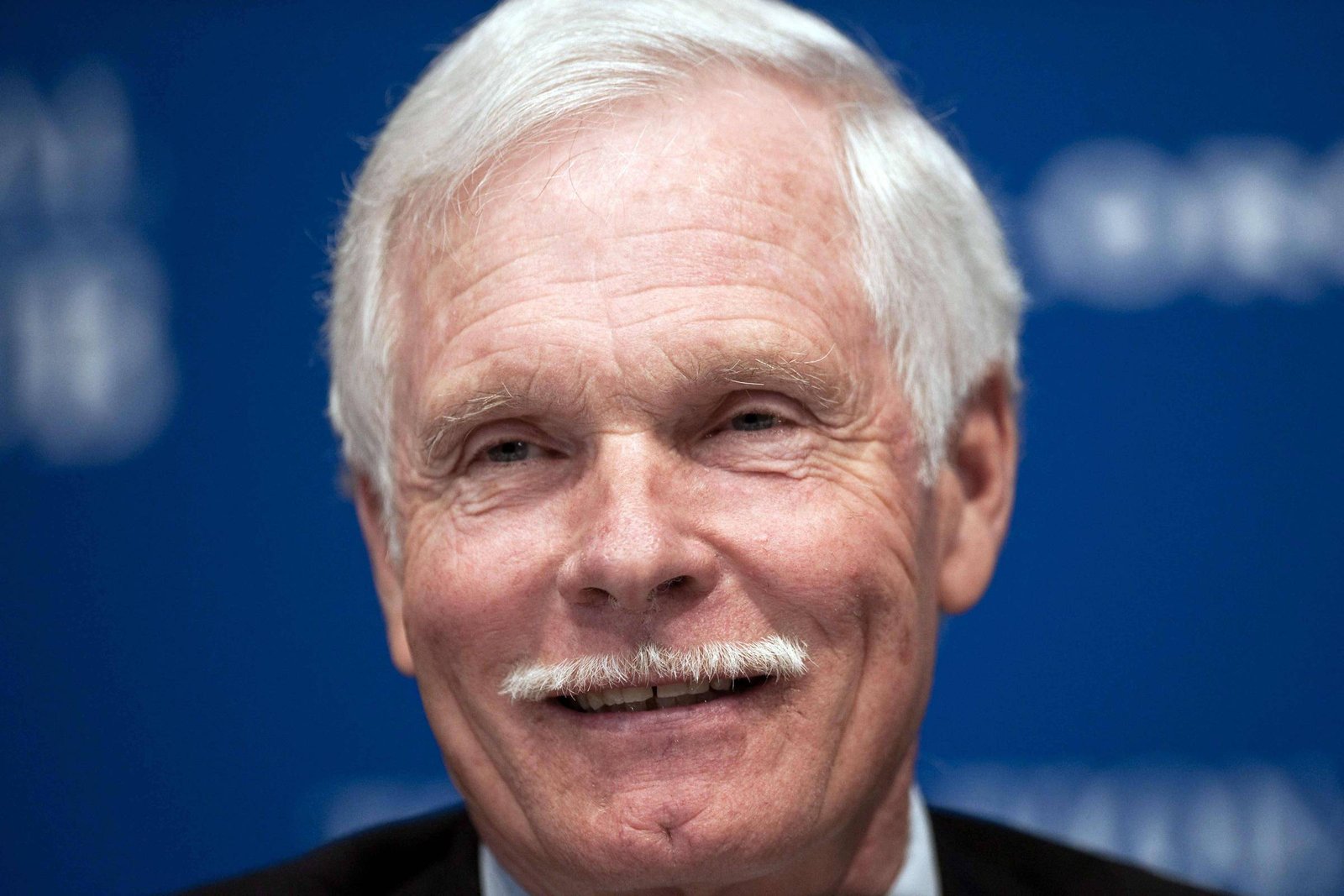
Ted Turnerthe media mogul who stood out for pioneering on the late 20th century American scene by dominating the cable television industry, died Wednesday at his home near Tallahassee, Florida. He was 87 years old.
He revolutionized news coverage on television when founding CNN, in Atlanta (Georgia), in 1980, and determining that the cable channel would broadcast news 24 hours a day.
Turner’s life also marked his involvement in professional sports, philanthropy and environmental activism. His family claims that the businessman died surrounded by his family.
The cause of death was not reported. Turner, the conglomerate that controls CNN, announced in 2018 that he had dementia with Lewy bodiesa progressive brain disease.
The businessman was married to actress Jane Fonda.
The CNN founder’s portfolio extended far beyond the media conglomerate and his impact on American culture was considerable, according to the New York Times.
The businessman, who lived in Atlanta, built a media empire that spanned the first cable TV superstation and popular movie and cartoon channels, as well as professional sports teams like baseball’s Atlanta Braves.
Give people news whenever and wherever they want. That, says CNN CEO Mark Thompson, was one of Ted Turner’s brilliant insights in starting the network in the early days of cable TV. And if CNN doesn’t follow this advice in the digital age, Thompson says the company could cease to exist.
As a spin-off from CNN, Turner created the CNN Headline News and CNN International channels. He founded the cable and satellite sports and entertainment “superstation” that became known as TBS, which spun off into the movie channel TNT. All of these stations are still on the air.
While building a media empire, the executive found the time and energy to captain the 1977 America’s Cup-winning yacht and to take an active role as owner of the Atlanta Braves, giving the team extended national exposure on Turner-owned television.
Born in 1938, into a traditional Ohio family, Turner was also one of the largest landowners in the United States, according to a survey by the Bloomberg agency. He owned an area of around 810 thousand hectares, in which he was one of those responsible for repopularizing bison farming in the USA.
Turner’s political stance was contradictory and controversial. Although he declared himself an arch-conservative Republican with warm ties to evangelical groups and far-right members of the John Birch Society, he also cultivated friendships with Cuban leader Fidel Castro and defended the repressive conduct of the Chinese communist government.
In an extraordinary act of philanthropy, he donated a billion dollars to the United Nations, an organization detested by American conservatives. He loved hunting, but became a darling of environmentalists when he purchased more than a million acres of wilderness and farmland, turning it into nature preserves.
He became the fourth largest private land owner in the United States, in addition to having vast tracts that he owned in Argentina and other countries.
Turner’s influence was most evident in the way his CNN transformed television journalism by presenting news 24 hours a day, with constant updates, conveying a sense of immediacy.
“Today, news is available when it actually happens, not when it’s convenient for the Big Three TV networks to broadcast it,” father-and-son authors Robert Goldberg and Gerald Jay Goldberg wrote in the tycoon’s 1995 biography, “Citizen Turner: The Wild Rise of an American Tycoon.” Whether covering the fall of the Berlin Wall, the crackdown on the Chinese student movement in Tiananmen Square, or the 1991 Persian Gulf War, Turner’s CNN was the vehicle to watch history in the making.
“I learn more from CNN than from the CIA,” President George HW Bush said in a widely quoted wartime statement.
Turner himself claimed not to have much interest in news or any other type of business. It was the thrill of the hunt that moved him, not the prey. As he told the New York Times: “I’ve always been more of an adventurer than an entrepreneur.”
To journalist Dale Van Atta, then a reporter for Reader’s Digest magazine, the founder of CNN said, in 1998, that he was trying to set the all-time record for achievements by a single person in a single life. “And that puts me in quite a company: Alexander the Great, Napoleon, Gandhi, Christ, Mohammed, Buddha, Washington, Roosevelt, Churchill.”
Not even his most ardent admirers placed Turner on such a high pedestal. But even a fierce rival like media mogul Rupert Murdoch — who once published the headline “Is Turner crazy?” in his New York Post — had to admit that he was one of the most influential figures in the history of mass media.
In 1996, the Turner was sold to Warnerwhich this year was acquired by Paramount —business that still needs approval from regulatory bodies.
With New York Times