Sunday, June 14, 2026
    The GeoStrategic Consensus
    No Result
    View All Result
    • Login
    • HOME
    • AMERICAS
      • Argentina
      • Brazil
      • Canada
      • Chile
      • Colombia
      • Costa Rica
      • Cuba
      • Dominican Republic
      • Ecuador
      • El Salvador
      • Greenland
      • Guatemala
      • Honduras
      • Mexico
      • Nicaragua
      • Panama
      • Paraguay
      • Peru
      • United States
      • Uruguay
      • Venezuela
    • ASIA-PACIFIC
      • Australia
      • Brunei Darussalam
      • Cambodia
      • China
      • Federated States of Micronesia
      • Fiji
      • Indonesia
      • Japan
      • Kiribati
      • Laos
      • Malaysia
      • Marshall Islands
      • Mongolia
      • Myanmar
      • Nauru
      • New Zealand
      • North Korea
      • Palau
      • Papua New Guinea
      • Philippines
      • Samoa
      • Singapore
      • Solomon Islands
      • South Korea
      • Taiwan
      • Thailand
      • Timor-Leste
      • Tonga
      • Tuvalu
      • Vanuatu
      • Vietnam
    • CARICOM
      • CARICOM – Non-English
        • Haiti
        • Suriname
      • CARICOM Associates
        • Anguilla
        • Bermuda
        • British-Virgin-Islands
        • Cayman-Islands
        • Curacao
        • Turks-and-Caicos
      • CARICOM English
        • Antigua and Barbuda
        • Barbados
        • Belize
        • Dominica
        • Grenada
        • Guyana
        • Jamaica
        • Montserrat
        • Saint Kitts and Nevis
        • Saint Lucia
        • Saint Vincent and the Grenadines
        • The Bahamas
        • Trinidad and Tobago
    • EURASIA
      • Armenia
      • Azerbaijan
      • Balarus
      • Georgia
      • Kazakhstan
      • Kyrgyzstan
      • Moldova
      • Russia
      • Tajikistan
      • Turkmenistan
      • Ukraine
      • Uzbekistan
    • EUROPE
      • Albania
      • Andorra
      • Austria
      • Bosnia and Herzegovina
      • Bulgaria
      • Croatia
      • Cyprus
      • Czech Republic
      • Denmark
      • Estonia
      • Finland
      • France
      • Germany
      • Greece
      • Holy See
      • Hungary
      • Iceland
      • Ireland
      • Italy
      • Kosovo
      • Latvia
      • Liechtenstein
      • Lithuania
      • Luxembourg
      • Malta
      • Monaco
      • Montenegro
      • Netherlands
      • North Macedonia
      • Norway
      • Poland
      • Portugal
      • Romania
      • San Marino
      • Serbia
      • Slovakia
      • Slovenia
      • Spain
      • Sweden
      • Switzerland
      • United Kingdom
    • MIDDLE EAST AND NORTH AFRICA
      • Algeria
      • Bahrain
      • Egypt
      • Iran
      • Iraq
      • Israel
      • Jordan
      • Kuwait
      • Lebanon
      • Lybia
      • Morocco
      • Oman
      • Palestinian Territories
      • Qatar
      • Saudi Arabia
      • Syria
      • Tunisia
      • Turkey
      • United Arab Emirates
      • Western Sahara
      • Yemen
    • SOUTH ASIA
      • Afghanistan
      • Bangladesh
      • Bhutan
      • India
      • Maldives
      • Nepal
      • Pakistan
      • Sri Lanka
    • SUB-SAHARAN AFRICA
      • Angola
      • Benin
      • Botswana
      • Burkina Faso
      • Burundi
      • Cabo Verde
      • Cameroon
      • Central African Republic
      • Chad
      • Comoros
      • Cote d’Ivoire
      • Democratic Republic of the Congo
      • Djibouti
      • Equatorial Guinea
      • Eritrea
      • Eswatini
      • Ethiopia
      • Gabon
      • Gambia
      • Ghana
      • Guinea
      • Guinea Bissau
      • Kenya
      • Lesotho
      • Liberia
      • Madagascar
      • Malawi
      • Mali
      • Mauritania
      • Mauritius
      • Mozambique
      • Namibia
      • Niger
      • Nigeria
      • Republic of the Congo
      • Rwanda
      • Sao Tome and Principe
      • Senegal
      • Seychelles
      • Sierra Leone
      • Somalia
      • South Africa
      • South Sudan
      • Sudan
      • Tanzania
      • Togo
      • Uganda
      • Zambia
      • Zimbabwe
    • HOME
    • AMERICAS
      • Argentina
      • Brazil
      • Canada
      • Chile
      • Colombia
      • Costa Rica
      • Cuba
      • Dominican Republic
      • Ecuador
      • El Salvador
      • Greenland
      • Guatemala
      • Honduras
      • Mexico
      • Nicaragua
      • Panama
      • Paraguay
      • Peru
      • United States
      • Uruguay
      • Venezuela
    • ASIA-PACIFIC
      • Australia
      • Brunei Darussalam
      • Cambodia
      • China
      • Federated States of Micronesia
      • Fiji
      • Indonesia
      • Japan
      • Kiribati
      • Laos
      • Malaysia
      • Marshall Islands
      • Mongolia
      • Myanmar
      • Nauru
      • New Zealand
      • North Korea
      • Palau
      • Papua New Guinea
      • Philippines
      • Samoa
      • Singapore
      • Solomon Islands
      • South Korea
      • Taiwan
      • Thailand
      • Timor-Leste
      • Tonga
      • Tuvalu
      • Vanuatu
      • Vietnam
    • CARICOM
      • CARICOM – Non-English
        • Haiti
        • Suriname
      • CARICOM Associates
        • Anguilla
        • Bermuda
        • British-Virgin-Islands
        • Cayman-Islands
        • Curacao
        • Turks-and-Caicos
      • CARICOM English
        • Antigua and Barbuda
        • Barbados
        • Belize
        • Dominica
        • Grenada
        • Guyana
        • Jamaica
        • Montserrat
        • Saint Kitts and Nevis
        • Saint Lucia
        • Saint Vincent and the Grenadines
        • The Bahamas
        • Trinidad and Tobago
    • EURASIA
      • Armenia
      • Azerbaijan
      • Balarus
      • Georgia
      • Kazakhstan
      • Kyrgyzstan
      • Moldova
      • Russia
      • Tajikistan
      • Turkmenistan
      • Ukraine
      • Uzbekistan
    • EUROPE
      • Albania
      • Andorra
      • Austria
      • Bosnia and Herzegovina
      • Bulgaria
      • Croatia
      • Cyprus
      • Czech Republic
      • Denmark
      • Estonia
      • Finland
      • France
      • Germany
      • Greece
      • Holy See
      • Hungary
      • Iceland
      • Ireland
      • Italy
      • Kosovo
      • Latvia
      • Liechtenstein
      • Lithuania
      • Luxembourg
      • Malta
      • Monaco
      • Montenegro
      • Netherlands
      • North Macedonia
      • Norway
      • Poland
      • Portugal
      • Romania
      • San Marino
      • Serbia
      • Slovakia
      • Slovenia
      • Spain
      • Sweden
      • Switzerland
      • United Kingdom
    • MIDDLE EAST AND NORTH AFRICA
      • Algeria
      • Bahrain
      • Egypt
      • Iran
      • Iraq
      • Israel
      • Jordan
      • Kuwait
      • Lebanon
      • Lybia
      • Morocco
      • Oman
      • Palestinian Territories
      • Qatar
      • Saudi Arabia
      • Syria
      • Tunisia
      • Turkey
      • United Arab Emirates
      • Western Sahara
      • Yemen
    • SOUTH ASIA
      • Afghanistan
      • Bangladesh
      • Bhutan
      • India
      • Maldives
      • Nepal
      • Pakistan
      • Sri Lanka
    • SUB-SAHARAN AFRICA
      • Angola
      • Benin
      • Botswana
      • Burkina Faso
      • Burundi
      • Cabo Verde
      • Cameroon
      • Central African Republic
      • Chad
      • Comoros
      • Cote d’Ivoire
      • Democratic Republic of the Congo
      • Djibouti
      • Equatorial Guinea
      • Eritrea
      • Eswatini
      • Ethiopia
      • Gabon
      • Gambia
      • Ghana
      • Guinea
      • Guinea Bissau
      • Kenya
      • Lesotho
      • Liberia
      • Madagascar
      • Malawi
      • Mali
      • Mauritania
      • Mauritius
      • Mozambique
      • Namibia
      • Niger
      • Nigeria
      • Republic of the Congo
      • Rwanda
      • Sao Tome and Principe
      • Senegal
      • Seychelles
      • Sierra Leone
      • Somalia
      • South Africa
      • South Sudan
      • Sudan
      • Tanzania
      • Togo
      • Uganda
      • Zambia
      • Zimbabwe
    No Result
    View All Result
    Agentially
    No Result
    View All Result
    Home ASIA-PACIFIC Taiwan

    Taiwan’s lost cinema finds a new audience

    The Analyst by The Analyst
    June 14, 2026
    in Taiwan
    Taiwan’s lost cinema finds a new audience


    Screenings of restored 1950s and 1960s Taiwanese-language films in Britain do more than celebrate a cinematic anniversary — they showcase the rediscovery of a multilingual cultural heritage once thought largely vanished

    • By Ming-yeh T. Rawnsley (蔡明燁) / Contributing reporter

      READ ALSO

      Sweden set to ban mobile phones in schools, joining trend of shelving screens for students

      Environmental Impact Assessment: Greening Taiwan’s favorite protein

    Audiences in Leicester, Cardiff, London and Sheffield will this month gather to watch a series of black-and-white Taiwanese-language films made more than 70 years ago. On the surface, these screenings commemorate the seventieth anniversary of taiyupian (台語片) — Taiwanese-language cinema. Yet the significance of these events extends far beyond nostalgia or film history. They represent a remarkable chapter in Taiwan’s ongoing effort to recover, preserve and reinterpret a cultural heritage that was once thought to have largely disappeared.

    The centerpiece of the program is the Ho Chi-ming (何基明) directed Xue Pinggui and Wang Baochuan (薛平貴與王寶釧), a film produced in 1955 and released to enormous success in 1956. Historians generally regard it as the work that launched Taiwan’s Taiwanese-language film boom, which would eventually produce well over a thousand films over the following two decades. Yet for many years the film itself was believed lost.

    Like much of Taiwan’s early cinema, it seemed destined to survive only in newspaper advertisements, production records and fading memories. The rediscovery of the film by the Tainan National University of the Arts (TNNUA, 南藝大) in Miaoli in 2013 therefore transformed our understanding of Taiwan’s cinematic past. It demonstrated that what appeared absent from history could sometimes return unexpectedly and compel us to rethink what we thought we knew.

    Photo courtesy of the Taiwan Film and Audiovisual Institute

    MULTILINGUAL CINEMA

    The rediscovered version proved even more surprising because it was dubbed in Hakka rather than Hoklo (more commonly known as Taiwanese). This discovery challenges conventional assumptions about the relationship between language and cinema in post-war Taiwan. The term “Taiwanese-language film” often suggests a distinctly Minnan-speaking cultural sphere. Yet the Hakka version of Xue Pinggui and Wang Baochuan reveals a far more fluid media environment in which films travelled across linguistic communities through dubbing, adaptation and musical transformation. Rather than existing within separate cultural worlds, Taiwanese and Hakka audiences participated in overlapping networks of popular entertainment.

    This multilingual dimension carries particular resonance today. Contemporary discussions of Taiwan often emphasize its democratic achievements, technological innovation and geopolitical importance. Less visible internationally is Taiwan’s long history as a multilingual society in which cultural exchange across communities has shaped everyday life. The rediscovered film reminds us that linguistic diversity is not a recent policy aspiration but a historical reality deeply embedded in Taiwan’s cultural development.

    Photo courtesy of the Taiwan Film and Audiovisual Institute

    TAIWAN’S FILM HERITAGE

    The British screenings also highlight another important story: the growing international recognition of Taiwan’s film heritage. For decades, research on Taiwanese-language cinema was constrained by the simple fact that so few films survived. Although approximately 1,200 to 1,500 taiyupian were produced between the 1950s and 1970s, only a fraction remains today. The scarcity of surviving prints meant that scholars frequently had to reconstruct film history through secondary evidence. In recent years, however, restoration projects undertaken by institutions such as the Taiwan Film and Audiovisual Institute (TFAI, 國家電影及視聽文化中心) and the Graduate Institute of Documentary and Film Archiving at Tainan National University of the Arts have begun to change this situation dramatically.

    The current screenings are the latest stage of a longer international effort. Since 2017, the “Taiwan’s Lost Commercial Cinema” project has introduced restored Taiwanese-language films to audiences across Britain and Europe. What began as a relatively small initiative has gradually generated growing scholarly and public interest. Researchers who once had little access to these films can now engage directly with the surviving works, while audiences encounter an alternative history of Taiwan that differs markedly from the political narratives that often dominate international news coverage.
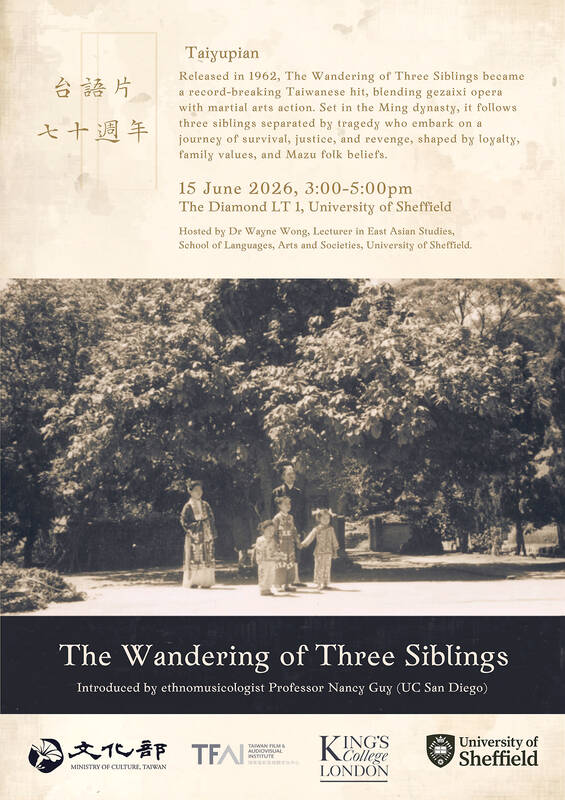
    Poster courtesy of Ming-yeh T. Rawnsley

    The films themselves reveal why this rediscovery matters. Consider The Wandering of Three Siblings (流浪三兄妹), directed by Shao Lo-hui (邵羅輝) one of the other films featured in this year’s program. Released in 1962, it combines Taiwanese opera traditions, martial arts action, folk religion and melodrama. Its story of children separated from their family, enduring hardship before ultimately achieving justice, resonated strongly with audiences during a period of rapid social change. The film demonstrates how Taiwanese-language cinema developed distinctive narrative and emotional forms rooted in local cultural traditions while simultaneously experimenting with new genres and cinematic techniques.

    Such films remind us that Taiwan’s cultural history cannot be understood solely through politics or economics. Popular cinema offers insight into how ordinary people imagined family, love, loyalty, mobility and justice. It captures aspirations, anxieties, and social values that official historical records often overlook. In this sense, film restoration is not simply an act of preservation; it is also a process of recovering voices, experiences and cultural memories that might otherwise remain inaccessible.

    The timing of the British program is therefore significant. As Taiwan becomes increasingly visible on the international stage, there is growing interest in understanding the society beyond the headlines. Cinema provides one pathway into that understanding. Through film, audiences can encounter Taiwan not merely as a geopolitical issue but as a place with a rich cultural history, shaped by multiple languages, performance traditions, and generations of creative experimentation.

    Seventy years after the birth of Taiwanese-language cinema, these screenings demonstrate that the story of taiyupian is far from over. What once seemed a lost chapter of Taiwan’s past is finding new audiences across the world. In doing so, it reminds us that cultural memory is never fixed. It survives through acts of preservation, rediscovery, and reinterpretation. The films being shown in Britain this month are not simply historical artifacts. They are evidence that Taiwan’s cultural heritage continues to speak across generations, languages and national borders.

    Ming-yeh T. Rawnsley is a research associate at SOAS University of London’s Centre for Taiwan Studies.

    Event Notes

    * Information for “Starting from Music: 70 Years of Taiyupian” Symposium and Screenings at SOAS, University of London on Friday, can be found at: https://sl1nk.com/q5zzhj8
    * Information for the Garden Cinema in London event on Friday can be found at: https://sl1nk.com/7h5s8wl
    * Information for the Cardiff event on Thursday, can be found at: https://sl1nk.com/ydxssyx
    * Information for the Leicester event on Thursday, can be found at: https://sl1nk.com/jl2c74g
    * The Sheffield event will be held at the University of Sheffield from 3pm to 5pm on Monday at: The Diamond Lecture Theater 1
    * Information for the “Taiwan’s Lost Commercial Cinema” project, can be found at: taiyupian.uk


    Source link

    Related Posts

    Sweden set to ban mobile phones in schools, joining trend of shelving screens for students
    Taiwan

    Sweden set to ban mobile phones in schools, joining trend of shelving screens for students

    June 14, 2026
    Environmental Impact Assessment: Greening Taiwan’s favorite protein
    Taiwan

    Environmental Impact Assessment: Greening Taiwan’s favorite protein

    June 14, 2026
    France, Germany abandon joint fighter jet project
    Taiwan

    France, Germany abandon joint fighter jet project

    June 14, 2026
    India flyover school offers lifeline to street children
    Taiwan

    India flyover school offers lifeline to street children

    June 14, 2026
    US case fuels fears of Chinese spying
    Taiwan

    US case fuels fears of Chinese spying

    June 14, 2026
    Next Post
    In ‘Toy Story 5,’ time — and tech — catches up with the toys

    In 'Toy Story 5,' time — and tech — catches up with the toys

    POPULAR NEWS

    ‘Stop pretending we don’t exist’: Seoul fills its streets with Pride colour | South Korea

    ‘Stop pretending we don’t exist’: Seoul fills its streets with Pride colour | South Korea

    June 14, 2026
    Kuwait Airport Radar Targeted Again, Files Third Complaint to ICAO

    Kuwait Airport Radar Targeted Again, Files Third Complaint to ICAO

    June 14, 2026
    Al-Riyadh newspaper | Trump wishes the American team success in a phone call

    Al-Riyadh newspaper | Trump wishes the American team success in a phone call

    June 14, 2026
    The real bottleneck in brand design is consistency, not talent

    The real bottleneck in brand design is consistency, not talent

    June 14, 2026
    Undersecretary of the Yemeni Ministry of Education to Okaz: Saudi support is a lifeline for our educational system – Saudi News

    Undersecretary of the Yemeni Ministry of Education to Okaz: Saudi support is a lifeline for our educational system – Saudi News

    June 14, 2026

    EDITOR'S PICK

    Music, football, gaming: Orange Talents is banking on the passions of young Moroccans

    Music, football, gaming: Orange Talents is banking on the passions of young Moroccans

    June 14, 2026
    Zaha Cultural Center launches an artistic work that embodies the Jordanian identity and the values ​​of creativity in conjunction with the joy of Nashama’s qualification

    Zaha Cultural Center launches an artistic work that embodies the Jordanian identity and the values ​​of creativity in conjunction with the joy of Nashama’s qualification

    June 14, 2026

    Teach You a Lesson: A powerful call to protect students and teachers

    June 14, 2026
    Beirut MPs: Disparity, divergence, and competition govern their movement

    Beirut MPs: Disparity, divergence, and competition govern their movement

    June 14, 2026

    Recent Posts

    • Al-Riyadh newspaper | Trump wishes the American team success in a phone call
    • The real bottleneck in brand design is consistency, not talent
    • Undersecretary of the Yemeni Ministry of Education to Okaz: Saudi support is a lifeline for our educational system – Saudi News
    • US Under Fire After Indian Sailors Killed in Gulf Tanker Strike, Shashi Tharoor Slams ‘Insensitive’ Washington

      © 2026 Agentially - Navigating shifting sovereignties and global risk .

      Welcome Back!

      Login to your account below

      Forgotten Password?

      Retrieve your password

      Please enter your username or email address to reset your password.

      Log In
      No Result
      View All Result

        © 2026 Agentially - Navigating shifting sovereignties and global risk .

        This website uses cookies. By continuing to use this website you are giving consent to cookies being used. Visit our Privacy and Cookie Policy.