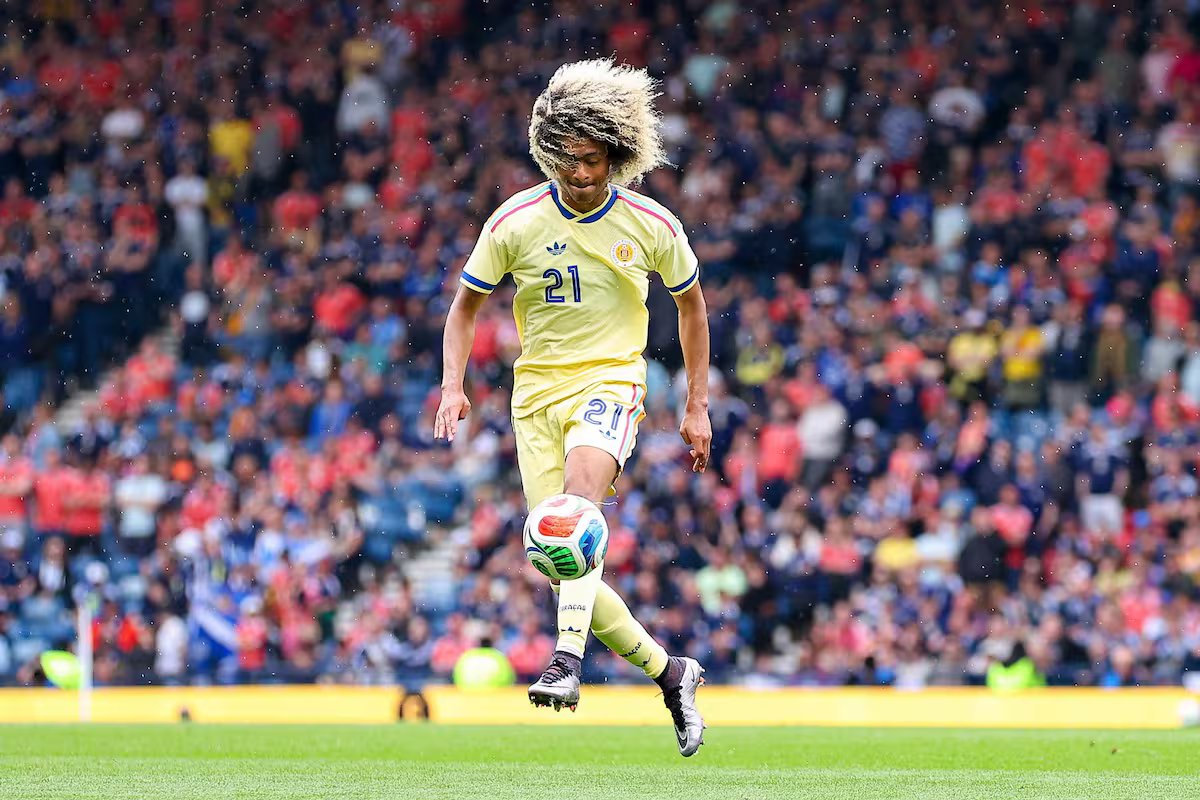
When Curacao take the field this Sunday at 2 p.m. in Argentina to face Germany and face the first World Cup in its historyan image will summarize a good part of the uniqueness of that team. Of the 26 players called up by coach Dick Advocaat, Only one was born on the island he will represent. It is about Tahith Chongend of Sheffield Unitedformerly of Manchester United and owner of an unmistakable mane of hair that for years made him one of the most recognizable faces of the Dutch youth teams.
The statistic is as striking as it is symbolic. Curacao arrives in Canada-United States-Mexico with 25 footballers born in the Netherlandsand even the coach is Dutch. The only one born in Curacao territory, Chong, was born on December 4, 1999 in Willemstad, the capital of the Caribbean island.
However, his football career was far from developing there. Like so many other young people from Curacao, He emigrated to the Netherlands as a childfavored by the historical links between both territories. Curaçao is part of the Kingdom of the Netherlands and for decades functioned as a natural extension of migration to Europe.
He recalls his first steps in Willemstad. “I have very nice memories of my childhood. My family is still there. I remember playing football when I was six years old. I used to go back every summer from the age of 15 or 16 to see my family,” he recalled in a FIFA.com interview.
His talent appeared very early. Chong trained in Feyenoord since 10 years and he caught the attention of Manchester United, who signed him when he was 16. In England he was considered one of the most promising projects in the youth team. Being left-footed, he can play as a winger on both wings and in the last half he plays as a playmaker behind the striker. He won the Jimmy Murphy Award for best youth of the club and also Denzil Haroun at best reserve team playerrecognitions that usually anticipate important careers at Old Trafford.
Its emergence coincided with a feature that was impossible to ignore. The enormous curly hair that accompanied him during much of his youth made him an easily recognizable figure. When he officially debuted at Manchester United, for the FA Cup in 2019, much of the reaction focused on both his appearance and his talent. The comparisons with Colombian legend Carlos Valderrama They appeared almost immediately.
The technical director Jose Mourinho I had already included him in first team tours and training, but he was Ole Gunnar Solskjaer who ended up giving it continuity. Chong went on to star in Premier League and Champions League matches, and shared the squad with several of the club’s main figures.
His career then continued with Werder Bremen, Brugge, Birmingham City, Luton Town and Sheffield United, the club for which he currently plays. Without becoming the star that many imagined during his youth years, he nevertheless built a solid career in competitive European football.
For a long time it seemed impossible to imagine him wearing any other shirt than the orange one. Chong represented the Netherlands in all youth categories. He went through the under 15, under 16, under 17, under 19, under 20 and under 21 teams, accumulating 59 international matches. He was a regular presence in one of the most prestigious training structures in the world and for years he was projected as a possible member of the senior team.
The reality ended up being different. Fierce competition for a place on the Netherlands national team and the growth of Curaçao’s sports project led him to rethink his future. Finally, in 2025 He made a decision that surprised many: He chose to represent the country where he was born.
“The idea of playing for Curacao was present for years because it is our true home”explained the attacker 1.85 meters. And he added: “For me it was like coming home. I feel like a cycle has closed”. His debut in the island team took place last year and Chong became an important piece in the historic qualification for the World Cup.
His story has another unique chapter. The soccer player’s last name comes from a great-grandfather who emigrated from Canton to the Antilles in the 1940s. That family branch opened an unexpected possibility: represent China.
As it turned out, the footballer analyzed that alternative, but the lack of official documentation proving the genealogical line ended up closing the way. Curaçao’s historical records prior to 1960 are incomplete and Chong had a manually constructed family tree. Then, destiny ended up taking him to the most obvious and, at the same time, the most symbolic place: the country where he was born.
The paradox is perfect. Curacao will face the first World Cup in its history with a squad built almost entirely in the Netherlands. And the only footballer born on the island is one of those who completely developed their careers away from it. Chong represents better than anyone the identity of a team shaped by the diaspora. He was born in Willemstad, trained in Rotterdam, made his debut in Manchester, toured Europe, wore the Dutch shirt in 59 youth matches and only at the age of 25 chose to defend Curacao.
Now he is coming off a discreet season, of just 726 minutes in the Championship league, the second English category. It matters little to his family, who did not stop encouraging him with a view to the World Cup. “Every time I talk to my mother she tells me: ‘World Cup… Curaçao is going to the World Cup.'”
When the Caribbean team faces Germany At her World Cup premiere on Sunday, the image of her hair sweeping through the Houston stadium will attract attention. It will be that of a footballer who could represent several countries, but who finally decided to return to the first of all. The origin of its history.