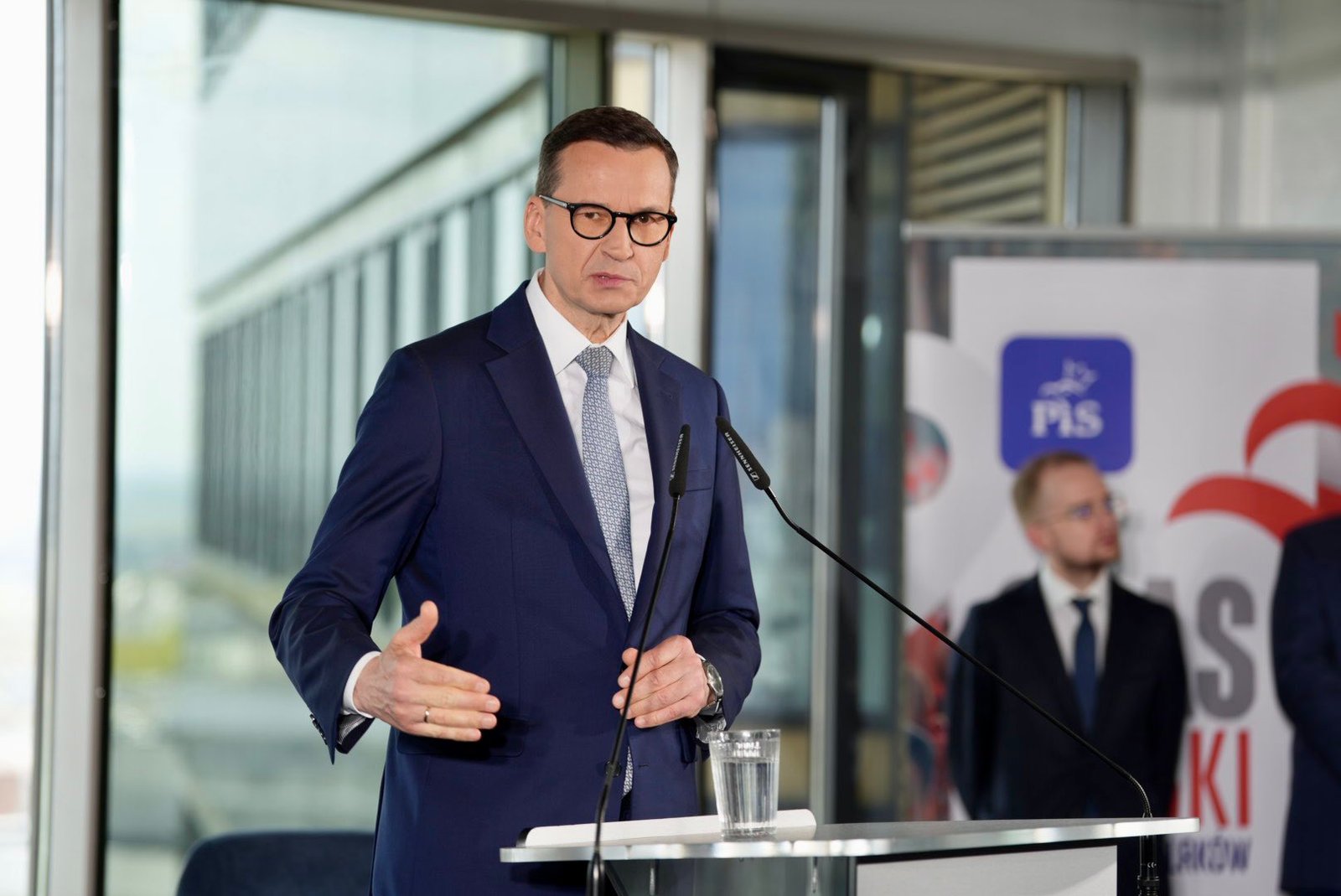
“Let me put forward a slogan: let’s stop subsidizing China immediately, through our trade, economic, and tax policies. With European and Polish money, we are financing four or five major Chinese industries – electrolyzers, batteries, cars, turbines, and panels, which have emerged from nothing and will dominate the world for decades,” said former Prime Minister Mateusz Morawiecki.
During his speech at the economy-focused congress “Thinking Poland 2.0,” Morawiecki outlined the actions necessary to prepare the Polish economy for the future.
Alongside the need for significant defense investments within Poland, he also emphasized the importance of legal regulations.
“Today, the competitive advantage of individual countries will depend on the speed of decision-making. (…) The pace of decision-making will be crucial in competing for advanced technologies, including data centers, hardware, software, and AI implementation. We cannot bury our heads in the sand. A powerful industrial revolution is underway, and alongside the intense competition of the Western world, a new industrial player has emerged, one that has gone through in 50 years all the stages that took the West 250-500 years. They are an extremely powerful competitor to our economic area,”
Morawiecki said, referring to China.
“Let me repeat. Let’s stop subsidizing China immediately. Through our trade, economic, and tax policies. With European and Polish funds, we are supporting four or five powerful Chinese industries – electrolyzers, batteries, cars, turbines, and panels, which have emerged from nothing and will dominate the world for decades, unless some breakthrough occurs. These industries are crucial because, as I mentioned, we are witnessing a trend toward the electrification of everything,”
he added.
He stressed that, thanks to specific legal regulations, “China can rapidly attract productive capital, advanced technologies, appropriate them, and integrate them into its economic system.”
“We must do the same. We must be able to protect parts of our industry smartly, even though we are part of the WTO and the EU, which have exclusive competence over trade policy. Our ability to respond quickly in investment processes is key. If we don’t address attracting investment, mere balances and funding amounts won’t be enough. They will either be insufficient or directed toward low-productivity ventures,”
he argued.
“We propose regulatory acceleration, through the principle of tacit consent, faster investment decisions, and local content requirements. (…) We have not managed to restructure our regulatory system in a way that ensures outcomes are in our favor. Ours must come first, our priorities, our domestic interests. Why do we buy Polish products even if they are more expensive? Because they are Polish, because jobs are here, taxes are paid here, and know-how is developed here. This makes a significant difference, and this domestic multiplier should be reflected in public procurement law, administrative law, environmental assessments, everything that currently severely hinders both private and public capital in carrying out investments,”
he concluded.