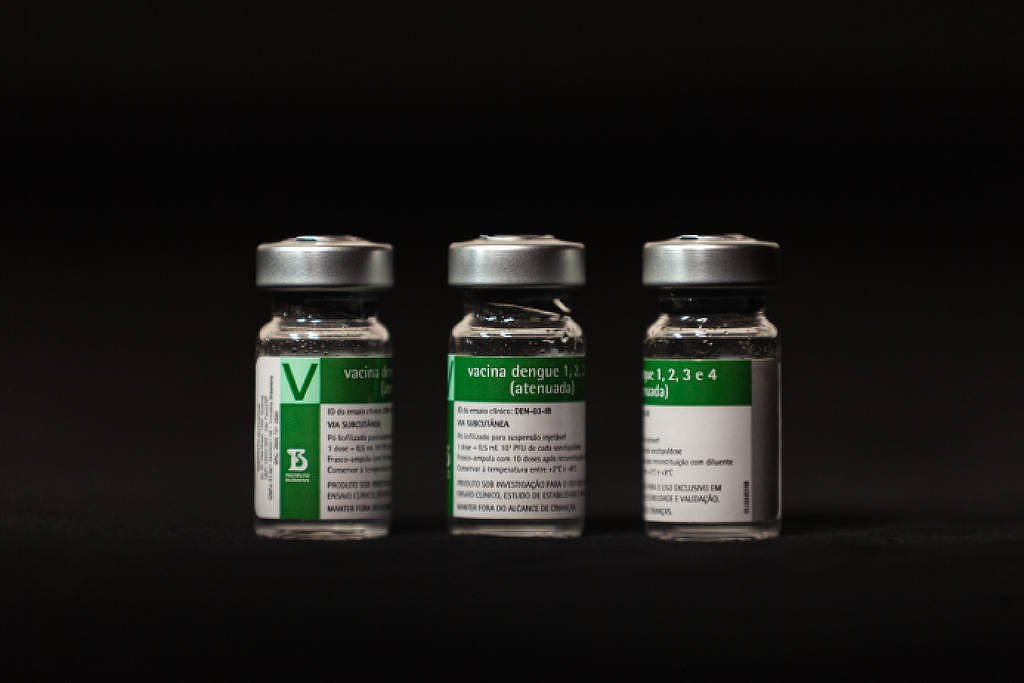
The decision to stop using the vaccine from the dengue manufactured by the Butantan Institute created uncertainty about the pace of the mass immunization plan against the disease. The announcement of the suspension was made this Monday (8) by the Minister of Health, Alexandre Padilhaafter recording 42 cases of severe adverse reactions and two deaths.
Eder Gatti, director of the PNI (National Immunization Program), said during the announcement that there is no doubt about the effectiveness of the vaccine and that the measure was taken as a precaution, to evaluate cases with “warning signs” after the application of more than 500 thousand doses.
The Ministry of Health emphasized that the events are rare, corresponding to 0.008% of the doses applied, and that the link between the use of the vaccine and the two deaths is not certain.
Butantan-DV is the main bet of the SUS (Unified Health System) to protect the population in a long-term strategy. In addition to being applied in a single dose, there is an expectation of expanding the contract, which foresees the delivery of 3.9 million doses by the end of 2027, to around 60 million vaccines.
The scenario of vaccination in mass, however, it depends on the conclusion of the analysis on possible adverse reactions of the immunizer. THE Health states that there is no deadline to present the results, while Butantan recognizes that it will reevaluate the rate of dose production.
“Time is the time needed to conclude the investigation. That’s why we don’t set a deadline. We’re going to demand daily what’s happening (in the investigation)”, he stated Padilha.
“The faster the investigation is completed, with a definition on the use of the vaccine, the better for us,” he said.
The leap in Butantan-DV production involves a partnership between Butantan and the Chinese company WuXi Vaccines. The use of vaccines made in a foreign laboratory still depends on certifications from the Anvisa (National Health Surveillance Agency).
The decision to temporarily suspend involved debate between bodies linked to the PNI, with the participation of Anvisa, local secretariats of health and experts.
Before making the interruption public, SUS technicians expressed fear that the announcement would mix with the electoral debate by fueling interpretations of a possible disagreement between the administrations of President Lula (PT) and Tarcísio de Freitas (Republicans), governor of São Paulo and ally of the Bolsonaro clan.
To dispel this perception, the press release was made by Minister Padilha alongside the president of Anvisa, Leandro Safatle, and the director of Butantan, Esper Kallás. The São Paulo institute is linked to the government of São Paulo.
Padilha stated that Butantan will continue the clinical research that Anvisa requires to authorize vaccination for the public aged 60 and over. Today the vaccine is registered with the regulatory body for the group aged 12 to 59 years.
The Butantan vaccine was approved by Anvisa at the end of November 2025. The following month, the Ministry of Health signed the purchase of R$367.9 million for 3.9 million doses.
Now, SUS will only have Qdenga for immunization against dengue. In 2024, the ministry purchased around 10 million doses, for R$1.3 billion, from the pharmaceutical company Takeda, which is based in Japan and is aimed at people aged 4 to 60 years old.
Padilha states that around 8 million vaccines have already been delivered and that the SUS should receive another 9 million doses in 2026 and next year. Takeda’s vaccine is aimed at people aged 4 to 60.
The Takeda and Butantan vaccines cost the SUS around R$95, but the ministry sees two major advantages in the model developed in the São Paulo laboratory: immunization takes place with the application of one dose, while the competitor requires two vaccines, and the partnership with WuXi promises to boost production.
The search for mass immunization gained greater priority in the SUS after the explosion of dengue cases in 2024, when 6,321 deaths were recorded — in 2026, the ministry recorded 177 deaths.
The number of 2024 became a crisis for the Lula (PT) government and put pressure on the then minister Nísia Trindade. In August of that year, she stated that the SUS’s main bet was the Butantan vaccine. “The vaccine is a strategy that we will continue to use, but it is not the main strategy for 2025. It may be for 2026, depending on the development of the Butantan vaccine,” he said at the time.