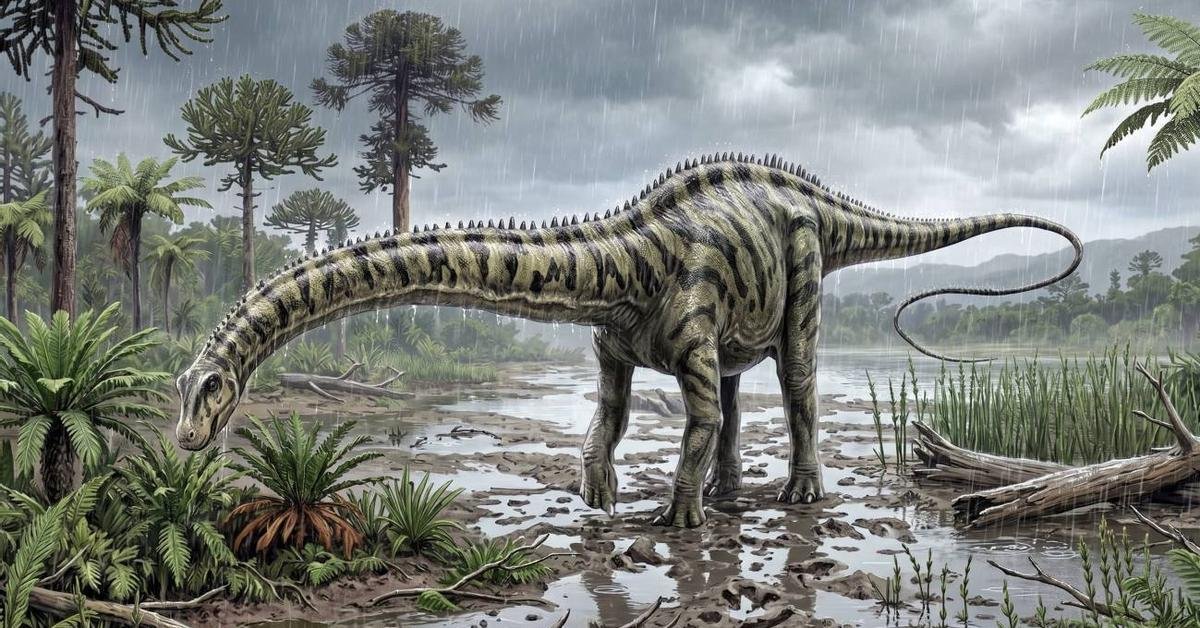
Madrid/Paleontologists from the Teruel-Dinopolis Paleontological Ensemble Foundation have described fossils of a sauropod dinosaur from the La Tejería site in the municipality of El Castellar (Teruel, Spain). The results of their research, recently published in the prestigious scientific journal Journal of Vertebrate Paleontology, have allowed these remains to be identified as belonging to the genus Diplodocus; a dinosaur that, until now, had only been recognized in the Jurassic of North America.
Sauropods, popularly known as “longnecks,” are one of the most characteristic groups of dinosaurs. In general, they were herbivorous, quadrupedal animals, with long tails and necks, and a relatively small head in relation to the total length of their body. Within this group, diplodocids stand out mainly for their extremely long tails.
Within this group, diplodocids stand out mainly for their extremely long tails.
The specimen studied from El Castellar comes from sediments dating from the end of the Jurassic period, about 150 million years ago, and is represented by fourteen vertebrae, belonging to the middle and posterior region of the tail, and by several chevrons – bones that articulate with the lower part of the vertebrae. Its study has allowed it to be identified as belonging to the genus Diplodocus, classifying it as Diplodocus sp.
The tail of Diplodocus presents a set of distinctive anatomical characteristics, among which the large pneumatic cavities of the vertebrae, the elongated vertebral centers without lateral ridges, the deep longitudinal grooves of the lower surface of the vertebrae, and the bifurcated chevrons stand out.

/ Dinopolis
Diplodocus is one of the most recognizable dinosaurs in popular culture since its discovery in the United States in 1878. For this reason, and since the beginning of the 20th century, replicas of its skeleton have been exhibited in the main natural history museums in the world, becoming a symbol of world paleontology. Its presence in exhibitions and audiovisual productions about dinosaurs has contributed to making it one of the “terrible lizards” best known to the general public.
Sergio Sánchez Fenollosa, researcher at the Dinópolis Foundation and first author of the article, explains that “the anatomical study and evolutionary analyzes carried out have allowed us to identify the specimen from El Castellar as belonging to the genus Diplodocus. It is one of the most complete diplodocids discovered to date in Europe and constitutes the first evidence of this genus outside of North America. This finding provides one of the most solid paleontological evidence of episodes of dispersal and faunal exchange between both continents. “through the proto-Atlantic Ocean during the Late Jurassic. Furthermore, this discovery allows us to better understand the Iberian Mesozoic ecosystems and the diversity of sauropod dinosaurs that inhabited Jurassic Europe.”
For his part, Alberto Cobos, managing director of the Dinópolis Foundation and co-author of this article, highlights that “the Diplodocus of El Castellar was approximately 25 meters in length, which makes it another of the great giant sauropods from the Jurassic of Spain, along with other sauropod dinosaurs from Teruel with characteristics very different from those of the diplodocids, such as Turiasaurus and Losillasaurus, among others. The fossils of all these dinosaurs, including those of the new Diplodocus and that make Teruel a reference place for the knowledge of this great diversity, are currently exhibited in the dinosaur room of the Aragonese Museum of Paleontology in Dinópolis in Teruel.”
/ Dinopolis
Fountain: Sync