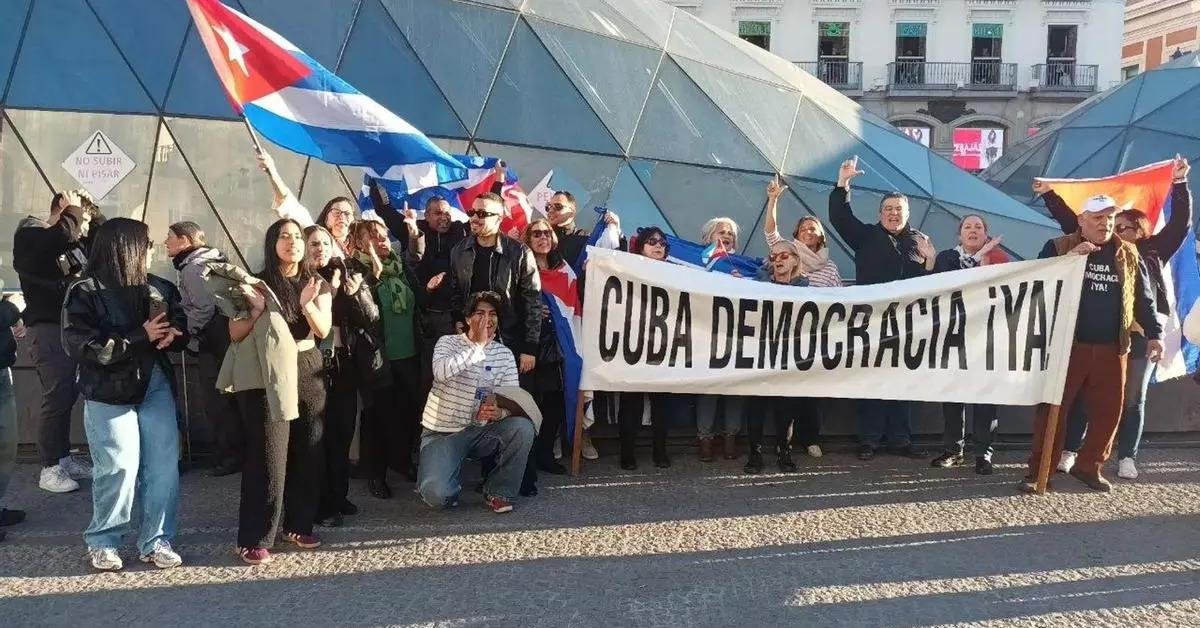
Madrid/The vote of foreigners nationalized by the Memory Law has a favorite: the Spanish Socialist Workers Party (Psoe). An analysis published by The Debateprepared together with the company Target Point based on 14 barometers from the Center for Sociological Research (CIS), maintains that those born outside Spain mostly tend to support the party of the current head of Government, Pedro Sánchez, with the notable exceptions of those from Mexico and Venezuela.
Voters from the Island are also distinguished because the radical right party Vox appears in second position in their preferences, and in that they are similar to Venezuelans.
The study, quoted by the Spanish newspaperanalyzes the CIS barometers between January 2025 and March 2026. The total sample amounts to 56,385 surveys, from which Target Point extracted and weighted the responses of 3,709 interviewees born outside Spain and with Spanish nationality. According to the technical sheet published by The Debateall CIS respondents included in the analysis have Spanish nationality, so they are part of the electorate with the right to vote in general elections.
The general result favors the Psoe. According to The Debatenaturalized foreigners who can now vote in Spain lean mostly towards the socialists. However, the same analysis warns that there is no homogeneous “immigrant vote.” Voting behavior changes significantly depending on country of birth, migratory trajectory, and previous political experience.
Among those naturalized born in Cuba, the Psoe obtains the greatest support, with 26.15%, followed by Vox, with 19.27%, and the PP, with 16.97%.
That’s where the Cuban data comes in. In a first publication, the newspaper points out that “Vox would be the second most voted force among foreigners from Cuba.” The uniqueness is not in the first position – which the Psoe also occupies among Cubans – but in the weight of Vox, which surpasses the center-right Popular Party (PP), and positions itself as the main alternative to the socialists among the nationalized people born on the Island.
The comparison with other groups reinforces this difference. According to the same analysis, nationalized Moroccans show a clear preference for Pedro Sánchez: 38% would opt for the Psoe, well ahead of PP and Vox, which together would add up to 19%. Mexicans, on the other hand, appear as another exception, with 36% of sympathy towards the PP. Brazilians would have a vote more distributed among the three main parties, while Chileans would favor the Psoe easily.
According to the graph published by The DebateAmong those naturalized born in Cuba, the Psoe obtains the greatest support, with 26.15%, followed by Vox, with 19.27%, and the PP, with 16.97%. Regarding the parties that are located to the left of the Psoe, Sumar barely reaches 1.38% and Podemos does not register support among Cuban respondents.
These percentages are not official electoral results nor do they automatically project the behavior of all Cubans naturalized in Spain. They do allow, however, to observe a trend within the analyzed sample: among those born in Cuba, Vox has more weight than the PP and becomes the second option after the Psoe.
For the Cuban and Venezuelan diasporas, references to the left, socialism or communism are part of a biography marked by scarcity, political control and exile.
The same thing happens with Venezuelans, who give even greater support to Vox (21%), although they differ from Cubans by preferring the PP (more than 28%) and rejecting the Psoe (less than 14%).
The data takes on more importance due to the context of the Historical Memory Law, expanded with the so-called grandchildren law. In another article published this Saturday, The Debate Remember that the Minister of Foreign Affairs, José Manuel Albares, recognized that until March 31, 2026, some 2.4 million people had requested Spanish nationality in this way. The Spanish Government has already approved 545,000 files and the approval percentage is close to 90%, a figure that will continue to grow in the coming months.
Thousands of descendants of Spaniards have seen in the grandchildren law a way to obtain a European passport and open a door of exit from the crisis on the Island. On the other hand, these new Spaniards can also become voters of a political system that many know from a distance, but that they interpret through their own experience with Castroism.
For an important part of the Cuban and Venezuelan diasporas, references to the left, socialism or communism are not ideological abstractions, but part of a biography marked by scarcity, political control and exile. Hence the data of The Debate –Vox as the second force among those born in Cuba and Podemos without support registered in the sample– is consistent with a community in which anti-communism can weigh more than among migrants from other origins.