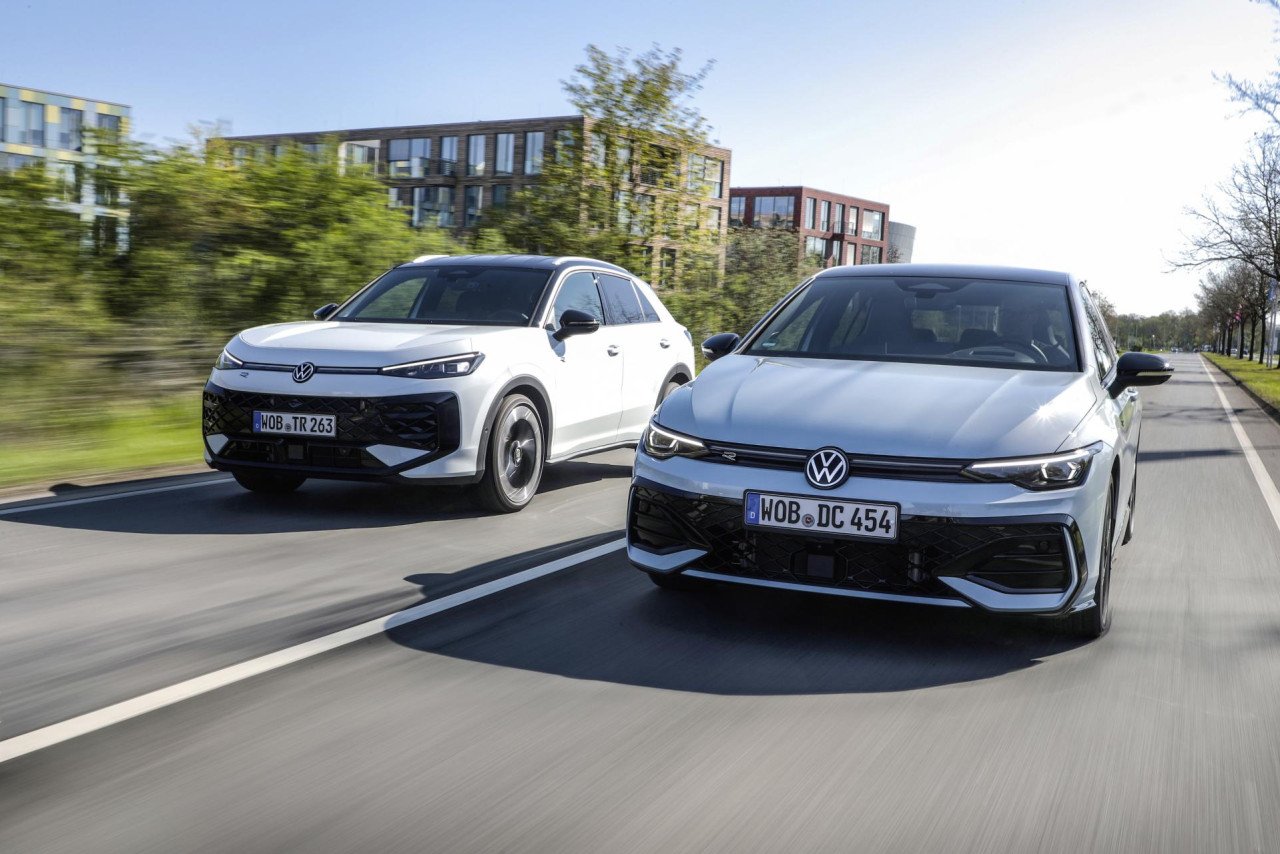
Volkswagen has developed a new hybrid drive that combines temporary electric driving with high efficiency and long range. The new drive system is planned for use in the Golf Hybrid¹ and T-Roc Hybrid¹ models from the fourth quarter of this year. The new hybrid models do not depend on charging cables or charging infrastructure: the energy for the electric driving phases in these Volkswagen models is produced in the vehicle itself using recuperation and the gasoline engine in combination with a generator. The new hybrid system will in the future be offered in two power levels and offers lower fuel consumption compared to the mild hybrid drive.
The new hybrid drive offers numerous advantages: compared to a simpler mild hybrid, it enables a greater share of electric driving and thus lower emissions and consumption values, as well as lower fuel costs. Compared to plug-in hybrids that charge externally, the purchase price of a full hybrid is lower, and no charging infrastructure is required.
On the example of the Golf, the new hybrid system is labeled “Hybrid” and fills the gap between the mild hybrid, which is already available as “eTSI”, and the plug-in hybrid offered in the Golf under the designation “eHybrid”² or as a sporty GTE. Volkswagen thus uses an even wider spectrum of electrified drives, which allows it to, in addition to fully electric ID models. offer the family a suitable drive solution for every usage scenario and every customer.
The new hybrid drive drives the front axle. Its basic components are a hybrid module, a turbo petrol engine (TSI) and a lithium-ion battery. The hybrid module includes an electric motor for propulsion, a second electric motor as a generator, energy management electronics, a differential and a single-stage power transmission, as well as an electronically controlled multi-plate clutch with its own control unit that serves to “connect” and “disconnect” the TSI engine in the powertrain. In the front part of the vehicle, the electric air conditioning compressor and the electric brake booster are integrated. The high-voltage battery, adapted to the hybrid drive with NMC cells and with a capacity of 1.6 kWh (gross), common for HEV vehicles, is integrated into the floor of the vehicle in the rear part of the Golf and T-Roc models.
Volkswagen designed the way the 1.5 TSI evo2 turbo petrol engine, two electric motors and high-voltage batteries work together to achieve a good balance between efficiency, dynamics and comfort. The electric motor in charge of propulsion replaces or supports the gasoline engine in all phases in which it provides greater efficiency. That’s why Golf Hybrid and T-Roc Hybrid often drive exclusively on electric drive, which makes them very quiet when moving, driving at low speeds and in city traffic.
The drive system offers three operating modes, which are automatically activated depending on the vehicle’s usage profile:
Electric motor drive – driving at low speeds exclusively on electricity, the TSI engine is switched off
Serial drive – electric motor + generator: driving on electric drive while the TSI engine produces energy via the generator in the optimal operating range, which extends the electric range
Parallel drive – gasoline engine and electric motor: the TSI engine is the primary source of power at around 60 km/h on roads and highways, while the electric motor supports the engine, for example as a “boost” during acceleration
In the new Golf Hybrid and T-Roc Hybrid models, the driver will be able to choose between three driving profiles: Eco, Comfort and Sport. In the Eco profile, the maximum total system power is limited to 70%, and the boost function is deactivated to reduce energy consumption. The Comfort profile does not limit the power of the system and allows the use of boost. In the Sport profile, sporty characteristics are achieved by switching the drive to series mode earlier, which makes full power quickly available.
In Croatia, we expect new Golf and T-Roc HEV models in the fourth quarter of 2026, when the prices will be announced.