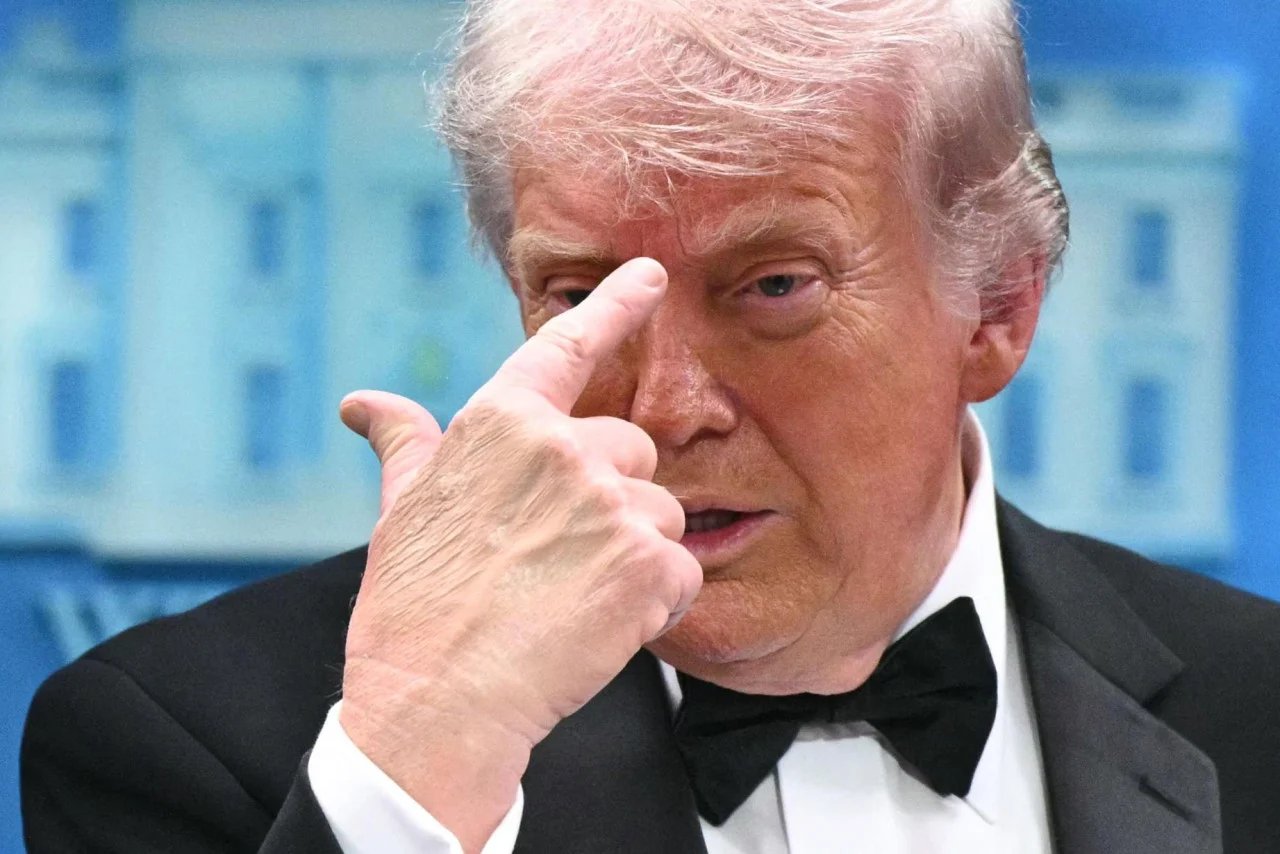
US President Donald Trump said on Sunday that Iran may call if it wants to negotiate an end to the war launched by the US and Israel, while Iran’s foreign minister returned to Pakistan for talks despite the absence of his American counterparts.
Hopes of a revival of peace efforts dwindled after Trump canceled a visit to Islamabad by his envoys Steve Witkoff and Jared Kushner, although Iranian Foreign Minister Abbas Arakchi continued to travel between the intermediary countries.
“If they want to talk, they can come to us, or they can call us. You know, there’s a phone. We have nice, secure lines,” Trump said in an interview on Fox News’ “The Sunday Briefing.”
“They know what has to be in the agreement. It’s very simple: they can’t have nuclear weapons, otherwise there’s no reason for us to be meeting,” Trump said.
Iran has long demanded that Washington recognize its right to enriched uranium, which Tehran says it wants to possess for peaceful purposes, but which Western powers and Israel say is aimed at building nuclear weapons.
Although the ceasefire halted full-scale fighting that began with the US-Israeli attack on Iran on February 28, there was no agreement on terms to end a war that has killed thousands, spiked oil prices, soared inflation and dented hopes for global economic growth.
Tehran has largely closed the Strait of Hormuz, which normally carries a fifth of global oil shipments, while Washington imposed a blockade on Iranian ports.
After negotiations in Pakistan, Arakçi flew to Oman on Sunday, where he met with Omani leader Haysam bin Tariq al-Said.
They discussed strait security and Arakci called for a regional security framework away from outside interference, according to Iran’s foreign ministry.
Arakchi later returned to Islamabad, Iranian state media reported. Pakistani government sources said he would hold talks with Pakistani leaders before heading to Moscow.
Iran’s semi-official Tasnim news agency reported that Arakchi’s talks with Pakistani officials would include “implementing a new legal regime over the Strait of Hormuz, receiving compensation, assurances that there will be no further military aggression by warmongers and lifting a naval blockade.”
The talks will not be related to Iran’s nuclear program, according to the report.
Speaking in Florida before rushing out of a White House Correspondents’ Association dinner in Washington after gunfire broke out nearby, Trump said he canceled his envoys’ visit because of the excessive travel and cost of what he called Iran’s inadequate offer. Iran “offered a lot, but not enough,” Trump said.
An earlier round of talks in Islamabad, where a US delegation led by Vice President JD Vance met with Iranian Parliament Speaker Mohammad Bagher Ghalibaf, ended without an agreement.
After the latest diplomatic trip was cancelled, two US Air Force C-17 planes carrying security personnel, equipment and vehicles used to protect US officials have left Pakistan, two Pakistani government sources told Reuters on Sunday.
Trump also said Sunday that he had “good talks” with Russian President Vladimir Putin and Ukrainian President Volodymyr Zelensky as he seeks to resolve the war in Ukraine.
“We are working on the Russian situation, the Russian situation and the Ukrainian situation, and we hope to resolve it,” Trump said in an interview on “The Sunday Briefing” on Fox News.
Trump said he did not want to reveal when he last spoke with Putin.
“I talk to him and I talk to President Zelenski, we have good talks,” he said, without specifying when the call with the leaders took place.
“The hatred between President Putin and President Zelenskyi is senseless. It is insane. And hatred is a bad thing. Hatred is a bad thing when you try to agree on something, but it will happen,” he said.
Trump promised to end the war that began with Russia’s invasion of Ukraine in February 2022, but more than a year into his second term, the war continues.