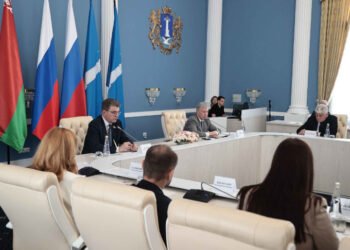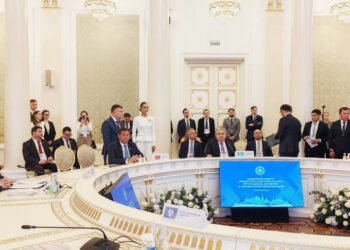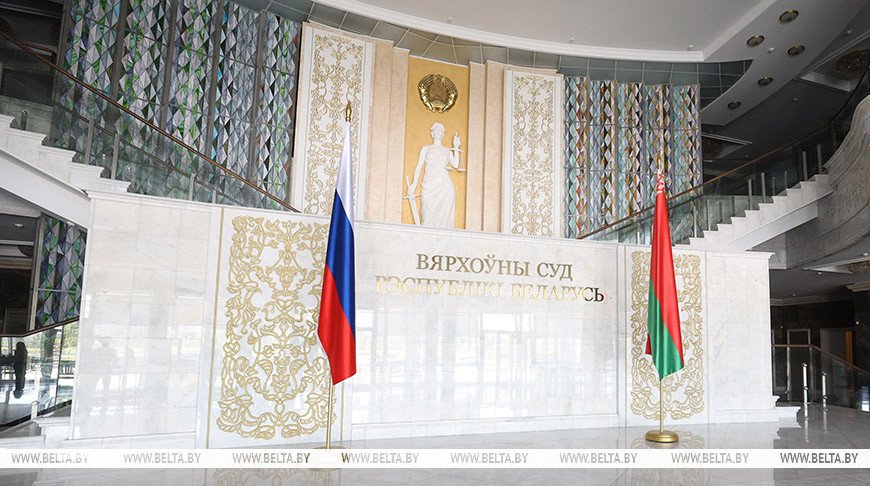
MINSK, 10 June (BelTA) – Chairman of the Supreme Court of Belarus Andrei Shved has suggested creating a permanent cooperation body at the level of the supreme court chairmen of Belarus and Russia during a meeting with his Russian counterpart, Igor Krasnov, BelTA has learned.
“Today we propose to consider, on a working basis, the establishment of a permanent body for cooperation under the memorandum. As a tentative title, we might call it the organizational council for judicial affairs, to be chaired by the supreme court chairmen of Belarus and Russia,” Andrei Shved said.


The supreme court chairman also suggested drawing up a detailed action plan starting next year, one that would encompass the full range of relations across various areas, and called for instituting a regular exchange between court leaders in the near future.
Chairman of the Supreme Court of Russia Igor Krasnov accepted the proposals put forward. Regarding the cooperation program for the next two years, he noted that the document will be filled with activities of mutual interest, of which there are a great many.

Commenting on the Belarusian side’s suggestion to study the experience of the university run by the Supreme Court of Russia (the training of highly qualified specialists and judges is a particularly relevant matter), Igor Krasnov pointed to significant potential for developing relations in education, judicial training, and the scientific and academic sphere.
“If there is interest, and I have already seen that you are interested, we stand ready to share our expertise and the educational programs currently in place at the university,” he said.

The chairman of the Supreme Court of Russia also expressed his conviction that following the signing of the first memorandum of understanding and cooperation between the supreme courts of Russia and Belarus in the history of the two states, the level of interaction in this and other areas will only continue to grow.
Andrei Shved emphasized that his counterpart’s yesterday’s meeting with the president of the Republic of Belarus is a clear sign of deepening integration processes within the Union State.
“In recent years, we, like you, have made considerable progress in improving the national justice system. This has included the unification of general and economic courts, procedural reforms, and substantial investment in material and technical infrastructure. At the same time, we now face many new challenges: the digitalization of judicial proceedings, the harmonization of legal positions, and the protection of the rights of citizens and legal entities in the conditions of the sanctions directed at the Union State,” he said.
Igor Krasnov noted that the leaders of the two countries have consistently emphasized the distinctly strategic character of bilateral relations in every dimension, as well as their shared aspiration to build a seamless legal regime across the territory of the Union State.