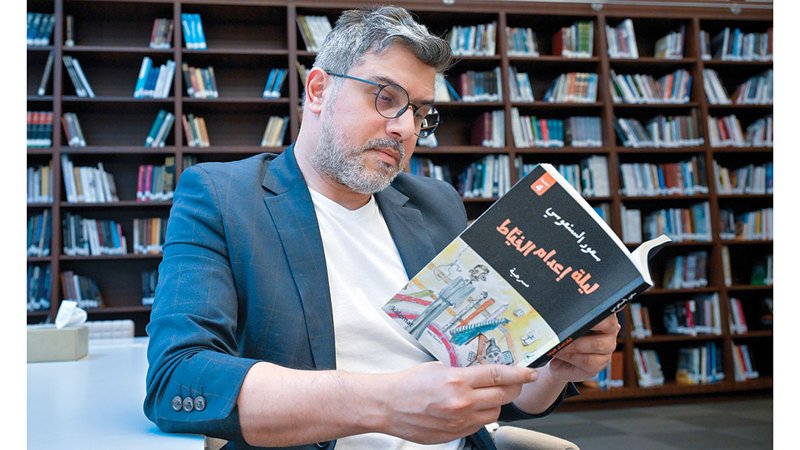
Between the question of identity and belonging, and the obsession with writing as a constant attempt to understand and express, the literary project of the novelist, Saud Al-Sanousi, moves, as he is considered one of the most prominent Arab narrative voices who were able to raise thorny questions related to belonging and societal transformations, as well as to present characters that reflect the complexities of man in confronting his reality and his surroundings.
During his career, the Kuwaiti writer moved between multiple fictional worlds, relying on research and documentation on the one hand, and on narrative imagination on the other hand, which allowed him to build projects that had an imprint on the literary scene.
Al-Sanousi said, in his interview with “Emirates Today,” that “writing falls on the personal level within the framework of self-realization and an attempt to understand and express, and if I were good at something else for expression, I would not write. If I were good at playing the oud, I would not write a single word, but I saw in narrative writing, in particular, what gives me the space to express my thoughts and ask my questions in which I question our societies and our history.”
He added: “The writer’s involvement with a question and raising it makes his role stop. The issue of questions and existential anxiety, in their entirety, are motivations for writing to reach other segments that share the writer’s same concern, so that he does not feel that he is alone, but the writer does not have the answers.”
Great job
Regarding “Travels of the City of Mud,” Al-Sanousi explained that in the beginning it was not the intention to present a three-part experience, but he was certain that he was accomplishing a great work of its literary size, and he imagined that the novel would appear in the size of 800 pages, and then it was transformed into two parts, and after he had come a long way in the second part, he found that he had not reached the world he set out to build, so the idea of the three parts came as a necessity, and they were written at one time, but the last part was issued with a time distance of up to a year.
As for the time period covered by the trilogy, it extends from 1920 to 1990, and bears many transformations in Kuwait City, starting with mud houses and the time of pearl diving, all the way to after the oil revolution and cement houses, and this imposed work that extended nine years of writing and research, and Al-Sanousi added: “This novel was like a dream. I wrote the novel that I wished to read one day. It discusses topics of identity, and presents A side of Kuwait that was not presented by a novelist.”
He stressed that the combination of the trilogy between writing and research did not reduce the space of imagination, which was greater than the space of documentation that was in the background of the event, as there was a theater of events and stories of approximately 20 characters, and history was not an obsession at all, because what he wanted to write was the history of the simple and poor people that had not been written. He also covered in this work an important stage of the history of Kuwait, and covering 70 years out of three centuries in its history is a task that pleased him, and to this day he feels satisfied with this work.
The curse of the single novel
The Kuwaiti writer, who achieved a large part of his fame in the world of literature through the novel “The Bamboo Stalk,” which won the Arab Booker Prize in 2013, revealed that the long list for the award at that time included fictional works that he loved as a reader more than his novel, but the jury had its own criteria for selection, and he explained that the novel’s topic and timing contributed to its victory, even though it was not a new topic, pointing out that the idea of the curse of a single novel suffered from many people. Writers, including Gabriel García Márquez, but as a writer he will remain indebted to this novel, and he saw that the average reader associates the writer with one work of fiction, while the follower who follows the entire experience will develop with the writer, as every creator has his most prominent novel, but it does not necessarily have to be “The Rooster’s Egg,” and that if he were asked to choose his most prominent work, it would be “Travels of the City of Mud” and not “Bamboo Stalk.” He stressed that the success of any experiment does not make him present the same form and template in the subsequent experiment, but rather tries to remove his skin with Each work, so the reader is not accustomed to one style.
A dream that did not come true
Al-Sanousi believes in Milan Kundera’s saying that a writer’s characters are unfulfilled potentials, pointing out that not all of the characters he presented are necessarily unfulfilled potentials, as when he begins writing, the work swallows him up with all its worlds and characters, and he does not think about (Saud), but after the work is published, he discovers that there are things that he did not achieve in his life that he passes on to the characters, giving the example of his failure to learn to play the oud in high school and his switch to the piano, so none of his novels is empty. From the presence of the character of the oud player, with the exception of “Salha Camel,” in which he placed the rebab instead of the oud, due to the nature of desert life, and this applies to playing the oud and other things that he may have failed in in life and achieved on paper.
The burning question
The Kuwaiti writer considered that the question of identity, which constitutes a major concern for him, has become more urgent at the present time, as the world is moving toward classification, and there are many identity dilemmas in many countries such as France, America, Kuwait, and others. He stated that the tribal and tribal heritage in Arab societies makes addressing identity dilemmas more difficult, because classification of the other based on his difference exists, and that other may sometimes be a partner in the homeland, noting that he presented in his works the identity crisis in its various forms. Between the desert and the metropolis, and religious, ethnic, and societal identity, and that our various problems in the world are due to identity crises.
Theater experience
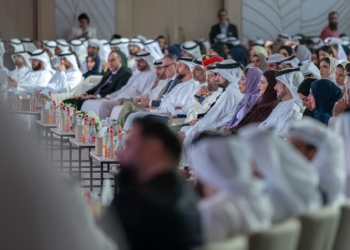
Regarding his story with writing to “Father of the Arts,” Saud Al-Sanousi – who was a recent guest at the “Library Talk” initiative at the Etihad Museum in Dubai, to discuss his play “The Night of the Tailor’s Execution” – said that his experience was easy because he did not turn a work of fiction into a play, as the dilemma could be in turning the novel into any other work, whether drama, cinema, or theatre, because the novel says everything and it is difficult to turn it into a visual work, stressing that starting from scratch in writing a series or play is easier. Much, as he presented more than one series with works of six to eight episodes, and he found himself in them.
. 70 years are covered by the novel “Travels of the City of Mud.”
. 2013 The Kuwaiti innovator won the Arab Booker Prize.
. When I write, I do not think about “Saud,” but after the work is published, I discover that there are things that I have not achieved in my life that I pass on to my characters.