The thousands of migrants who camped in dangerous and unsanitary conditions in the “Jungle” camp in the French coastal city of Calais, waiting to cross to the United Kingdom, in 2016, became a symbol of the shame and failure that plagues European immigration policies.
Ten years after the dismantling of the controversial camp, and in light of the tightening of immigration rules in the European Union, the problem of illegal crossing of the English Channel has not been resolved, and in fact, in the wake of recent agreements aimed at intensifying surveillance on the French coast with British funding, it now threatens to spread to neighboring Belgium.
The sharp increase in the number of small boats loaded with migrants, which were seized by the Belgian authorities, during the first months of this year, raised the alarm among local authorities, as well as among European institutions, which presented an “action plan” in an attempt to find new solutions to a dilemma that no one seems able to solve.
At the end of the long beach of the Belgian resort of De Panne, located on the border with France, stands the Westpunt, a huge geometric concrete staircase that begins and ends at the same point, forming an arch from which the neighboring French city of Dunkirk can be seen. And beyond that, and somewhere on the horizon filled with clouds, rises the British coast, which many illegal immigrants are eager to reach at any cost, even if they risk their lives by boarding fragile rubber boats. They carry with them only the clothes they are wearing, and life jackets that may not be of much use if they drown in the perpetually cold waters of the English Channel, one of the busiest shipping lanes in the world.
Tens of thousands have tried to do this in recent years, especially since the land route through the Channel Tunnel, starting from Calais, has become almost practically impossible, due to the tightening of inspections of trucks in which migrants are hiding.
In 2025 alone, 49,966 people, on board 795 boats, often rubber boats, attempted to cross the English Channel from the northern coast of France, while French forces rescued 6,177 migrants at sea, according to the annual report of the English Channel and North Sea Governorate.
The European Union estimates the total number of attempts to cross the Channel during the year 2025 at about 64,000 attempts, and many have succeeded in doing so, as London acknowledged that more than 41,000 people arrived on the shores of the United Kingdom that year, which is the second highest number since the British government began counting arrivals in 2018, and at least 25 people died while trying to cross.
If the crossing is already risky from Calais, as the closest point to the British coast, the risks double when setting off from Belgian beaches located further away, and yet the number of people trying to do so is increasing. While only a small number of boats were spotted departing from Belgian beaches during 2024 and 2025, the authorities have, so far in 2026, intercepted at least 30 boats.
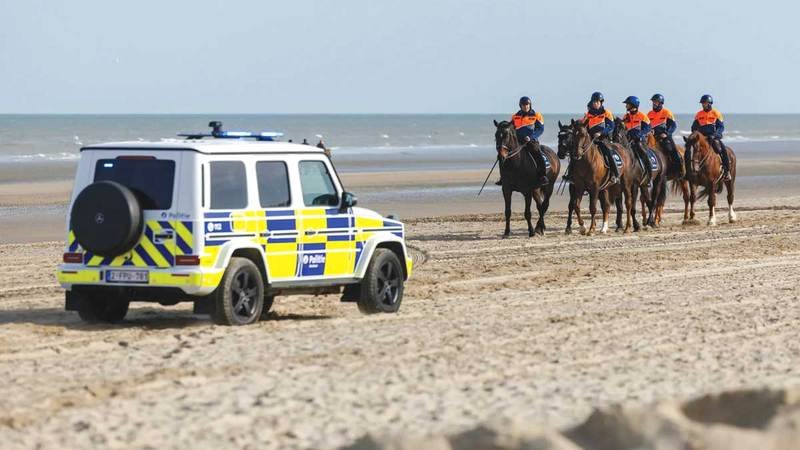
Police operations were particularly intense during the last weeks of April and the beginning of May, when about 200 migrants were detained along the 18-mile-long coast between De Panne and Middelkerke, either inside small trucks that transported them to the beach, or while they were hiding among the sand dunes extending along the Belgian coast, waiting for human smuggling gangs that were supposed to help them reach British shores.
According to police figures reported by the Belgian press, more than 400 people have been intercepted so far this year, and 55 suspects have been arrested, believed to belong to gangs that facilitate illegal crossings.
In addition to the boats that depart directly from Belgian shores with between 60 and 80 people on board, the “Flochtlingenwerk Flanders” organization, an organization that includes a number of non-governmental organizations working with migrants, has monitored a new phenomenon known as “taxi boats.”
According to the organization’s policy coordinator, Joost Depot, “These boats depart from the Belgian coast. They are mostly rickety rubber boats, equipped with small engines, and try to reach the coast opposite Calais and Dunkirk,” where they pick up migrants from different points. About “El Pais”
• According to police figures reported by the Belgian press, more than 400 people were intercepted this year, and 55 suspects were arrested, believed to belong to gangs facilitating illegal crossings.