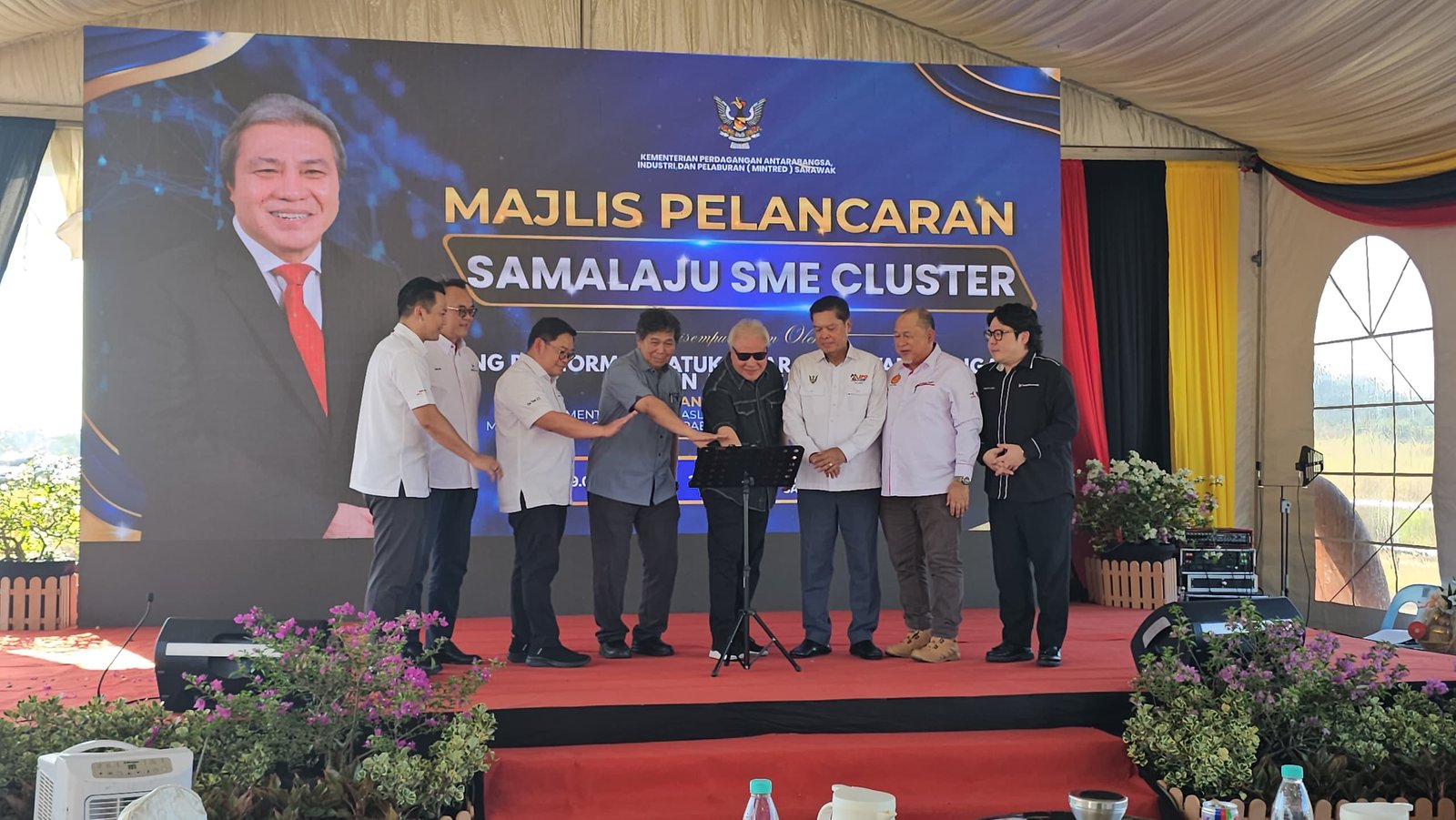

Awang Tengah (fourth right) officiates the launch of Samalaju SME Cluster in Bintulu. – Ukas photo
BINTULU (June 29): The Sarawak government has reaffirmed its commitment to building a more inclusive industrial ecosystem through the launch of the Samalaju SME Cluster, a strategic initiative aimed at integrating micro, small and medium enterprises (MSMEs) into the rapidly expanding industrial value chain in Samalaju.
Deputy Premier Datuk Amar Awang Tengah Ali Hasan said the initiative reflects the government’s continued efforts to strengthen Sarawak’s industrial and investment ecosystem while ensuring broader participation of local MSMEs in economic development.
Speaking at the launch of the Samalaju SME Cluster here on Monday, he said the initiative would promote sustainable, competitive and inclusive growth.
“Industrial development in Sarawak must not only be measured by the value of investments attracted, but also by the extent to which its benefits are enjoyed by the people, particularly local entrepreneurs,” he said.
Awang Tengah said the Samalaju SME Cluster was developed to complement the existing industrial ecosystem and provide more opportunities for local entrepreneurs to supply value-added products and services to multinational corporations operating in Samalaju.
He said the cluster will be developed in 10 phases covering 96.72 hectares, with an estimated total development cost of RM223 million.
As an initial step, he said the Sarawak Government has completed Phase 1 and Phase 2 at a cost of RM25.8 million, involving 21.53 hectares and the provision of 21 industrial lots.
He said the cluster is not merely as an industrial site, but as a modern MSME ecosystem equipped with comprehensive facilities and a conducive business environment.
Awang Tengah, who is also Minister of International Trade, Industry and Investment (Mintred), said the Samalaju Industrial Park (SIP) has become as one of the state’s most strategic industrial nodes under the Sarawak Corridor of Renewable Energy (SCORE).
He said Samalaju is now recognised as one of the most significant international heavy industrial hubs in Malaysia and the Asean region.
“With its renewable energy advantage, strategic location and increasingly mature industrial ecosystem, Samalaju has successfully attracted leading multinational corporations in the aluminium, steel, ferroalloys, manganese, polysilicon and industrial gas sectors,” he said.
To date, SIP has secured investments exceeding RM60 billion, creating more than 9,100 jobs and generating significant economic spillovers for the state.
Awang Tengah said Sarawak’s investor-friendly policies, political stability, efficient governance and strong infrastructure have contributed to its outstanding investment performance.
Awang Tengah added that Sarawak attracted RM116.8 billion in investments between 2021 and 2025, expected to create more than 28,190 high-income jobs.
The state also recorded a trade value of RM179 billion in 2025, with a trade surplus of RM59 billion.
Awang Tengah further said the Samalaju Industrial Port has approved as a Free Commercial Zone by the federal government, strengthening its role as a regional logistics and trade hub.
Emphasising the importance of MSMEs, Awang Tengah said the sector remains the backbone of Sarawak’s economy, wit more than 71,000 registered MSMEs contributing significantly to output and employment across the state.
He said MSMEs in Sarawak have demonstrated strong resilience, with a survival rate of 77.3 per cent, above the national average.
To maximise the opportunities available, MINTRED will implement the Samalaju Collaborative and Operational Readiness Engine for MSMEs (SCORE-MSME), focusing on vendor development, certification, mentoring, skills enhancement, digitalisation and financing access.
“I am confident that this approach will enable local MSMEs to grow into competitive regional and global players, ensuring every investment benefits the local economy,” he said.
Awang Tengah said the Samalaju SME Cluster is expected to serve as a model that can be replicated in other industrial areas across Sarawak.