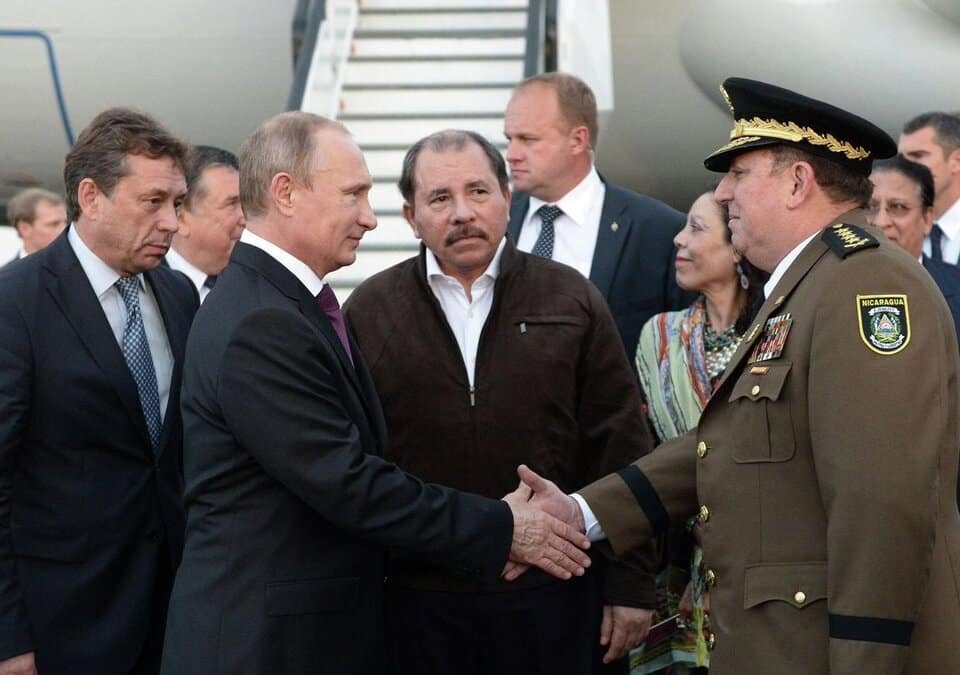
The Federation Council (Senate) of Russia ratified its agreement to strengthen military cooperation with Nicaragua, signed in Moscow in September 2025.
The agreement “will establish the necessary legal bases to determine the objectives, directions and forms of bilateral military cooperation, (and) will defend the interests of Russian citizens who carry out missions within the framework of said agreement in the jurisdiction of Nicaragua,” according to the explanatory note of the corresponding Russian law.
The pact also stipulates cooperation between the parties in several key areas, such as the exchange of information on matters of mutual interest in the military field.
It also contemplates “the coordination of efforts to jointly counter challenges and threats to global and regional security and stability” and “the exchange of experiences and information in the fight against extremist ideologies and international terrorism.”
It also includes “the exchange of experiences and information in the fight against piracy and the joint training of troops.”
The agreement was signed on September 22, 2025 by the Russian Minister of Defense, Andréi Beloúsov, the date on which he held a meeting with the head of the Nicaraguan Army, General Julio César Avilés, and was ratified on Wednesday, May 1, 2026.
Nicaragua’s military agreements with Russia
Previously, in December 2024Russia had already approved a draft intergovernmental agreement on military cooperation with Nicaragua proposed by the Russian Ministry of Defense and coordinated with the Ministry of Foreign Affairs and other Russian institutions, for a period of five years.
The project stipulated that military cooperation with Nicaragua will include the exchange of opinions and information on military issues of mutual interest and the coordination of efforts to jointly confront challenges and threats to global and regional security and stability.
Russia is a former ally of Nicaragua that during the first Sandinista Government (1979-1990) provided Soviet weapons to the Nicaraguan Armed Forces, an alliance that endures today not only with material and military aid, but also with political support in the main international organizations.
In August 2024, an investigation of CONFIDENTIAL revealed that a Nicaraguan Army base located on Cerro Mokorón, south of Managua, has become one of Russia’s main espionage centers in recent years.
The report Russian spy center operates at Mokorón military base in Managua details that Russian officials are the only ones who control and manipulate the equipment and information obtained, while Nicaraguan officials limit themselves to providing “security” at the base, as revealed by sources who have had access to the military installation.
“Nicaragua is the most visible center of Russian surveillance (in Latin America), under the unconditional support of the (Daniel) Ortega regime for (Vladímir) Putin, and the long-standing historical ties with the former Soviet Union,” according to a report from the Jack D. Gordon Institute for Public Policy from Florida International University (FIU), prepared by Douglas Farah, a researcher in national security issues, detailed an article by CONFIDENTIALpublished in October 2024.
“Nicaragua becomes a Russian military base”
The ratification of the military agreement between Russia and Nicaragua turns the Central American country “into a Russian military base,” denounced Nicaraguan opposition leader Félix Maradiaga.
In a statement, the opposition leader, who in February 2023 was one of the 222 former political prisoners who were banished to the United States and deprived of their nationality, also warned that this agreement “breaks the reasonable balance of forces in Central America and directly violates the 1995 Framework Treaty on Democratic Security in Central America.”
The also interim national coordinator of the Ruta del Cambio party warned that the spouses and co-presidents of Nicaragua, Daniel Ortega and Rosario Murillo, not only violate Nicaraguan sovereignty, but also put the security of Honduras, El Salvador, Guatemala, Costa Rica, Panama and Belize at direct risk.
Maradiaga urgently called on Central American governments to formally invoke the 1995 Framework Treaty and begin the procedure for the expulsion of the “Ortega regime from the Central American Integration System (SICA).”
He also called on the Organization of American States (OAS) to speak out with the “firmness required” by the Inter-American Democratic Charter and to begin the process of formally declaring the “illegitimacy of the Ortega regime.”
And to the United States, the European Union, the United Kingdom, Canada and the democratic allies, not to close their eyes to this military cooperation agreement, which, he warned, “will have far-reaching security consequences for the entire Western Hemisphere.”
“To the international community as a whole, to understand that tolerating this pact in silence is enabling a new authoritarian outpost at the very doors of the American continent,” he added.
Ortega and Murillo, “sell homelands”
For Maradiaga, what was signed and ratified in Moscow “is a Russian military base installed at the gates of the” American continent, and not “a routine act of bilateral cooperation.”
“It is the formalization of an inadmissible political project: the conversion of Nicaragua into a satellite state of Vladimir Putin, into an operational platform at the service of the Kremlin’s geostrategic interests within the American hemisphere,” he said.
In his opinion, this is an agreement written as a “blank check” in favor of Moscow, which contemplates the exchange of military and intelligence information on “matters of mutual interest”; coordination of efforts against “threats to global and regional security”; joint troop training; cooperation in radio electronic warfare; cooperation in radiological, chemical and biological protection; creation of a permanent working group and a joint annual military cooperation plan.
With this agreement, valid for five years with automatic indefinite extension, and which offers “special jurisdictional protection” to Russian citizens who carry out missions in Nicaraguan territory, “Nicaragua becomes, as of today, a Russian military base,” said the opposition leader, exiled in the United States, who reproached the “geopolitical servility” of Ortega and Murillo towards Russia.
“Ortega is not an ally of Russia, he is a vassal of Russia. And it is not the first time that he has dragged the country into a foreign adventure. Whoever authorizes this pact today is the same one who in the 1980s involved Nicaragua, at its most vulnerable moment, in the worst of the geopolitical conflicts of the 20th century – the Cold War -, with a devastating human and economic cost from which we have not yet recovered,” he launched.
“Today he does it again. He does it, furthermore, by aligning himself with a regime that illegally invades Ukraine, that holds the theocratic regime of the Ayatollahs in Iran with its hands behind it, and that is a time bomb for world peace. Ortega, with abject codependency and confessed servility, once again bets the entire fate of a country on the interests of a foreign power,” continued the opposition leader, who described this agreement as “an act of selling the country.”
The octogenarian president of Nicaragua, Daniel Ortega, in power since 2007, co-chairs the Central American nation with his wife, Rosario Murillo, and is the main ally in the region of the president of Russia, Vladimir Putin.
Nicaragua, along with North Korea and Syria, are the only countries that have recognized the legality of Russia’s annexation of the Ukrainian regions of Donetsk, Luhansk, Zaporizhzhia and Kherson.
Previously, Nicaragua recognized the independence of the Russian-backed Georgian breakaway regions of Abkhazia and South Ossetia.
*With information from EFE