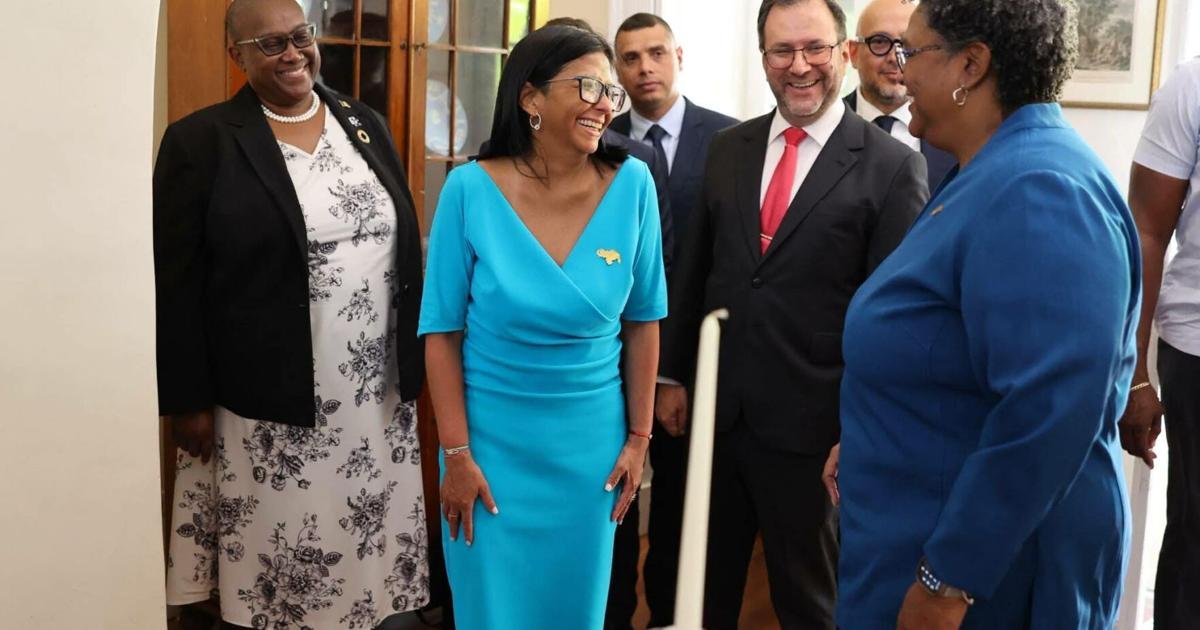
As Venezuela’s Interim President Delcy Rodriguez met with Barbadian Prime Minister Mia Mottley inviting the country to invest in Venezuelan oil and gas earlier this week, she wore a brooch appearing to depict a map of Venezuela that includes the disputed Essequibo region of Guyana on her chest.
Rodriguez, a regime loyalist who has been functioning as Venezuela’s Head of State in the aftermath of the US military operation that extracted former President Nicolas Maduro, has reportedly worn the same accessory during a previous meeting with Grenada’s Dickon Mitchell last week, drawing condemnation from Guyanese President Irfaan Ali, and a number of other local bodies.
Since Rodriguez first assumed the office in early January, reportedly cautioned by US President Donald Trump that without cooperation she may face a fate worse than her predecessor, she has yet to publicly issue a firm stance on Venezuela’s previous claim to the oil-rich region. She has in the past four months softened her anti-US stances, cooperating with American policy makers and strengthening diplomatic relations between the two.
In the past however, Rodriguez, who appeared as a key figure in Venezuelan politics under Maduro’s rule, has thrown support behind the ousted Socialist leader’s resurrection of the border dispute. In 2023, as he denounced an 1899 agreement that allotted Essequibo to Guyana, unveiled a new map and nominated an army general as Essequibo’s governor Rodriguez vowed a “proportional response” to what she claimed were “gross violations” on Guyana’s part.
In February 2024, Rodriguez had claimed that Ali had disposed of pending delimitation, granting transnational energy companies’ concessions and breaching international law, in a post to her X account. “Venezuela does not recognize nor will recognize the fraudulent boundaries of the dispossessing award. And it will never renounce the defense of its rights. Our response will be proportional to the gross violations by Guyana and its imperialist masters!” she had written.
Early into the Trump Administration’s tenure in 2025, US Secretary of State Marco Rubio had met with Ali, issuing a warning to Venezuela that there would be consequences to any forceful action in asserting claim to Guyanese territory.
For most of late 2025, as the US began ramping up its military presence in the Caribbean Sea and carried out its campaign of lethal boat strikes, Rodriguez grouped Guyana and Trinidad and Tobago into a category of “vassal states” warning them both not to cooperate with US forces for any attack against Venezuela.
This warning came as Trinidad and Tobago’s Prime Minister issued her own to Venezuela, that any attack on Guyana would grant the US unflinching access to T&T’s territory.
Ali writes to Caricom

Border talks: Guyana President Irfaan Ali, left, and
Venezuela President Nicolas Maduro sit opposite each other during their meeting in St Vincent and the Grenadines on December 14. —Photo: OFFICE OF THE PRESIDENT OF GUYANA
In a letter penned to Caricom President Terrence Drew today, Ali noted with concern Rodriguez’s “public display” of the incorrect map. He wrote that Guyana respects the sovereign right of Caricom states to engage in bilateral relations with all partners, including Venezuela.
However, he said, it was deeply regrettable that these engagements featured the prominent display of symbols asserting the Venezuelan claim.
“The use of CARICOM engagements to project or promote a territorial claim against a Member State risk being interpreted as acquiescence or tolerance. No action, whether deliberate or inadvertent, should create the impression that the Community’s platforms may be used to advance claims now before the International Court of Justice. CARICOM’s principled support for Guyana must be reflected not only in declarations, but also in the context and conduct of official engagements.”
“This is not a matter of symbolism alone. It is a calculated and provocative assertion of a claim that Guyana has consistently and lawfully rejected, and which is before the International Court of Justice for final adjudication,” he wrote.
Ali said that as the case is before the Court Venezuela could not seek to normalise such symbols, maps, legislation or official displays that have not been established in law. This conduct, he said, undermined Venezuela’s case and a stated commitment to peaceful settlement, international law and good neighbourly relations.
Citing the 19th century Arbitral Award, which he said determined the boundary as a full, perfect and final settlement, Ali argued Venezuela’s claims formed a pattern of conduct inconsistent with international law.
“These actions persist notwithstanding the Order of the Court of 1 December 2023, which required Venezuela not to take any action that would modify the situation that currently prevails in the territory in dispute, whereby Guyana administers and exercises control over that area, and required both Parties to refrain from any action that might aggravate or extend the dispute or make it more difficult to resolve,” he wrote.
Ali said he was writing to Caricom to convey Guyana’s concern and urge vigilance.
“Guyana reminds all CARICOM Heads of Government of their repeated and unequivocal support for Guyana’s sovereignty and territorial integrity, and for the resolution of the controversy through the judicial process before the Court. That position was reaffirmed most recently at the Fiftieth Regular Meeting of the Conference of Heads of Government.”
“Guyana remains fully committed to the peaceful resolution of this matter in accordance with international law. We continue to repose our confidence in the Court and to respect its processes and eventual judgment,” he said.
He added that it expected all states to refrain from provocation.
“At the same time, Guyana expects all States, including Venezuela, to act consistently with the principles of the United Nations Charter, refrain from provocation, and respect the ongoing judicial process,” he said.