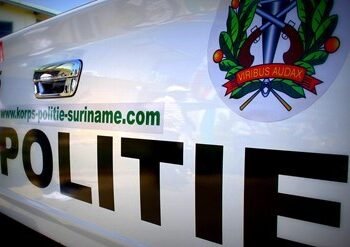
While deaths and injuries seem to be occurring en masse left and right during Road Safety Month, the Ministry of Justice and Security has launched the updated website of the Road Safety Institute (VVI) launched. With a so-called National Road Safety Dashboard Traffic accidents will now be better mapped, which “can contribute to a more targeted approach to road safety in the country”. But numbers on a computer screen don’t stop road pirates or fix holes in the asphalt.
Text Armand Snijders
Image FB Justice and Security
There is less one week left in Road Safety Month, which lasts from August 15 to September 15. A month in which the government traditionally calls for reflection with the slogan ‘No crazy tap’ a road surface’. But anyone who has opened the newspapers or taken part in traffic in recent weeks knows that this appeal falls on deaf ears. The Surinamese roads have turned into an anarchic battlefield where the law of the strongest – or the boldest – applies. This Road Safety Month has already seen more than ten road deaths.
“Figures only become meaningful when they are translated into concrete decisions and measures”
Minister Harish Monorath
Favorite buzzwords
With much fanfare, the Ministry of Justice and Security presented a dashboard in response to this humanitarian crisis: a renewed website for the Road Safety Institute. It was explained that traffic accidents can now be “better mapped”, which should “contribute to a more targeted approach”. These are the favorite buzzwords of a government that excels in reactive behavior, but is otherwise powerless and chronically inadequate when it comes to actual intervention.
Of course, reliable data is essential for any modern country. VVI director Joanne Kasno-A Draai is absolutely right when she states that figures cannot bring back lost lives, but can help prevent new victims.
It is commendable that institutions such as the Suriname Police Force, the General Bureau of Statistics and the Academic Hospital Paramaribo are finally putting their heads together digitally. In a country where data has often disappeared into dusty folders in back rooms, this is progress.
Bottlenecks
But the fundamental mistake made is to confuse the presence of data with the presence of policy. A dashboard is a thermometer. It tells exactly how high the fever is, but the thermometer itself does not cure the patient. After all, it has been known for years where the bottlenecks lie.
An advanced computer model is not needed to see that the Martin Luther Kingweg turns into an illegal race track at night, to conclude that the lighting on the Afobakaweg has been insufficient for months or that the markings on the roads in Commewijne are virtually invisible. Citizens see it every day. The police know. The data has been there for a long time – also in the form of human suffering. It all has to be translated into action.
Minister Harish Monorath of Justice and Security rightly noted during the launch that the dashboard should not be an end in itself for the government. “Figures only gain meaning when they are translated into concrete decisions and measures,” said the minister. These are beautiful quotes that make the newspapers, but they clash with the daily practice of his own ministry.
What are the priorities?
Because how does the minister intend to implement these “concrete measures”? Sufficient officers are needed to provide additional enforcement at locations that the dashboard turns red. Motivated officers, that is, who are equipped with, among other things, well-functioning surveillance cars, blowguns and speed radars.
However, the reality is that the KPS has been struggling with a chronic lack of resources for years. Police posts sometimes still run out of gas, vehicles break down along the road and surveillance has become virtually invisible in many neighborhoods. Enforcement does not fail because the police do not know where to stand, but because they simply do not have the resources to be there.
The minister acknowledged that the development of the dashboard cost quite a bit of money. That raises the question of where the priorities lie. Apparently there is money and foreign donor support available for software and expensive consultants to build a website, but if brake discs have to be bought for a police car, the coffers are empty. It is a form of window dressing that Surinamese society is now tired of. The exterior is being polished, while the enforcement engine has been running aground for years.
(read more below the photo)

Culture of impunity
Even with the best dashboard in the world, the Surinamese traffic mentality cannot be changed from a computer screen. The anarchy on the road is the direct result of a deep-rooted culture of impunity. The chance of being caught in traffic is laughably low.
Anyone who gets behind the wheel after having had a drink knows that the chance of being stopped is minimal. Anyone who drives without a driver’s license or uses an unapproved vehicle is betting – often successfully – that there will be no checks after all. And if you are already arrested, there is often the informal Surinamese way of ‘arranging’ a fine. Especially if you belong to the so-called elite or know the right people.
The dashboard will not break this mentality. This only happens when serious consequences are attached to violations. Where is the promised introduction of section checks? Where are the speed cameras that register violations 24 hours a day, without a corrupt link in between? Where is the structural reform of driver training, so that young drivers learn not only how to park, but also how to behave responsibly in traffic?
“Numbers cannot bring back lost lives, but they can help prevent new victims”
VVI director Joanne Kasno-A Draai
Expensive PR stunt
According to the ministry, it will become clear in the coming period to what extent the collected data is actually translated into concrete measures on the street. That is the ultimate litmus test.
But it is to be feared that after Road Safety Month, the dashboard will slowly sink into bureaucratic oblivion – just like so many other pointless committees, reports and task forces that Suriname has known in recent decades. And that the launch was nothing more than an expensive PR stunt, while Surinamese citizens continue to die on the asphalt. It must be hoped that Monorath remembers his own words: numbers do not save lives. Deeds yes.