
Madrid/The Cuban Observatory for Human Rights (OCDH) is pressing to ensure that the doctors’ mission in Calabria, Italy, is at least investigated. The organization, based in Madrid, urges Rome and Brussels to “activate and evaluate” a battery of mechanisms that make it possible to determine under what conditions health workers carry out their work and whether they can be considered “forced labor.”
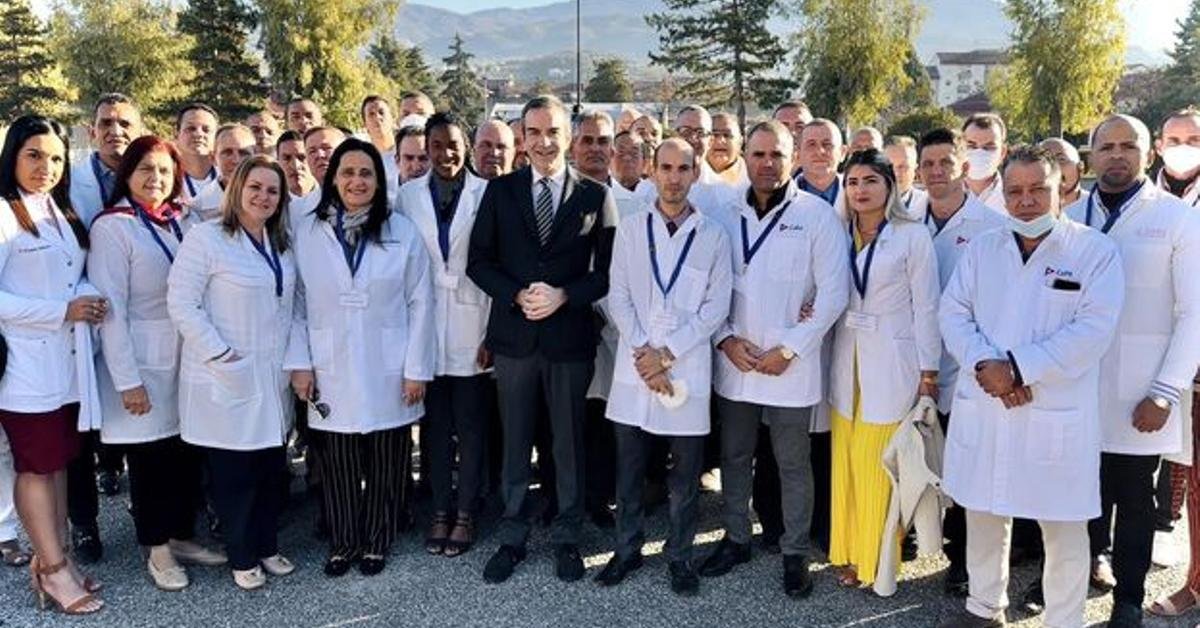
The Cuban doctors who work in this region of southern Italy are hired directly by the Calabrian health system since the initial agreement, from 2022, was modified. with Havana. The decision was made due to accusations of slavery that have been persecuting these brigades for years, mainly due to the appropriation of up to 90% of the salaries of each professional and the retention of their passports. Although these contractual conditions are not known, the health workers themselves have revealed who receive their salaries in full, but donate up to half to the State, supposedly voluntarily.
The report, more prudent than the Observatory’s press release, does not presume that the Calabrian authorities have committed any type of crime, on the contrary, it suspects that the contracts conform to the norm. However, he insistently points out that the obligation of the Italian and European authorities is to ensure compliance with its international commitments for the prevention, early detection and prosecution of trafficking and forced labor. To this end, they emphasize that “the signing of a contract or initial consent does not validate the subsequent loss of freedom to leave the service.”
The report recalls that the Cuban regime subjects doctors to exhaustive control, against whom there are even threats of prison if they abandon missions abroad.
The report recalls that the Cuban regime subjects doctors to exhaustive control, against whom there are even threats of prison if they abandon missions abroad. Although doctors in Calabria are not strictly fulfilling that task, intimidation and coercion remain latent. The Ocdh urges the labor inspection to, at least, ask the interested parties for their passport to check if they have it in their possession or if someone is withholding it.
The Observatory cites several legal and institutional tools applicable in the European space, including the charter of fundamental rights and the directive on human trafficking, which contain a legal framework for these cases. It also names existing courts, the Greta expert group and the Italian Justice and Home Affairs institutions that could be used to report any possible violation of rights, although in practice all of them require proving the existence of specific coercion.
“Abusive working conditions do not automatically constitute trafficking or forced labor, although they can provide relevant evidence to investigate their existence,” insists the report, which also provides a telephone number where those potentially affected can make a primary complaint with which to open the investigations.
“To substantiate the complaints, it is essential to provide individualized testimonies, contracts, cooperation agreements, salary receipts, disciplinary instructions, communications, requests for resignation and evidence of threats or reprisals. The documentation must make it possible to establish the real working conditions, the effective freedom of professionals to abandon missions and the possible coercive mechanisms used to prevent this,” he clarifies.
The Observatory report predictably seeks to pressure Italy to take measures just before the arrival in Rome of the Greta group of the Council of Europe, which will visit the country in early 2027 for its follow-up technical evaluation in the Fight against Trafficking in Human Beings. To this end, it urges to open ex officio “formal and independent investigations into the terms of the agreements signed, verify the voluntariness of the doctors and guarantee effective means of protection that protect doctors against possible reprisals.”