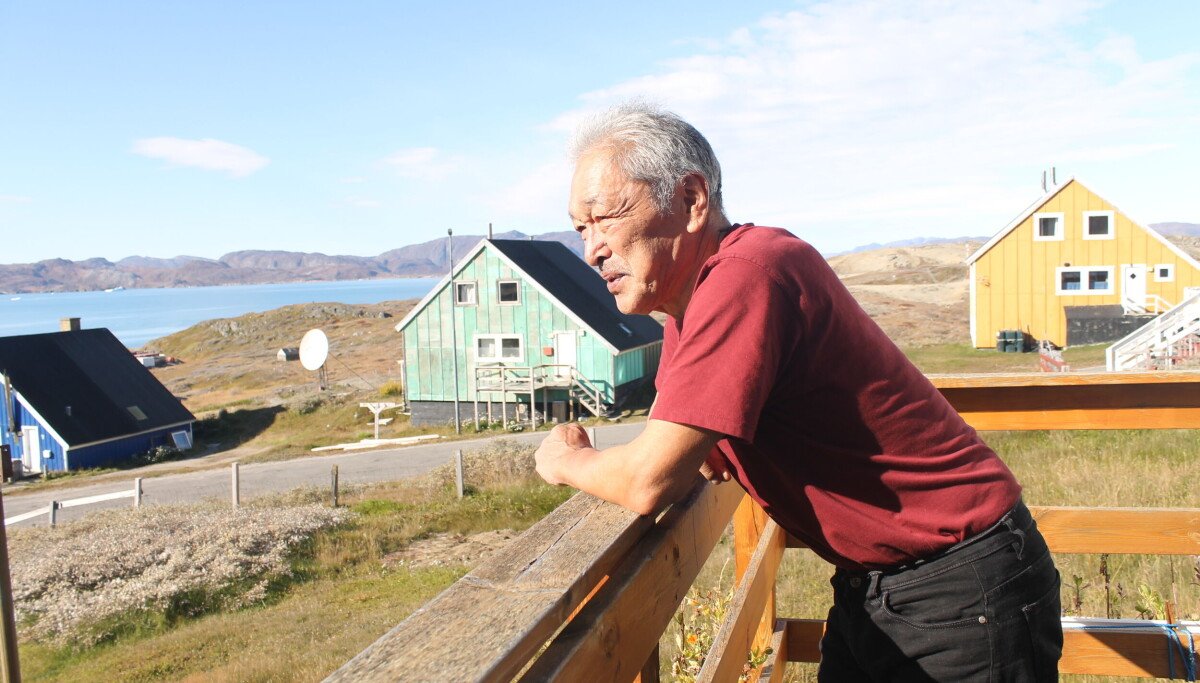
Oleeraq Nielsen stands on his terrace in Narsaq and misses the sun. The terrace overlooks his and his wife’s garden. It is large, they have plenty of space – and a view out over the fjord.
– It’s nice here, isn’t it? he says.
On a daily basis, Oleeraq Nielsen works at the Narsaq Museum. In addition, he and his wife are long-standing members of the environmental activist group Urani Naamik, which was officially founded in 2013 – but which, according to Oleeraq Nielsen, has existed since the search for minerals at Kuannersuit began in the 70s.
Therefore, Oleeraq Nielsen is not only a man who possesses great historical knowledge, but also a man with his clear views.
– When you have read so much about what radioactivity and mining do to nature, we are of course against it, he says.
– There are mining companies all over the world, and I have not heard of one that has cleaned up after itself.
It varies how often Urani Naamik meets, but currently they meet often, says Oleeraq Nielsen. Because there is enough to discuss.
We already have a gold mine a little further south at Nanortalik, but that has not affected the financial situation at all. So more is needed to convince us who are against mining.
Besides that the trial between the mining company ETM and several Greenlandic authorities continues to haunt in the background, has the mining sector in South Greenland has apparently also received new wind in its sails with the Tanbreez mining project at Killavaat Alannguat.
In addition, in recent years a lot has happened on the geopolitical scene in Greenland, Oleeraq Nielsen, like most others in this country, can state. When Sermitsiaq visits Oleeraq Nielsen in his home, it is only three days since the Defense Agreement between Greenland, the USA and Denmark was signed in New York.
An agreement that is about defense and security, but as the president of the United States several times since the signature has been presented as a bargain – and an entrance to look for oil and other raw materials in Greenland’s underground.
Sermitsiaq has visited Oleeraq Nielsen to understand how it feels to live in an area, where mining dreams sprout anew, but where the fear of pollution also lurks.
‘The place with the many big quans’
The mine at Kuannersuit, located a good eight kilometers from Oleeraq Nielsen’s house, was what really started the Greenlandic movement against mining.
– Kuannersuit has always been something very special, and the area has really always been a part of our lives, he says, pointing to the north-east.
Apart from the fact that as a child in Narsaq he helped to run up and collect sheep and lambs in the gorge between Kuannersuit and Qaqqarsuaq (Narsaq mountain) in the autumn, it was also an area full of life, he says.
– It was up there where the big quails grew. Kuannersuaq actually means ‘the place with the many big quans’, he says.
– When we are grouse hunting, it is still at Qaqqarsuaq and on the other side of Kuannersuit that it takes place.
That is why it was frightening for Oleeraq Nielsen when, in the 70s, systematic investigations for uranium in the area were started from the Danish side. According to an article in Ingeniøren large quantities of uranium ore were mined in the area from 1979 to 1980.
After that, things calmed down when Denmark later decided not to invest in nuclear power plants as an energy supply, but the resistance and popular movement against uranium had taken deep roots in the small town.
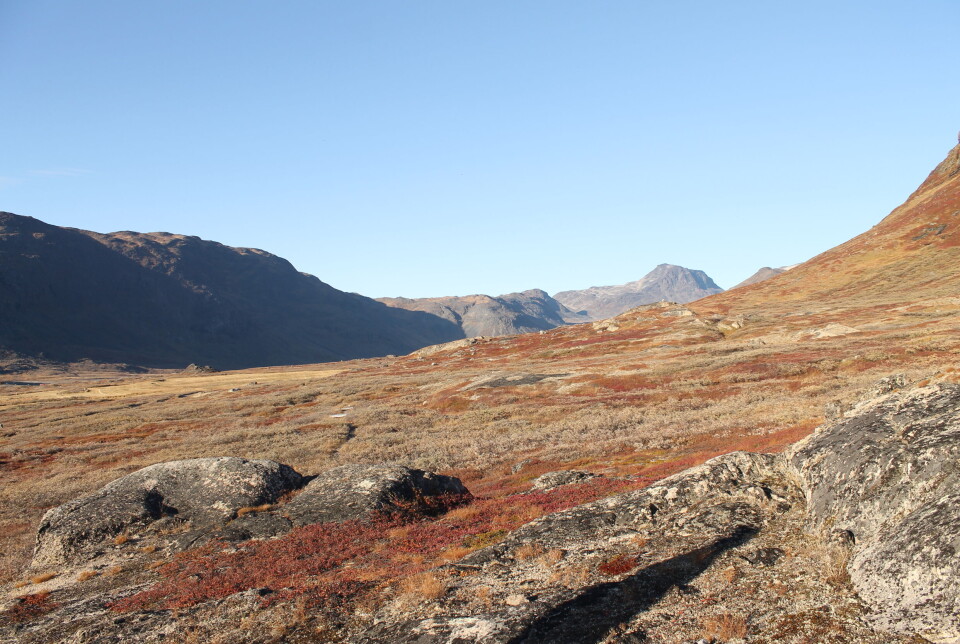
So when the Australian company Greenland Minerals and Energy, today called Energy Transition Minerals (ETM), got a license to search for rare earths at Kuannersuit in 2007, Oleeraq Nielsen, his wife and the other activists found the banners and battle cries again.
In 2021, as is well known, the Kuannersuit project was put to an end when the country’s uranium law was voted through in Inartsisartut. Since then, ETM has sued a number of authorities in this country, and the mining company is demanding an exploitation permit for Kuannersuit or up to DKK 76 billion in compensation.
– They have lost, that’s what they don’t want to face, says Oleeraq Nielsen.
Today, it is not only uranium mining and Kuannersuit that Urani Naamik deals with.
– It started in its time with mining in the cities. That’s what we said no to in the beginning. Today it is also mining in a broader sense.
– Mining will go beyond nature. And our ocean currents also mean that the pollution will be carried elsewhere – so it is not just us that is affected.
Gold rush in Qaqortoq
While Oleeraq Nielsen, his wife and the other members of Uraani Naamik do what they can to make life difficult for the mining companies, there are others in this country who see great opportunities in developing the mineral sector in Greenland.
In Qaqortoq, about 45 minutes away from Narsaq, for example, the tone is different.
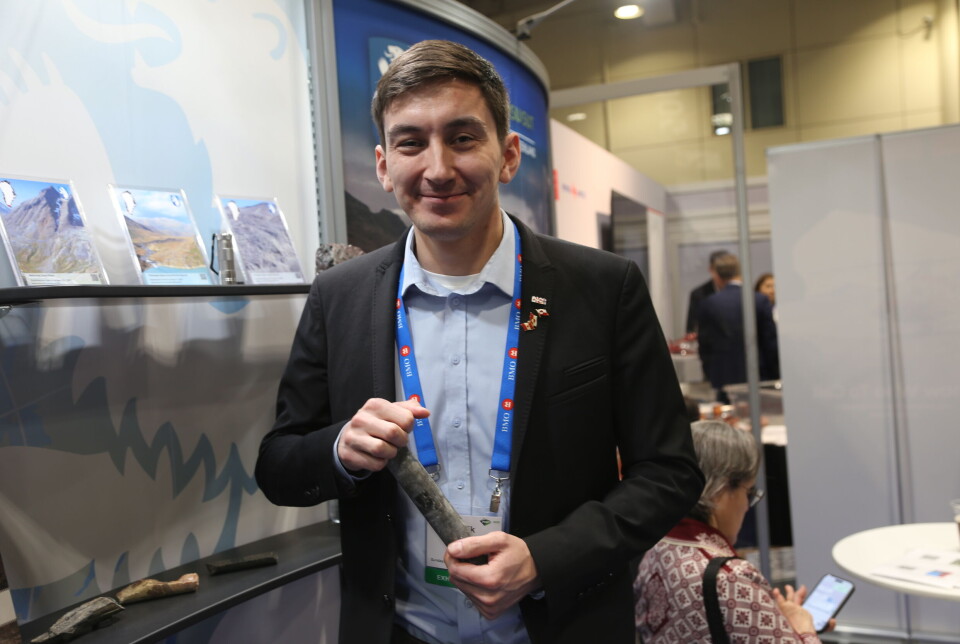
Here, Malik Vahl Rasmussen sits in his office at the construction company 60° North Greenland, which in the spring sold 70 percent of its shares to the Australian-American raw materials company Critical Metals Corp.
A trade that Malik Vahl Rasmussen, who remains the managing director of 60° North Greenland, has highlighted as a path to further growth for the contracting company, to strengthen the local community in South Greenland – and as an important step towards making the raw materials sector a fourth leg of the Greenlandic economy.
– Many of the raw materials projects we have seen in the past may have lacked customers or lacked the financial basis. But on this project we can feel that it is different. There are also some completely different geopolitical forces at play. That is why we have also chosen to focus so intensively on this project alone, Malik Vahl Rasmussen told when Sermitsiaq called him back in September.
At the time, activity was in full swing at Killavaat Alannguat, where a labor camp had been set up. Here, Critical Metals Corp had employed 60 men – everything from geologists to nurses – to work on the mining project together with around 130 employees from 60° North Greenland.
When Sermitsiaq talks to the contractor company director, he says that 60° North Greenland has gone from having 48 employees earlier in the year to 169 employees in September.
A future for the mining sector
Malik Vahl Rasmussen believes in a future for the mining sector in Greenland. If you ask what effect he imagines that mining projects such as the Tanbreez project can have on society, the arm movements are not small either.
– This project has both great support from NATO and the EU, and it can help raise the standard of living but also the level of education among the locals, he says.
– In addition, you have to remember that the value that the mining sector creates for us is not just tax revenue. After all, it is also people who get paid, and employees in the mines who have to go down and shop in Brugseni, buy a membership in the fitness club or invest in a new car, says Malik Vahl Rasmussen.
Many mining projects around the world cause a lot of pollution, and mining projects like the one at Killavaat Alannguat are going to be visible in the landscape. Is it something that you look at with annoyance or destruction of nature just a sacrifice that you have to make if you want to get mining going in Greenland?
– The area in there has been so hidden, for me at least, that it has no influence on the everyday life we live, replies Malik Vahl Rasmussen.
– The environmental consequences that have been mentioned, much of it is not factually correct. PR and communication are therefore also something that the mining company should have a greater focus on, in order to shut down some of the rumors that are spread very quickly.
– By involving as many locals as possible, I hope that this project can become a socially accepted project, he says.
Can you understand that some people may be worried about a larger mining sector – for example, if you are used to hiking and using nature?
– Of course I can. I have also spoken to many fishermen, but as such it will not have any effect on the stock, he says.
– And some of those I have spoken to can also see that there is a level down here in South Greenland that needs to be raised.
Mine is ok – if they do not destroy nature
Back on the terrace in Narsaq, there are not many positive notes to trace when the talk falls on the Tanbreez project. Both because Killavaat Alannguat is not that far from the Kuannersuit mountain – but also because Oleeraq Nielsen is not thrilled that it is a foreign mining company behind the project.
– We do not think positively of people who sell our companies to foreign mining companies, Oleeraq Nielsen says dryly.
After all, things have gone downhill for Narsaq for a long time. More and more people have moved from here, and there is no longer as much business activity as there once was. Won’t mining projects in general in South Greenland be able to create some more life and some more momentum for the region?
– We already have a gold mine a little further south at Nanortalik, but that has not affected the financial situation at all. So more is needed to convince us who are against mining, replies Oleeraq Nielsen.
If it was up to him, more was done to invest in the other natural resources found in the area. He points to a few plants and areas in the garden where he and his wife are experimenting with growing some crops and vegetables. Including potatoes.
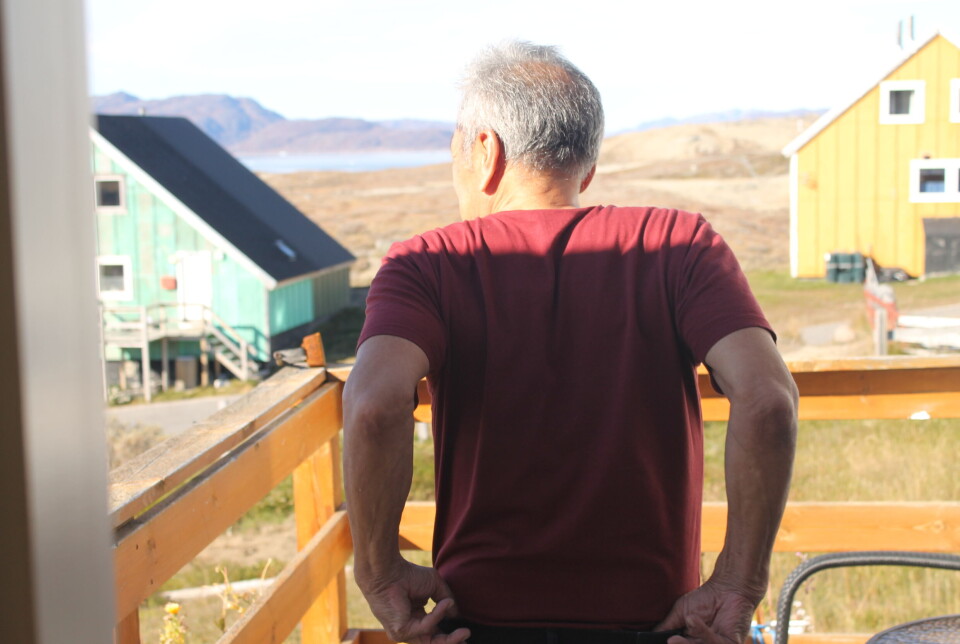
– We are South Greenland’s food chamber – people often forget that. The majority of the Greenlandic potatoes that are eaten here come over from the other side of Kuannersuit, he says.
Although Oleeraq Nielsen would prefer to see a world without mining, he has also recognized that this is the way the development in the world is moving. That is why he answers ‘no’ when asked if he thinks it is wrong to bet on mining in Greenland.
– We cannot avoid mining. Although we are against mines, we must recognize that there is something in the world that we cannot do without for our future. I don’t believe we can keep the earth as it is. We have to destroy it a little to make it more beautiful, he says.
What does that mean?
– If we can find a way to do it properly without destroying nature and the surroundings, then yes I to talk to anyway. Because we need the underground.