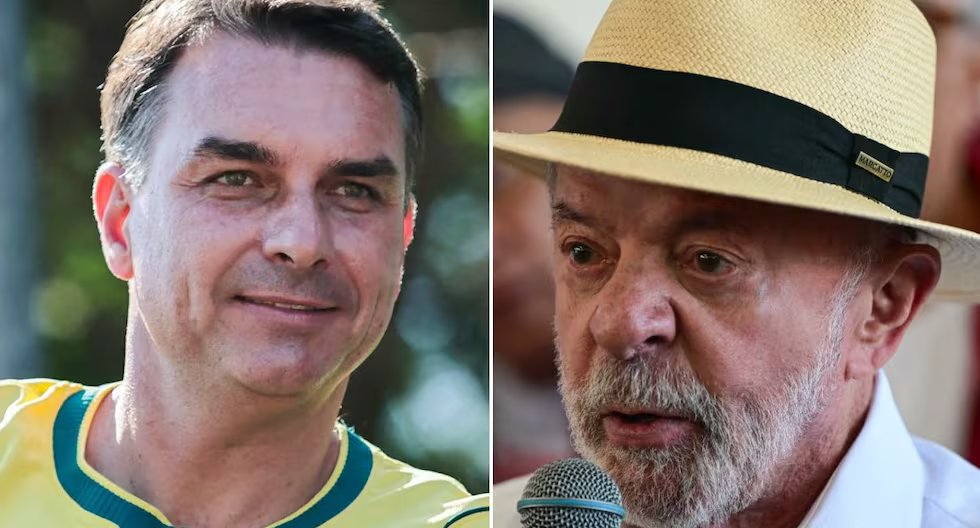
With 100% of tables scrutinized, the senator Flavio Bolsonaroson of the former president Jair Bolsonaroobtained the 47.03% of the votes, almost two points more than the president Lula (45.16%).
Bolsonaro not only surpassed Lula in percentage, but his 56.1 million votes are above the 49 million that his father obtained in the 2018 elections and the 51 million in 2022.

Flávio Bolsonaro holds a photograph of his father, former president Jair Bolsonaro, during a caravan with supporters in Goiânia, Brazil, on September 27, 2026. (Photo by Sergio Lima / AFP).
/ SERGIO LIMA
To win in the second round, the main source of new votes for Bolsonaro are the minor right-wing candidatesthat They concentrated around 8% of the preferences.
Since they all have conservative positions, the candidate of the Liberal Party He has room to negotiate his support and consolidate the anti-Lula or anti-Workers’ Party (PT) vote.

The result of the presidential elections in Brazil. (EFE).
While Lula It has less room to gain support from defeated candidates. So, your strategy should go through mobilize abstentionists, 21% of the registry, and capture white and null votes.
Abstention, transfers and null votes: the three keys to the runoff

The president of Brazil and candidate for reelection for the Workers’ Party (PT), Luiz Inácio Lula da Silva, addresses his followers after knowing the results of the first round. (Photo by NELSON ALMEIDA / AFP).
/ NELSON ALMEIDA
For Francesco Tuccidirector of the Communication and Journalism Career at the Peruvian University of Applied Sciences (UPC), the advantage of two points of Flavio Bolsonaro It is too narrow to consider that the choice is defined.
The international analyst maintains that the final result will depend mainly on three variables: the ability of candidates to mobilize abstentionists, to capture the votes of those who were left out of the race, and to prevent part of the electorate from opting for the white or null vote.
Tucci considers It is especially important to focus on the more than 33 million voters who did not go to the polls.. ““The candidate who knows how to activate the abstention vote will have an important advantage.”he indicates.
It specifies that it is not possible to assume that those who did not vote in the first round are necessarily voters opposed to Lula or favorable to Bolsonaro. Rather, it states that A part of that electorate may be expressing its rejection of the country’s strong political polarization.without fully identifying with either of the two options.
Bolsonaro and the right-wing vote

The right-wing senator and presidential candidate of the Liberal Party (PL), Flavio Bolsonaro, and his wife, Fernanda Bolsonaro, make the victory sign. (Photo by MAURO PIMENTEL / AFP).
/ MAURO PIMENTEL
Regarding the transfer of votes from the eliminated candidates, Tucci highlights that these will not necessarily automatically go to Bolsonaro.
He points out that so far only one of these candidates has clearly expressed his intention to mobilize his voters against Lula: Romeu Zemafrom the New Party. Others have chosen to maintain a neutral position, so Bolsonaro will have to negotiate and convince those sectors.
For the analyst, one must also consider the Existing fragmentation within the Brazilian right itselfbetween conservative and extreme right sectors. Therefore, he believes that the advantage obtained by Bolsonaro in the first round constitutes a favorable starting point, but not a guarantee of automatic transfer of votes.
The ambassador Juan Alvarez Vita indicates that Flávio Bolsonaro starts with an advantage that, although narrow, could give him a favorable position, because in the current situation two points are difficult to reverse.
He agrees that the voters of the other candidates They do not necessarily have their automatic support defined for the second round.
Lula’s bet, mobilizing his bastion

Supporters of Lula da Silva react after the first results of the presidential elections in Brazil, on October 4, 2026. (Photo by Luis ROBAYO / AFP).
/ LUIS ROBAYO
For Lulaone of the main tasks will be to recover participation in regions where historically the P.T. It has an important electoral base, especially in the northeast, Tucci says.
The analyst maintains that there is room to mobilize voters who traditionally support the PT and that they did not come to vote in the first round. At the same time, the leftist candidate “He will have to try to attract centrist sectors and voters from moderate parties that were left out of the second round.”
Tucci believes that intense mobilization in the northeast, combined with a significant capture of the moderate vote, could change the scenario for October 25.
With these variables on the table, Tucci avoids anticipating a winner.
“Much will also depend on the fragmentation of support for Lula. If abstention remains high and Bolsonaro does not achieve a significant transfer of the votes of the eliminated candidates, its initial advantage could be reduced. On the contrary, a strong mobilization of Lula in the northeast and the incorporation of centrist voters could modify the relationship of forces. “It is an extremely complex vote and difficult to predict,” summarizes Tucci.
Álvarez Vita maintains that Lula’s main margin of growth is in the 21% of the electorate that did not go to votein addition to those who opted for the white or null vote. But he warns that mobilizing that sector will be difficult.
The ambassador also identifies the increase in the cost of living as one of Lula’s main weaknesses facing the runoff. According to his reading, the economic deterioration can influence those voters who have not yet decided on their vote and become a factor that favors the opposition.
He also senses that precisely in that pocket of abstentionists There could be a good percentage of people who are dissatisfied with the economic situation, but who do not feel represented by an option like that of Flavio Bolsonaro.
Lula and the debates

The president of Brazil and candidate for reelection for the Workers’ Party (PT), Luiz Inácio Lula da Silva, addresses his followers after knowing the partial results of the presidential elections. (Photo by NELSON ALMEIDA / AFP).
/ NELSON ALMEIDA
Tucci indicates that Lula’s absence in the first round debates could have responded to a strategy to preserve his electorate already consolidated.
According to the analyst, participating in a debate does not necessarily benefit a candidate: an action considered negative can generate more costs than the decision not to expose oneself. He maintains that the campaign would have chosen to avoid exposure that could put at risk the support it already had.
However, facing the runoff the dynamic will be different. With only two candidates in the race, any public exposure will have greater weight and both will have to compete for a smaller and, at the same time, more decisive electorate, he points out.
Álvarez Vita considers that the result of the first round could have taken by surprise Lula and that, from now on, The president will have to take a much more active role in the campaignincluding their participation in the debates.
It indicates that Lula would have faced the first round with excess confidence, considering that victory was assured. Now, the result should force him to modify his strategy.