The political playground in Suriname has been the setting for a fascinating phenomenon for decades: acute and highly selective amnesia – memory loss. As soon as politicians take a seat on the green plush chairs, the memories of their own coalition agreements, signed resolutions and promises seem to disappear like snow in the sun. There is even an outbreak at the moment, against which no vaccine is yet available.
Text Armand Snijders
Image DNA
The political short-term memory in Paramaribo is as leaky as a basket, but the fingers being pointed at others are sharper than ever. It is a spectacle in which almost everyone has a problem, but refuses to look in the mirror. The recent debates in parliament and beyond provided yet another painful demonstration of this collective hypocrisy.
“When the coalition is cracked, former allies suddenly transform into pious moralists shocked by the other’s corruption“
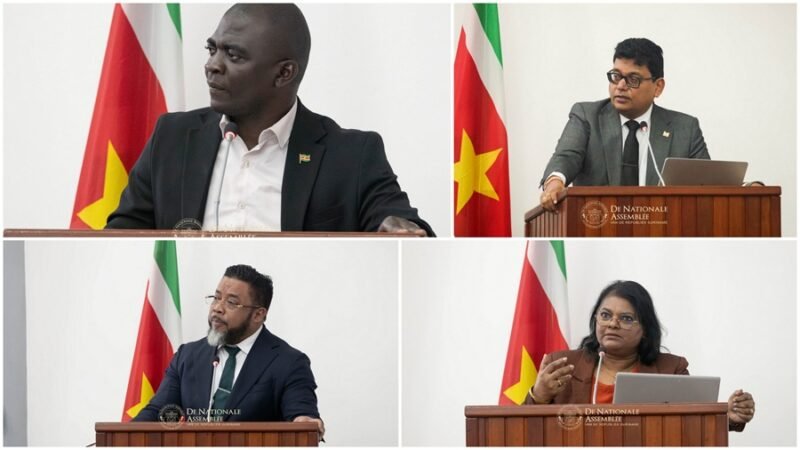
Now take the fierce outbursts of Abop parliamentarian Edgar Sampie towards the VHP. With much chest beating he ‘revealed’ that then President Chandrikapersad Santokhi had forced ministers to award contracts for police vehicles to his friends. Refusal simply meant that funds were frozen. The result? A chronic shortage of decent rolling stock for the Suriname Police Force and a fleet of defective, second- and third-hand vehicles.
The irony
The accusation is serious, but the irony is even greater. Sampie paints the picture as if his party, Abop, was a band of innocent spectators at the time, watching powerlessly from the sidelines. He conveniently forgets that Abop controlled almost half of the government at the time, including the vice president (Ronnie Brunswijk, Abop chairman) who chaired the government council every week. Party member Kenneth Amoksi was even the Minister of Justice and Police for five years at the time.
If there was actually blackmail with state resources and corrupt car deals at the expense of national security, why was there an eerie silence on the part of the yellow-black party? Why weren’t these abuses shouted from the rooftops into society at the time? The answer is as simple as it is cynical: at the time, silence served to preserve their own positions of power and peace within the coalition. Now that the electoral cards are different, the old laundry is suddenly put out to score political points.
Duty of Gajadeen
Naturally, the VHP did not go unpunished and responded in kind. Faction leader Asiskumar Gajadien challenged Sampie to provide evidence, but could not resist immediately throwing back a rhetorical grenade by hinting at the alleged financing of Abop by drug barons. If Gajadien is so sure about that, why doesn’t he put the evidence on the table?
In the mofo koranti It has been said for years that parties from all sides receive drug money to develop their activities and campaign. Not only Abop, but also other parties, including the VHP. Isn’t it Gajadien’s duty – especially as a representative – to report this to the judicial authorities? Why doesn’t he do that? Let him explain this if he really has the best interests of the country at heart.
It is classic Surinamese mudslinging: you accuse me of cronyism and theft, then I accuse your supporters of serious crime. And so the level of parliamentary debate remains stuck at the stage of an ordinary slum dispute, with the country’s real problems – such as the dire lack of security and resources for the police – disappearing into the background.
‘Rice tampering’
As if this display wasn’t sad enough, Pertjajah Luhur faction leader Bronto Somohardjo went even further. After the recent one seizure of hundreds of tons of disputed rice in Nieuw-NickerieSomohardjo casually claimed that the VHP has been repeatedly sponsored in the past to allow illegal rice shipments to pass through. He even mentioned names of famous rice traders.
Here too the same selective amnesia. After all, Pertjajah Luhur is a party that has governed, flirted and collaborated with the VHP in almost every conceivable constellation. However, Pertjajah Luhur’s political loyalty changes more often than the Surinamese course in times of crisis. Why is he only now raising this issue and not doing so during the previous government, when he was still a minister and undoubtedly also knew about the ‘rice tampering’.
In-depth research
The recent, theatrical outrage of VHP parliamentarian Krishnakoemarie Mathoera about the illegally staying Mennonites definitely also belongs in this list. She loudly demanded an in-depth investigation into ‘the organization’ behind their arrival. However, it was a fiery speech that rattled on all sides. She looks away from her own role as then Minister of Defense.
After all, the Mennonites didn’t sneak in through the back door in 2022. The red carpet was rolled out at the time by her own party colleague and colleague, Albert Ramdin of Foreign Affairs. Mathoera himself was sitting at the meeting table of the Council of Ministers when this pilot project was finalized. The fact that she now plays the murdered innocence and advocates a search for the guilty borders on political satire.
Anyone who demands a thorough investigation into the failing admissions policy of the time is in fact demanding an investigation into themselves. Now that the first groups have actually been deported, Mathoera is trying to put the blame elsewhere. But anyone who calls so loudly for accountability from ‘the organization’ could simply start by looking in the mirror of the coalition at the time.
“And so the level of parliamentary debate remains stuck at the stage of an ordinary slum dispute, with the country’s real problems disappearing into the background“
Shortcomings in administrative system
The behavior of the politicians exposes the shortcomings in the administrative system. Policy in Suriname is rarely a matter of continuity or national interest; it is an opportunistic chess game. As long as they are in government together, they share the sheets and the loot. There is a collective disregard for dubious awards, imports and appointments. Only when the coalition has cracked do former allies suddenly transform into devout moralists who are shocked by the other’s corruption.
NDP faction leader Rabin Parmessar rightly noted that Surinamese society will be deeply ashamed when watching the parliamentary displays. While the population struggles with daily inflation, the rising cost of living and the deterioration of public services, the people’s representatives engage in a destructive game of mutual blackmail.