Paris/The leader of the French radical left, Jean-Luc Mélenchon, accused of instigating the violent drift in the social protests this Saturday, distanced himself from the looting and looting that multiplied throughout the country.
With a message on his
“In Paris, the aberrant command has opened the door to chaos,” said Mélenchon, before pointing out that although he doubts that his voice will be understood in the current circumstances, his message “is clear: those who share our struggle have nothing to do with looting or acts of vandalism.”
“No matter how many the responsibilities of power are, no matter how much incompetence and violence it exercises,” he added, “we must refuse to participate in actions that lack political sense and are contrary to our methods.”
The Prime Minister, Sébastien Lecornu, also responded to him in X, reproaching him that accusing the police of being responsible for the violence “is a dangerous and cynical reversal of responsibilities.” For Lecornu, if what he is asking those who are ideologically with him is not to participate in the looting, he would have to start by specifying who the authors of the looting are. “You cannot ask for violence to stop and at the same time give excuses to the perpetrators,” he concluded.
From the extreme right, its leader and also candidate for the 2027 presidential election (favorite in the polls), Marine Le Pen, denounced that “legitimate social demands have once again been taken hostage by the extreme left and the speeches of Jean-Luc Mélenchon who, by legitimizing violence, by considering order as oppression and disorder as a right, seek to plunge the country into chaos.”
“By legitimizing violence, by considering order as oppression and disorder as a right, they seek to plunge the country into chaos”
The damage caused by the looting and vandalization of stores during the social protests organized this Saturday in France will be estimated at “hundreds of millions of euros,” said Alexandre Bompard, CEO of Carrefour and president of the Federation of Commerce and Distribution (FCD), this Sunday. He explained that in his chain there were fifty stores affected by acts of violence by some of the protesters and that twenty were “looted and vandalized,” while in total the number of stores attacked was 1,500.
In a country notorious for the unleashing of violence in the protests, but also for the massive participation – 550,000 protesters, according to the Government and more than 800,000, according to the organizers –, one of the controversies that are emerging is about the lack of protection of businesses and public buildings that were attacked.
From the Executive, the line of defense is that the forces of order had set as a priority that there were no personal victims in possible confrontations. The question is whether this was done to the detriment of protection measures for public buildings and businesses, and whether the security device was sufficiently sized for the mobilization that occurred.
The police and gendarmes carried out 1,800 arrests, according to a still provisional figure released this morning by the Minister of the Interior.
The police and gendarmes carried out 1,800 arrests, according to a still provisional figure released this morning by the Minister of the Interior
In Lyon, a total of 160 people were arrested during the day of protests this Saturday, according to the prefect of the department, Étienne Guyot, who stressed that law enforcement prioritized “protecting lives so that there were no victims” over businesses. “We had deployed a large security device, but we had a demonstration with an unprecedented level of violence,” Guyot defended himself before the media today.
In a press conference on the street with the mayor of what is the third city in France, the environmentalist Grégory Doucet, the Government delegate, emphasized that “the police were there as much as possible everywhere” and that they had the means, but that they cannot “put a police officer in every store.”
Doucet explained that on the tour he took this morning he was able to see “the chaos in the city” and was pleased that law enforcement had given priority to the protection of people and that the day ended without any serious injuries. The environmentalist mayor did not want to go directly into the question of whether the security device was sufficiently sized: “the prefect has to answer that.”
During the day of riots recorded on Saturday, one person died, according to the Paris Prefecture reported this Sunday. “A person has died after a cardiorespiratory arrest,” reported the Government delegation, without further details, at the end of a long report on the detainees and damages from the day before.
“A person has died after cardiorespiratory arrest,” reported the Government delegation.
The French Prime Minister, Sébastien Lecornu, affirmed that behind the violence into which some of the social protests this Saturday degenerated there is a political maneuver, and announced that 1,200 people had already been arrested on a day in which 150 police and gendarmes were injured.
In an appearance before the press shortly before midnight on Saturday during an outing to express his support for the forces of order, Lecornu indicated that his Minister of Justice, Gerald Darmanin, has instructed prosecutors to request provisional detention for those detained.
He justified these instructions because those arrested presented “particularly violent and dangerous profiles.” “You cannot allow a minority to destroy and always be the same ones who pay,” he added after having emphasized that in Paris there had been attempts to attack “the centers of power” such as the Elysee palace, Matignon, which is the official residence of the prime minister, or the National Assembly.
“Therefore it is clearly a political maneuver that accepts violence,” he added before stressing that “we will not allow ourselves to be intimidated.”
The mayors of Paris, Marseille and Lyon, three of the cities most affected by the destruction and looting, have requested a meeting with Lecornu early next week, “given the magnitude of the damage and the seriousness of the situation” related to the violence, vandalism and looting that occurred in their cities on Saturday.
“Therefore it is clearly a political maneuver that accepts violence,” he added before stressing that “we will not allow ourselves to be intimidated.”
“We demand a precise diagnosis that explains the chain of events that led to this situation. This cannot and must not happen again,” wrote socialist Emmanuel Grégoire (Paris), left-wing independent Benoît Payan (Marseille) and environmentalist Grégory Doucet (Lyon) in a joint statement. The three elected officials affirmed that they include all the mayors of the affected municipalities in their initiative.
The demonstrations that took place throughout the country with a long list of demands and called by a varied conglomerate of groups, starting with students, but also members of the “yellow vests” or public service employees, gathered 550,000 people, according to the Government and up to more than 800,000, according to the organizers.
A massive attendance (there were 110,000 in Paris alone, according to the Ministry of the Interior), which greatly exceeded the expectations of the Executive, which on the eve of this day had indicated that there would be at most 150,000 throughout the country.
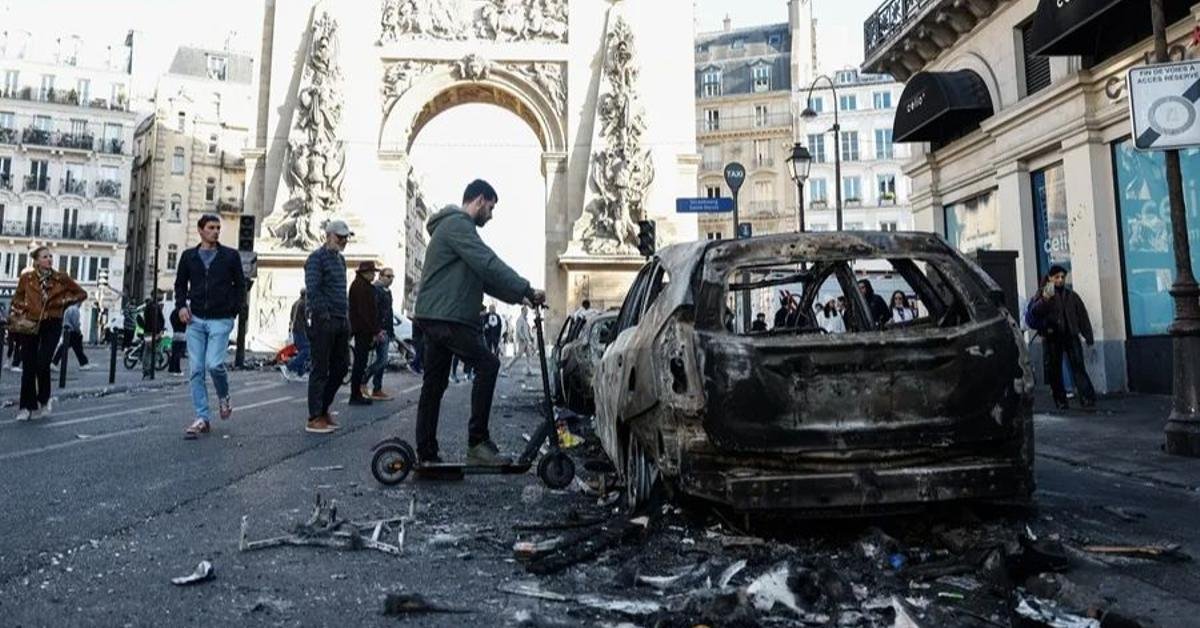
Another relative surprise was the level and breadth of violence in many cities, with attacks on public buildings (most notably the destruction by fire of the historic Limoges Town Hall building) and looting of hundreds of businesses.
The Limoges City Hall “is practically destroyed”, declared the prefect of Haute-Vienne
The riots left several shocking images, including the Limoges City Hall in flames, but it was not the only town hall attacked, since those in Marseille and Lille also suffered damage when groups of protesters broke into its interior after forcing the doors. The Limoges Town Hall “is practically destroyed”, declared the prefect of Haute-Vienne, Maurice Barate.
A tourist office located in the center of Lyon and the façade of a university building in Rouen were also burned, while the residence of the prefect (government delegate) of Bordeaux was attacked.
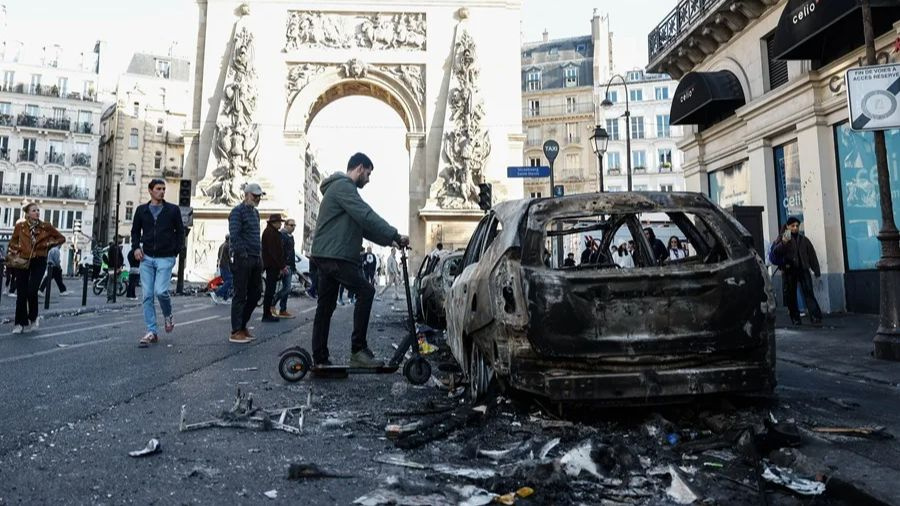
The fire was also very present in Paris, where uncontrolled groups lit the fuse that also burned businesses, while others were looted in several neighborhoods. There are “entire streets” that have been “systematically devastated,” denounced the mayor of the French capital, the socialist Emmanuel Grégoire, who estimated that the toll of the violence and looting committed will be “serious”, “of immense magnitude”, with “damage to public spaces and monuments vandalized and destroyed.”
The looting of businesses and the vandalization of establishments were especially important in the capital, even in the department store district, but the phenomenon was repeated in several cities.
The Minister of the Interior, Laurent Nuñez, pointed to “several thousand rioters”, between ultra-left groups and “opportunist criminals” as the authors of these attacks.
The Minister of the Interior, Laurent Nuñez, pointed to “several thousand rioters”, including ultra-left groups and “opportunist criminals” as the perpetrators of these attacks.
The French president, Emmanuel Macron, in a more institutional tone focused on underlining the message that in France there is “no place for violence” and that there will be punishment for the perpetrators of destruction and looting.
Macron, who has six agonizing months left in power, and who was also the subject of much criticism in the parades by protesters for his policies in the ten years of his mandate, also wanted to warn that there will be “a united front against those who sow chaos, who only seek to tear down our institutions and prevent those who peacefully express their demands from doing so.”