By Marlon Bute
The facts ought to come first.
On Nov. 27, 2025, the New Democratic Party won the general election in St. Vincent and the Grenadines in emphatic fashion, taking 14 of the 15 seats in Parliament and bringing to an end almost a quarter century of Unity Labour Party rule. It was not merely a defeat. It was a trouncing, an inglorious beating. The NDP did in one election what the ULP could not do in five. It secured an historic 14 seats and won the popular mandate by more than 10,000 votes.
Then came the petitions.
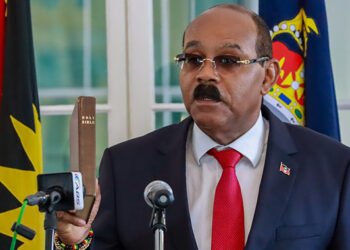
On Dec. 18, 2025, two defeated ULP candidates, Carlos Williams and Luke Browne, filed election petitions challenging the election of the new prime minister, Dr Godwin Friday, who is also minister of finance, legal affairs and justice, economic planning, and private sector development, and Dwight Fitzgerald Bramble, minister of foreign affairs, foreign trade, foreign investment, and diaspora affairs. In Williams’ case, the political folly is especially plain. He secured only 339 votes against Friday’s 2,183, and yet now seeks through the court what he was nowhere near securing at the polls.

In Browne’s case, the folly is no less apparent. This was his fourth outing and his fourth flogging, having now been rejected in four consecutive elections. And conversely, the two men whose elections are being challenged are the prime minister and the minister of foreign affairs, foreign trade, foreign investment, and diaspora affairs, two offices of the highest importance and in whom the people have plainly vested their confidence.
That is the context in which the present controversy must be understood.
My position on this is straightforward.
If a government has the constitutional power to act, and it deems it necessary to use it, then it should use it, especially since it considers, as it ought to consider, that it is a good thing to do in the interest of the country.
And frankly, the fact that the matter is before the court does not suspend the power or supremacy of the Constitution, nor does it suspend the intent of the vote to vest power in an administration with the elected right to govern. Parliament makes the laws which the courts themselves must interpret. That is how the system works.
The Constitution is the supreme law of the land, and Parliament is the only law-making body of the land and the supreme body in that regard. The people have vested in the NDP administration an overwhelming majority so that it may make such changes as it sees fit. Surely, the people, in their own judgment, elected the NDP with that majority with full knowledge of that fact, and with the confidence, as reflected by the vote, that it would act accordingly.
So, I see nothing wrong at all, once the requirements that have to be met are met, and given the context of the time we live in and the period that preceded these times.
On the matter of fighting politically, Ralph Gonsalves has no real force in this regard. The people saw to that in 2025.
And as a literary person, I find it rather poetic that, in the way he used the law to pursue a matter against two elected representatives, one now prime minister and one now minister of foreign affairs, one a longstanding parliamentarian of over 20 years and one now in his second term, to try to cut short their service on the grounds that they have Canadian citizenship and have sworn to a foreign power, the same Constitution is now being used by the government, which includes those two parliamentarians, to clarify that matter.
Indeed, this is an interesting time for students of history, of law, of literature, and indeed of life. It is also a veritable walk to maturity for our nation.
And I would mark this moment, because the government should use the power that it has now demonstrated that it knows it has, and is willing to use, to also consider and undertake other constitutional reforms to strengthen the rights of the people. That same acknowledgement of the power it has should permit it to do what is necessary, in all respects, to fulfil the mandate handed to it by the people.
What also follows from that, in my view, is that the same recognition by the NDP that it possesses this massive power, namely the majority required to address constitutional matters in a wholesome way, ought also to be a recognition that it has the overwhelming authority to remove any hindrance in the public service that stalls or frustrates its mandate as given by its true employers, the people of St. Vincent and the Grenadines.
That is of special interest to me.
For I wish to see, as I believe the government’s own policies, programmes and general direction suggest, that opportunities, and particularly the resources of the state, be realigned, refocused and redistributed, as it were, so that all and sundry who wish to access those opportunities and those resources in a fair and equitable way may do so, and thereby enhance their own material position.
And I say all of this because I am acutely aware, as are many Vincentians, that the main positions in the public service, which were occupied, and which continue to be occupied, under a previous political mandate, ought properly to be addressed so that they reflect the current political mandate. For where one political order has been defeated at the polls, but its residue remains entrenched in the upper reaches of the public service, there is always the possibility that the pace, direction and effectiveness of the people’s mandate may be slowed, frustrated or quietly resisted.
The government, therefore, ought not to be complacent. A man who held power for so long does not leave the stage without traces. He leaves behind alignments, habits, loyalties, reflexes and persons still situated in places from which obstruction may be carried out without noise. That, too, is part of politics, and it ought to be understood as such.
And there is another thing.
Gonsalves now speaks as though legal amendment is somehow improper when used by another administration. But the record shows that when private criminal proceedings were brought against him and later against figures on his own side, he publicly called for the law to be changed, and his government then amended the Criminal Procedure Code to require the permission of the DPP before private criminal complaints could proceed. Many would draw their own conclusion from that sequence, and mine is that the law was altered in a way that served his political protection.
That is not the record of a man allergic to legal intervention. It is the record of a man quite prepared to use law as an instrument of governance when it suited his purposes.
That is why some of the noise now rings hollow.
As I have written elsewhere, the Gonsalves years were years in which power was acquired, exercised, defended and normalised. For a long time, that power came to appear almost permanent. But permanence in politics is always an illusion, and in 2025 the people shattered that illusion decisively. So when he now speaks in tones of alarm because another government is using lawful authority through Parliament and the Constitution, one is entitled to see in that not principle, but discomfort at no longer being the one who commands the instruments of state.
They have the most powerful government in a quarter of a century. The only period in recent political history when a government was as powerful was in 1989, when the people gave the NDP all 15 seats, after having given them 12 seats in 1984.
And who knows, perhaps by 2030 or thereabouts we will see whether that feat can be repeated; whether the NDP, having secured 14 seats in 2025, may go on to take all 15.
Power given by the people through the Constitution and through Parliament is not meant to sit idly by. It is meant to be used lawfully, responsibly, and decisively for what the Government considers to be the good of the country.
And that is precisely what the NDP government is doing.
That is my take.
The opinions presented in this content belong to the author and may not necessarily reflect the perspectives or editorial stance of iWitness News. Opinion pieces can be submitted to [email protected].