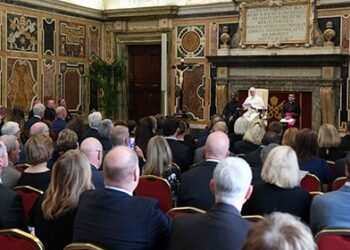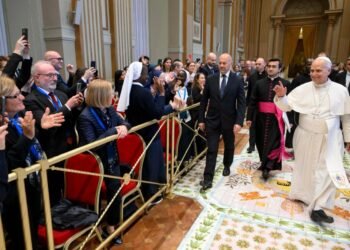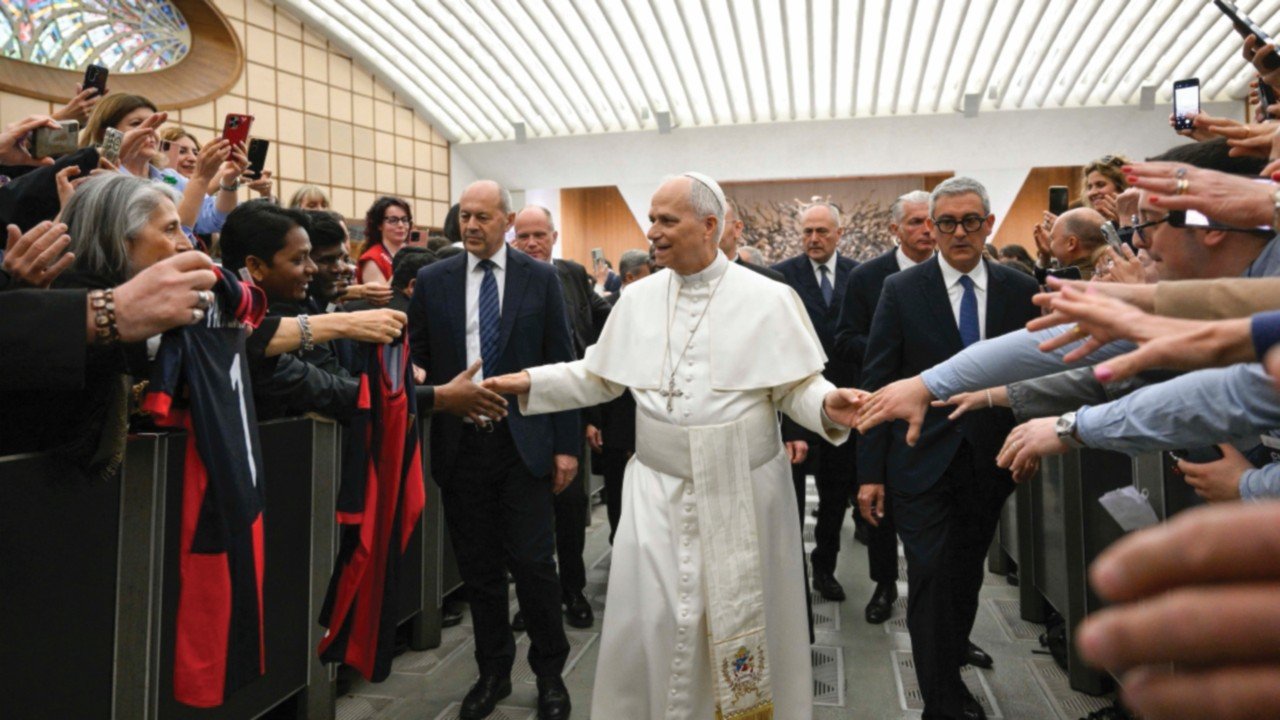
The teaching of the Catholic religion “is like a springboard from which children and young people can learn to dive into the fascinating adventure of internal dialogue, and in this it constitutes an indispensable element of that educational alliance which is so badly needed today”. Leo XIV underlined this to approximately seven thousand participants in the third national meeting of teachers of the Catholic religion, received this morning, Saturday 25 April. The audience with the Pontiff sealed the work of the conference promoted by the Italian Episcopal Conference and held in Rome on 23 and 24 April on the theme “The heart speaks to the heart”, inspired by the motto of Saint John Henry Newman, Doctor of the Church and co-patron of the educational world. Below is the speech given by the Pope in the Paul VI Hall.
In the name of the Father,
of the Son and of the Holy Spirit.
Peace be with you!
Dear brother Bishops,
Dear brothers and sisters,
good morning and welcome!
I greet you with affection and thank you for your presence and for your precious service that you carry out in the school. Your work is demanding, often silent and inconspicuous, and nevertheless very important for the growth of many children, teenagers and young people. The religious dimension, in fact, “is a constitutive element of human experience and cannot be marginalized in the educational process of the new generations” (CEI, Past Note. The teaching of the Catholic religion: a laboratory of culture and dialogue11 December 2025).
Saint Augustine wrote: «Man, a particle of your creation, wants to praise you (or God). It is you who stimulate him to delight in your praises, because you have made us for yourself, and our heart does not rest until it rests in you (…). May I seek you, Lord, invoking you, and invoke you in believing you” (Confessions1. 1). He spoke of an interior search to which the great questions of life, the relationship with God, with creation and with others have always been linked in the human being, so the thirst for the infinite, inherent in each person, can become energy to promote peace, to renew society and to bridge its contradictions.
In this context, your service, an expression of the Church’s care for the new generations, is like a springboard from which children and young people can learn to dive into the fascinating adventure of internal dialogue, and in this it constitutes an indispensable element of that educational alliance which is so badly needed today.
Not only that. The teaching of the Catholic religion is a discipline of great cultural value, useful for understanding historical and social dynamics, as well as the expressions of thought, ingenuity and arts that have shaped and continue to shape the face of Italy, Europe and many countries around the world.
All this enters into your lessons, in the light of the ever-current teaching of the Church, in dialogue with other fields of knowledge and religious research, and above all in the study of the inexhaustible pages of the Bible, from which we know Christ, Son of God made man, revelation of the face of the Father and perfect model of humanity. Thus you make accessible to the new generations, with full respect for everyone’s freedom, what might otherwise remain incomprehensible and vague, showing how true secularism does not exclude the religious fact, but rather knows how to treasure it as an educational resource. This is, moreover, part of a broader attitude, essential for any dialogue, in school as in society: to know and love what one is, to be able to meet others with respect and openness.
In light of this, I would like to share with you some reflections that are close to my heart.
As a title for your third national meeting you have chosen the expression “The heart speaks to the heart” (Cor ad cor loquitur), drawing inspiration from the motto of Saint John Henry Newman, Doctor of the Church and co-patron saint of the educational world. These words contain the proposal of a path in which truth is the goal and personal relationship is the way to reach it. They commit you, through teaching, to helping children to recognize a voice that actually already resonates within them, not to bury it, nor to confuse it with the noises that surround them. In an era in which we live constantly besieged by stimuli of all kinds, silencing that voice is very easy. Therefore, educating to feel it or to rediscover it is one of the greatest gifts that can be given to the new generations. Man cannot live without authentic truths and meanings, and young people, even if they sometimes seem apathetic, or insensitive, behind a facade of apparent indifference, in reality often hide the restlessness and suffering of those who “feel too much” and too intensely, without being able to give a name to what they experience.
Teaching, therefore, means training people to listen to the heart, and with this to interior freedom and the ability to think critically, according to dynamics in which faith and reason do not ignore each other, much less oppose each other, but are traveling companions in the humble and sincere search for the truth. For this reason, educating requires the patience to sow without expecting immediate results, respecting the person’s growth times. And above all – Newman teaches – it requires love.
Dear ones, the truth passes through people, and for your students you are also such people, called to become credible teachers because you are in love with God and them, to transmit values, without grandstanding or moralism, to offer uplifting views and to be witnesses of that humble and close coherence that makes even the most challenging contents dear and desirable. Your students do not need pre-packaged answers, but closeness and honesty from adults who support them with authority and responsibility as they face the big questions of life. They will remember the eyes and words of those who were able to recognize a unique gift in them, of those who took them seriously, of those who were not afraid to share a stretch of the road with them, showing themselves in turn to be men and women who seek, think, live and believe. All this, of course, without taking anything away from the need for solid competence, animated by a passion for study, cultural rigor and didactic preparation, because the teaching of the Catholic religion also requires updating, planning, use of adequate languages.
Schools today – in Italy, but not only – have dramatic and at the same time exciting challenges ahead of them. For this reason the Church, which walks with you, sends you to it as “servants of the educational world, choreographers of hope, tireless researchers of wisdom, credible creators of expressions of beauty” (Ap. Letter. Drawing new maps of hope11.3).
I thank you and encourage you to persevere in this commitment, while I entrust you to the intercession of the Virgin Mary and the saintly educators. I remember you in prayer and I cordially impart to you the Apostolic Blessing, which I extend to your families, your students and all your loved ones. Thank you!