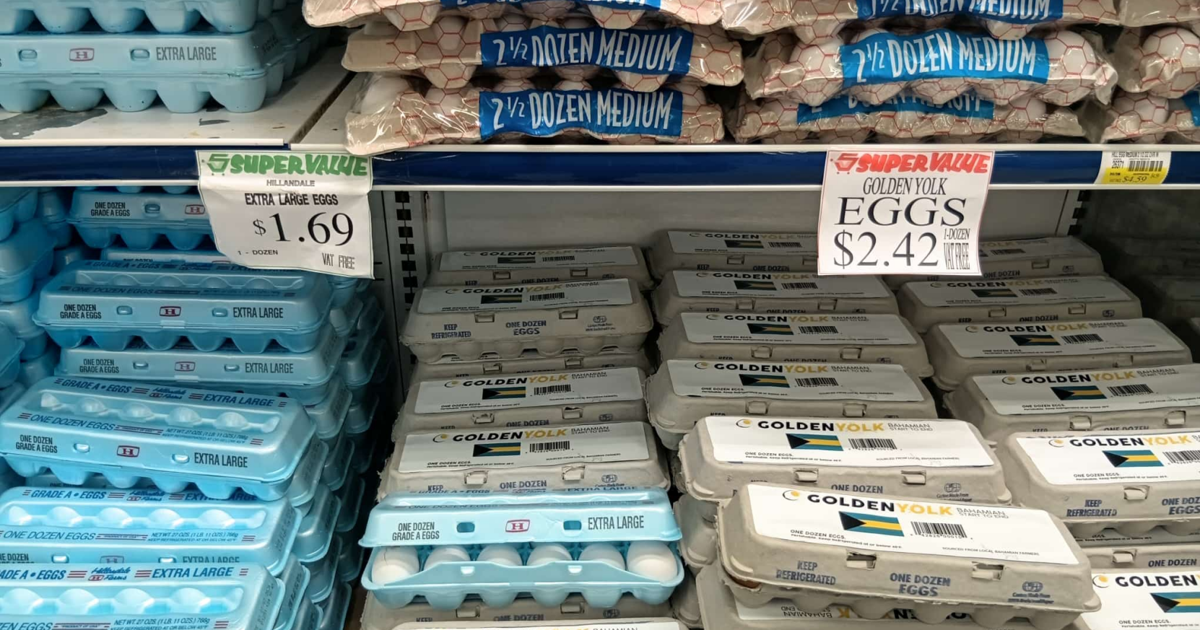
An Abaco-based poultry farmer said locally produced Golden Yolk eggs are facing strong competition from imported eggs from producers like US-based Hillandale Farms.
Lance Pinder, Abaco Big Bird Poultry Farm’s operations manager, told Guardian Business yesterday that as a result of the COVID-19 pandemic, a lot of smaller egg producers emerged due to the larger producers being hit with staff shortages and other production challenges. Now, larger producers like Hillandale are getting back to their pre-pandemic levels of production, he said.
“I don’t even know how Hillandale eggs are being imported and sold at $1.68 compared to local producers. I think a lot of the big producers in the United States missed out, and a lot of people went and bought a couple chickens here, there, and everywhere and started their own egg production, and larger producers are trying to kill that off now. Many people went into the egg business, or got themselves a couple of chickens in the last four or five years, and they [large producers] want them to get out of the business because it’s affecting their bottom lines,” Pinder claimed.
In comparison, locally produced Golden Yolk eggs sell for $2.42 per carton, while Hillandale Grade A large eggs sell for $1.68 per carton.
The Golden Yolk program is a national food security initiative by the Bahamian government designed to achieve 100 percent local egg production. Backed by a multimillion-dollar investment, the project features state-of-the-art poultry houses across New Providence and 12 Family Islands, with the main base at the Gladstone Road Agricultural Center.
Asked whether the Golden Yolk program is sustainable, Pinder said locally produced eggs face additional pressures that imported eggs do not.
“You’ve got to get the right feed if you want to get the right lay rate, and the right amount of eggs… A layer bird is going to eat seven and a half pounds of food a month. So that’s $3 for food to feed that bird a month, and then you’ve got to figure that bird could lay 22 to 24 eggs, so that’s 12 cents or 13 cents an egg before packaging or electricity costs, that’s just feed. So, you can times that by 12, that’s $1.50 right there.”
Pinder continued: “All it takes is an event like bird flu for the price of eggs to skyrocket again.”