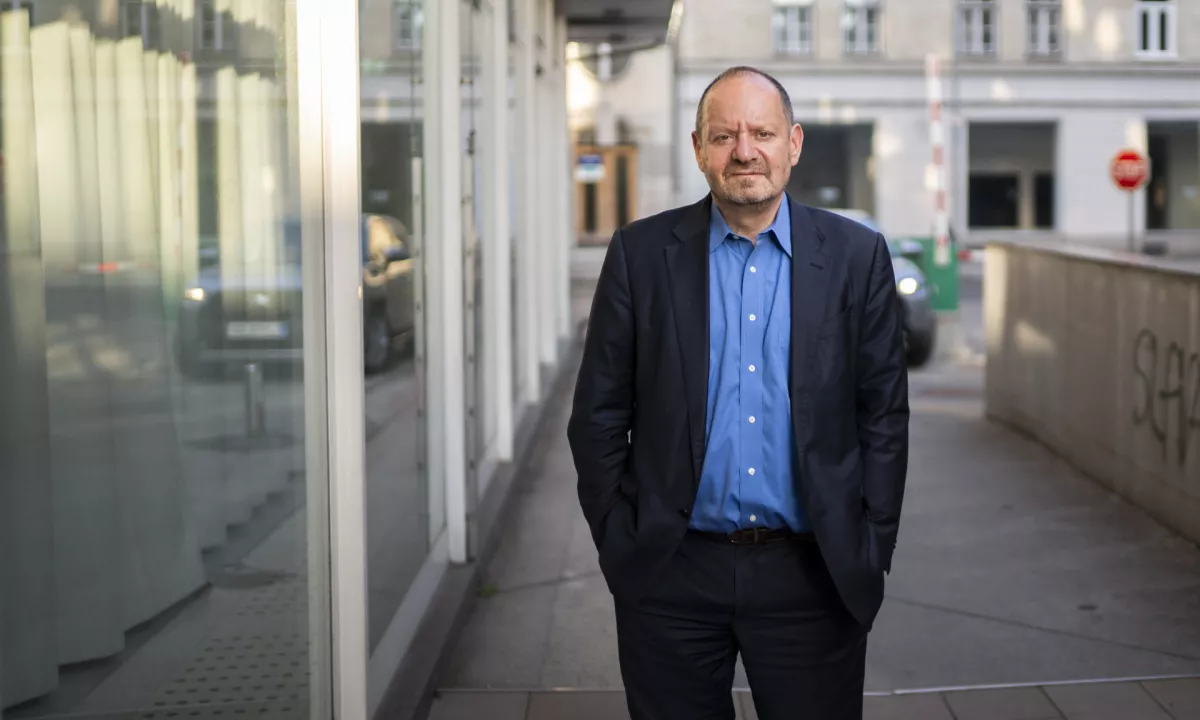
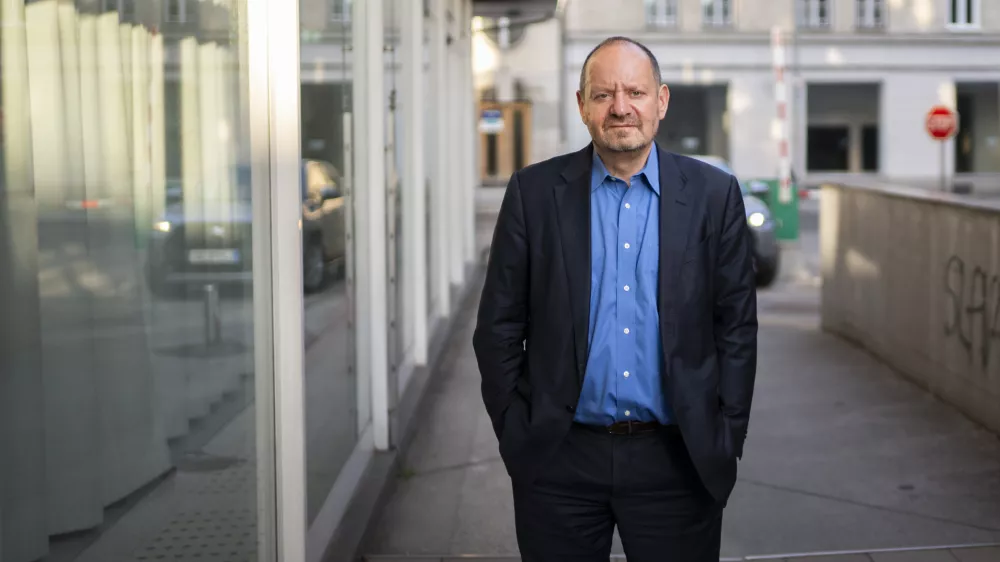
Photo: Nik Erik Neubauer
Philippe Sands, international lawyer: Genocide confirmation is a long-distance race
Philippe Sands is an international lawyer, professor at University College London and one of the most recognizable voices in the field of international criminal law. For decades, he has been dealing with the most difficult issues of the modern world, genocide, crimes against humanity and the responsibility of states and individuals. His work has taken him before the most important international courts, from The Hague to the International Court of Justice, where he participated in cases that marked the legal understanding of mass crimes.
He reached the wider public with a highly resonant literary book East West Street (with us: Return to Lemberg), in which, at the intersection of personal history and legal thought, he unravels the emergence of two key concepts of the 20th century: genocide and crimes against humanity. In the book, the history of his family is intertwined with the destinies of the jurist Hersch Lauterpacht, one of the most important jurists of international law in the 20th century, and Raphael Lemkin, the Polish-Jewish jurist who coined the term genocide, and with the city of Lviv (formerly Lemberg), which becomes a place where identities, empires and ideas intersect.
You got the material for the book when you started researching your family history. Where does your inspiration come from?
I knew my grandfather very well, he died at the end of the nineties when I was 37 years old. But I come from a family where the past wasn’t talked about much; and I think that this is nothing unusual, the same applies to the area of the former Yugoslavia. The past was “swept under the rug”. The turning point came only in 2010, when I was invited to lecture in Lviv, a city on the border between Ukraine and Poland. When I was there, I realized that the city changed its name over the decades and centuries, from Lvov to Lviv and during the German occupation, Lemberg. The latter city is the birthplace of my grandfather. So suddenly, and mostly unknowingly, I found myself in the place where he grew up and started researching it.
Why do you think it is so difficult to talk about the really bitter pasts of individuals or entire families?
I have spent most of my life dealing with cases of international crimes, from the International Court for War Crimes in the former Yugoslavia to the International Court of Justice and others. That is why I am very used to dealing with terrible situations, and I notice that a similar pattern is repeated everywhere in the world: both after the Second World War and in Yugoslavia, Rwanda or Kosovo. I think it comes down to several factors. Survivors are often ashamed of their survival. Those who may have been involved in bad deeds do not want to talk about it for obvious reasons. For many, I believe, it is a protective instinct. They want to protect their children and grandchildren from these terrible stories. Therefore, such silence is not necessarily malicious or negative; sometimes it can even be well-intentioned. In my grandfather’s case, I believe it was precisely this kind of protective silence. For others, the reason may be something completely different. I also wrote two sequels to the book Return to Lemberg; in one of the books, The RatlineI discuss the son of Otto Wächter, a high-ranking Nazi official in Lviv. There, silence is associated with the fact that what happened was “bad” and with an unwillingness to accept that their parents or grandparents did terrible things.
Isn’t it especially difficult for the descendants when they have to discover the truth about the family past, about which they knew nothing, on their own and with a delay, instead of their loved ones telling them when they were still able to do it or when the descendants were mature enough to understand it?
During my research, I met many descendants of various historical figures. Some people want to talk about the past, others don’t. Some read my books and wanted to talk about them, others simply avoided the books and the topic of the past. It is a distinctly personal question. I don’t believe there is a general theory or uniform pattern; it all depends on the family dynamics and the character of the individual. There can be five children in the same family, four do not want to talk about the past, and one does. Such an example is Niklas Frank, the son of Nazi Hans Frank (Nazi official, lawyer and personal legal adviser of Adolf Hitler, who was sentenced to death at the Nuremberg trials after being found guilty of war crimes and crimes against humanity), who talks about his father’s past all the time and researches it, while his four siblings reject the past and are not interested, two of them even committed suicide. So how to explain such different responses? I don’t know. It is an extremely complex issue.
The article is accessible only to subscribers
The article is accessible only to subscribers