The fifth edition of the “Banja Luka Fest” will be held from July 2 to 4 at the Banja Luka fortress Kastel.
This year’s festival, as stated by the organizers, brings an experience that goes beyond classic concerts – elegantly arranged zones, special scenography, carefully designed production and a recognizable atmosphere, which is why the audience chooses Kastel as the place of their best summer memories year after year.
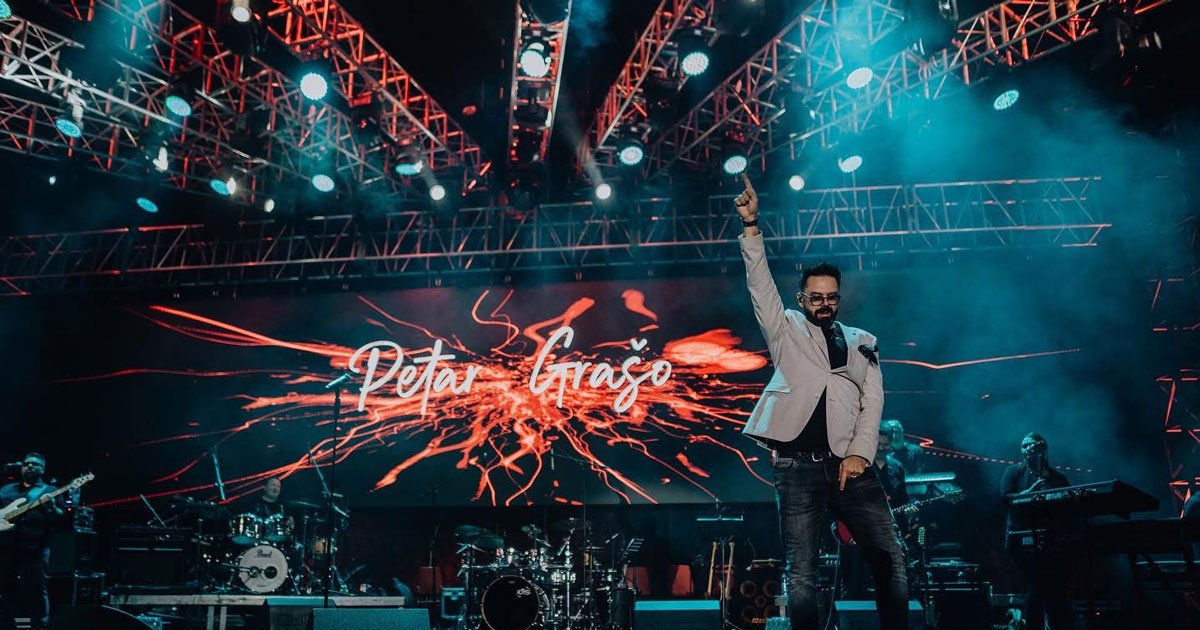
On July 2, the festival opens with a performance by Petr Graša, who three years ago performed between the walls of the centuries-old fortress, and on that occasion he greeted the audience in the town on Vrbas with the words: “Good evening, Banjaluka. Your task is to feast, to drink, to be in a good mood, that’s all I ask of you.”
At the beginning of the interview for “Nezavisne”, the well-known musician was only asked “if the people of Banja Luka feast and drink”, and what kind of relationship he actually has with the local audience.
“From my impressions, the people of Banja Luka not only feasted, but also enjoyed the music. I always say that the most beautiful part of this job is when you feel that people are singing louder than you from the first moment. Then you know that the songs are just as much theirs as yours. And that is the greatest award that an author and performer can receive,” said Grašo.
In an interview for our newspaper, he also talked about the repertoire with which he will perform in front of the audience in Banja Luka, his career, Oliver Dragojević, changes in the field of the music industry, and his plans for the future.
NN: In 2023, at the “Banja Luka Fest”, you held a concert together with Nina Badrić, and the audience heard a selection of your and her greatest hits, as well as several songs by Oliver Dragojević. What kind of repertoire will we listen to this year within the walls of Kastel fortress?
GRASO: You can expect the best from Petr Graša in every segment. From the big band that I have been working with for more than 20 years, to the professional technical team that comes with me, to, of course, the repertoire that is the most important. There will be nostalgia, romance and songs that are sung loudly, accompanied by dancing. I choose songs that have been proven to be the most successful because I don’t want to waste a second of time or allow the atmosphere to oscillate. Very from the first moment (laughs). We will also touch on some songs that I did not sing, but they bring me back to certain times and remind me of my dear colleagues.
NN: “Banja Luka Fest” is a meeting place for the audience and artists in a special outdoor festival atmosphere. It is a manifestation that is becoming a traditional event in the city’s cultural calendar. In your opinion, what is the most important aspect of it? What makes it different from other regional festivals?
GRASO: Nowadays, when we are all in a hurry, it is nice to have places that slow people down and remind them that emotions are still the most important and that they cannot be replaced by virtual stimuli. The castle has a special charm. When thousands of people sing under the open sky among the centuries-old walls, an atmosphere is created that is difficult to describe in words.
NN: Your beginnings date back to 1995, when Oliver Dragojević sang the song “Boginja” that you wrote at “Dora”, and the following year you won the “Zadarfest” as a debutant with the song “I need someone”. 30 years have passed since then. When you look back on those three decades, which moment do you consider crucial in your musical journey?
GRASO: People often look for one defining moment, but life rarely works that way. It’s more of a series of small decisions that eventually make a big story. Of course, Oliver was one of the biggest turning points because without him, my life would probably have taken a different path. But I believe that I would still reach the goal I wanted, which is music, creation, me at the piano and people singing.
Read more:
Great audience interest in the return of “Banja Luka Festa” to Kastel
NN: How much did it mean for a young author when Dragojević, who was already a big name at the time, gave him the wind behind him by singing his song, and did you later in your career feel the need to give a young talent the trust that Oliver gave you?
GRASO: When Oliver Dragojević sings a song for you as a sixteen-year-old, it is not only recognition, but also a great responsibility. Talent can open many doors, but your character, if wrong, can slam all those doors very quickly. I used the advice given to me by Oliver at the beginning of my career and I stick to it to this day. And they are simple – work hard, respect the people who listen to you and don’t be an arrogant fool.
That is why today I believe that it is very important if a person can leave behind the feeling that he has instilled faith in someone in his own path. I believe that my natural task is not only to write and interpret songs, but to leave a mark of good relationship with the people around me.
NN: You have four studio albums, three compilations, and for the last 10 years you have presented yourself exclusively with singles. What is the reason for the big record break?
GRASO: The world has changed. We used to live for albums, today songs live their own lives individually. Honestly, I’ve never been one to post something just because the calendar says it’s time. I’d rather release one song that will stay for 10 years than 10 songs that will last for 10 days.
NN: When you create a new song, how much are you guided by personal emotions and life experiences, and how much is it a conscious decision to convey a certain message to the audience?
GRASO: In every song there is an emotion that the author gives. If it weren’t for that, it would be pure craft. We also have songs like that, but those are the rules of the game that I’ve never played by. I don’t get carried away with big ideas of teaching people how to live with my songs. It is enough for me that in one part of the day, when they hear one of my songs, they get, even if it is a false one, the feeling that they are not alone or that I bring them back to some beautiful moments.
NN: From the time you started until now, a lot has changed in the music industry. Which changes, in your opinion, are detrimental to the quality of music, and which have brought good?
GRASO: Today, it is easier to reach an audience than ever before, but it is much more difficult to stay in their hearts and minds. Technology is a fantastic thing, but sometimes I feel like songs last as long as social media posts. And a good song should last at least one lifetime. Fortunately, audiences still recognize sincerity. Fashion passes, emotion remains.
NN: Less than two years ago, the region “bought” a recording of your daughter Alba singing the song “Ako te pitaju”, while you are her musical accompaniment. Many recognized in this the symbolism of the transfer of love for music within the family. How much support was your family during all the years of building your career and do you measure success today, as a father, differently than at the beginning of your musical journey?
GRASO: I used to measure success by the number of concerts, today I measure it by whether I get home in time to curl up on the couch with the kids. Children completely change a person’s perspective. You suddenly realize that there are much more important things than applause. Applause lasts a minute, family lasts a lifetime. And that’s exactly why today I enjoy everything more than before.
NN: What are your plans for the future?
GRASO: By the end of the year, our schedule is practically completely filled and we have a lot of concerts waiting for us, but what makes me especially happy happens between trips – in the studio. In parallel, we are finishing four new songs that have been prepared for a long time and that we will publish one by one. Working in the studio makes me happy almost as much as playing on big stages, because I still love the process of creating a song, just like the first moment. Between all that, I will spend every free moment with my family in our house by the sea, with dear people and fishing, which I especially look forward to because without being at sea I would not be able to withstand this pace. I always return to the sea because it knows best how to silence the noise that accumulates inside me.