Although the Public Ministry announced a few hours ago the beginning of the investigations, the Ministry for the Penitentiary Service announced in a statement this Tuesday that so far they have recorded the death of five inmates at the Yare III Penitentiary Center (Miranda state) due to an alleged collective fight.
The incident generated a strong alert among relatives of those deprived of liberty, who denounced this Monday, April 20, the arbitrary suspension of visits, incommunication and lack of official information for several hours.
According to reports from relatives and organizations such as the Venezuelan Prisons Observatory (OVP), the irregular situation began over the weekend, with access restrictions since April 19. Only food and personal items were allowed in, while relatives who gathered outside the prison were denied entry. Reports circulated of a violent confrontation, possibly linked to prisoner transfers, with initial rumors of more injuries and deaths.
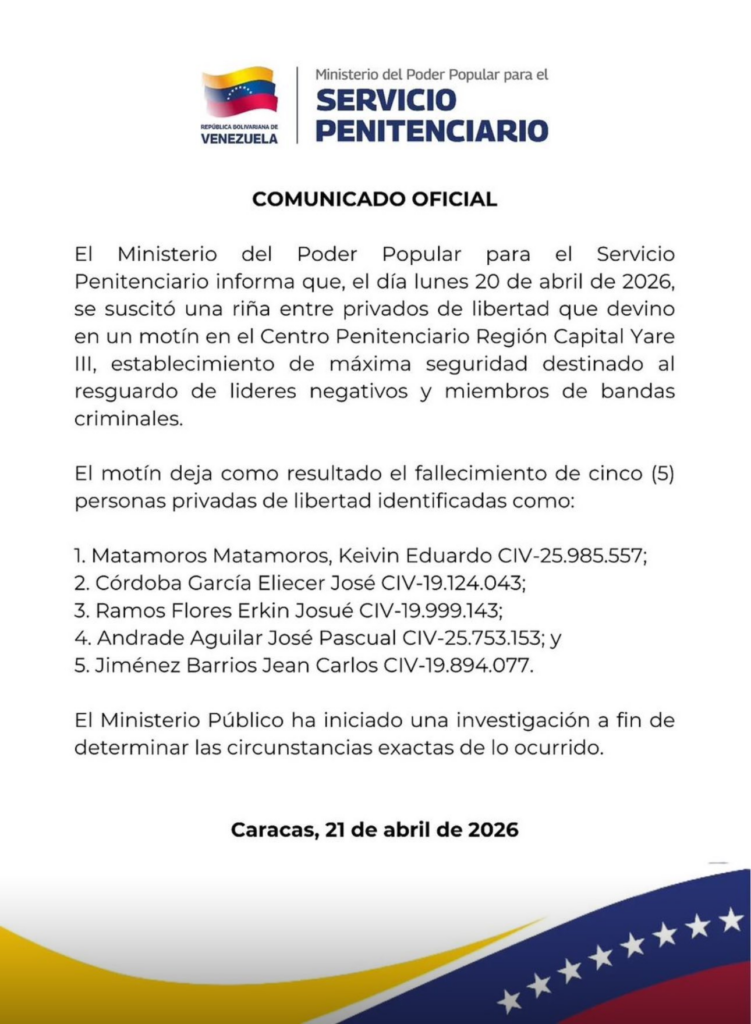
The Ministry of Penitentiary issued a statement confirming the five deaths as a result of a fight that escalated into a riot in the maximum security module. Authorities indicated that order was restored, but did not offer additional details about injuries or the exact causes of the incident.
This incident occurs amid a panorama of releases and transfers in the Yare prison complex. Just days before, on April 16, more than 50 releases were reported in Yare II, mainly of people linked to the “Pdvsa Obrero” case, as part of alternative measures or amnesty processes. Relatives of political prisoners have held vigils demanding proof of life and releases.
Yare, historically one of the most conflictive prison centers in Venezuela, has been the recurring scene of riots, fights and complaints about inhumane conditions and arbitrary transfers.
As of the writing of this note, there is no complete official report on the injured or identification of the victims. Relatives continue to demand transparent information and access to the prison. The case is still developing and is closely followed by human rights NGOs.