PANGU CONVENTION
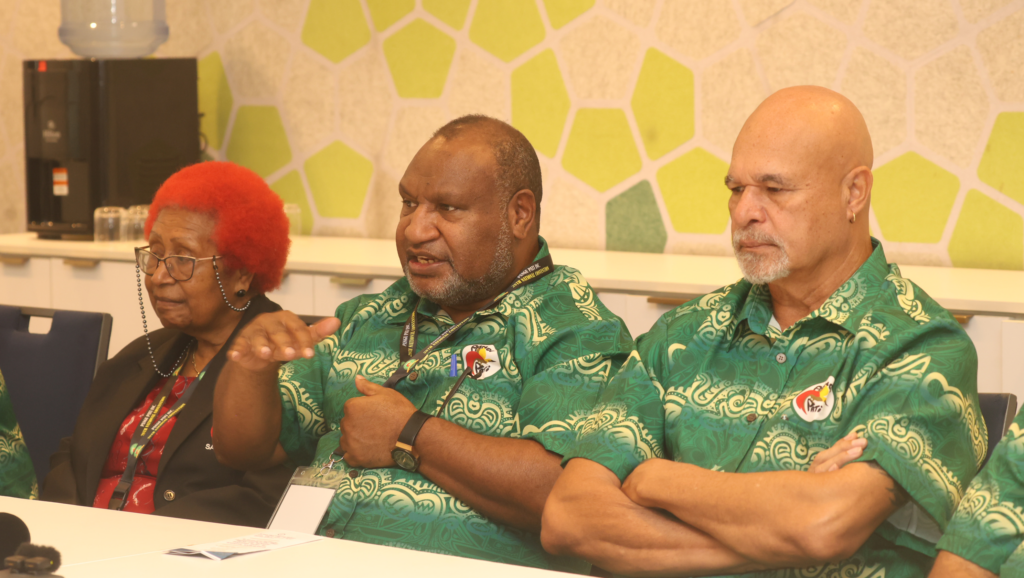
PRIME Minister and Pangu Pati Leader James Marape has commended the recent successful conclusion of the party’s 28th national convention in Port Moresby, describing it as one of the most substantive and policy-focused gatherings in the party’s history.
The convention brought together 44 provincial executives representing 21 provinces and Bougainville, alongside party council members and representatives of the parliamentary wing, to review the party’s progress, reaffirm its leadership, and set policy directions for the years ahead.
Marape said the convention demonstrated the strength, stability and growing maturity of Pangu Pati as it approaches its 60th anniversary next year.
“Pangu Pati remains one of Papua New Guinea’s most enduring political institutions,” he said. “Twenty-eight national conventions since the party’s establishment reflect a strong organisational structure, a functioning constitution, and a commitment to democratic participation and accountability. The convention was not about personalities. It was about policy, governance, and the future direction of our country.”
The convention unanimously reaffirmed the party’s leadership structure, including Prime Minister Marape as Parliamentary Leader, together with regional and provincial leadership teams throughout the country. Delegates also endorsed constitutional reforms introducing a two-term limit for leadership positions throughout the party structure.
“I welcome these reforms because leadership should always be accountable to members and subject to renewal through democratic processes,” Marape said.

Next generation, not next election
The convention reaffirmed Pangu Pati’s long-term development vision under the theme: “Next Generation, Not Next Election – Leaving No Place and No Child Behind.”
Marape said delegates strongly endorsed the Government’s ongoing investments in national infrastructure, including roads, bridges, ports, airports, electricity, telecommunications and internet connectivity.
The convention reaffirmed support for the Connect PNG Programme, which aims to connect approximately 20,000 kilometres of roads nationwide by 2040, linking communities, opening economic corridors and improving access to government services.
“Infrastructure remains the foundation for economic growth, national unity and service delivery,” Marape said.
Health: One-hour access to healthcare
The convention endorsed a policy objective that all Papua New Guineans should have access to quality healthcare within one hour of where they live.
Delegates supported continued investment in provincial hospitals, district hospitals, community health services and specialist medical care, while recognising the important role of Port Moresby General Hospital as the country’s principal national referral hospital. The convention further endorsed the principle that every province should have a fully functioning provincial hospital and every district should have access to modern healthcare services.
“Our goal is simple: no Papua New Guinean should be denied access to quality healthcare because of geography,” Marape said.

Education: No child left behind
The convention reaffirmed support for universal education through to Grade 12, ensuring every child entering school has the opportunity to complete a full cycle of education. Delegates endorsed continued investment in education infrastructure, teacher training, skills development and character formation.
The convention also reaffirmed the Government’s commitment to its K11 billion national education infrastructure investment programme, designed to improve learning environments across the country through to 2035.
“Education remains the single most important investment we can make in the future of our country,” Marape said.
Safer communities and stronger institutions
The convention reaffirmed the party’s commitment to strengthening law and justice institutions. Key targets endorsed by delegates included:
• Expanding the Royal Papua New Guinea Constabulary to between 10,000 and 15,000 personnel by 2035;
• Increasing Correctional Services personnel to 5,000 officers;
• Ensuring every province has access to correctional facilities;
• Strengthening village courts, mediation systems and community-based justice mechanisms.
The convention also endorsed initiatives to improve police recruitment, training and community policing arrangements.
“Papua New Guinea must be a safe, secure and orderly country where citizens can live, work and invest with confidence,” he said.

Defence and national security
Delegates endorsed strengthening the Papua New Guinea Defence Force towards a target strength of 7,000 personnel, supported by enhanced maritime, air and intelligence capabilities. The convention reaffirmed support for ongoing defence cooperation with Papua New Guinea’s traditional and regional security partners.
Economic growth
The convention reaffirmed the Government’s long-term economic growth agenda and endorsed ambitious national targets to grow the economy to: K200 billion by 2030; K300 billion by 2035; and K500 billion by 2045.
Delegates endorsed the acceleration of major nationally significant projects, including Papua LNG, Wafi-Golpu and other strategic investments, as part of a broader strategy to create jobs, generate revenue and expand economic opportunities.
The convention also reaffirmed support for downstream processing, greater national participation in resource development and policies aimed at ensuring Papua New Guinea receives a fair return from its natural resources. As part of this approach, the convention reaffirmed Pangu Pati’s preferred resource benefit-sharing framework of 55 per cent national benefits and 45 per cent investor benefits as a baseline principle for future resource developments.
Economic empowerment
Prime Minister Marape said delegates strongly supported the party’s objective of helping one million Papua New Guinean families participate in productive economic activity. The programme will focus on expanding opportunities in agriculture, fisheries, forestry, tourism, small business and other sectors capable of generating sustainable income.
“Our goal is not simply employment statistics,” he said. “Our goal is to ensure one million families are actively participating in economic activity, generating income and improving their quality of life.”
Public service reform and AI
The convention endorsed reforms aimed at improving public service performance, transparency and accountability, including greater use of digital technologies and artificial intelligence. Delegates supported the use of technology to strengthen merit-based appointments, improve procurement systems and reduce opportunities for corruption.
The convention also reaffirmed a workforce distribution principle aimed at placing government services closer to citizens:
• 10 per cent national headquarters;
• 20 per cent provincial offices;
• 70 per cent frontline service delivery throughout districts and communities.
“The public service must continue to evolve to meet the expectations of our people and the demands of a modern economy,” Prime Minister Marape said.
Commitment to the Bougainville Peace Process
The convention reaffirmed Pangu Pati’s commitment to the constitutional and legal processes governing Bougainville’s political future.
Marape said the party remained committed to the Bougainville Peace Agreement and the constitutional provisions under Section 342(2), which require the National Parliament to consider and decide on the outcome of the Bougainville Referendum.
“We remain committed to dialogue, consultation, peace and constitutional processes as we continue discussions with the Autonomous Bougainville Government,” he said.
Mature, forward-looking party
Marape commended party executives, councilors and members for their constructive participation throughout the convention.
He added: “Our members focused on policy, governance and nation-building. That is exactly what a modern political party should do. As we prepare for Papua New Guinea’s next chapter, Pangu Pati remains committed to building a safer, stronger and more prosperous nation for all our people. Our focus remains firmly on the next generation, not simply the next election.”