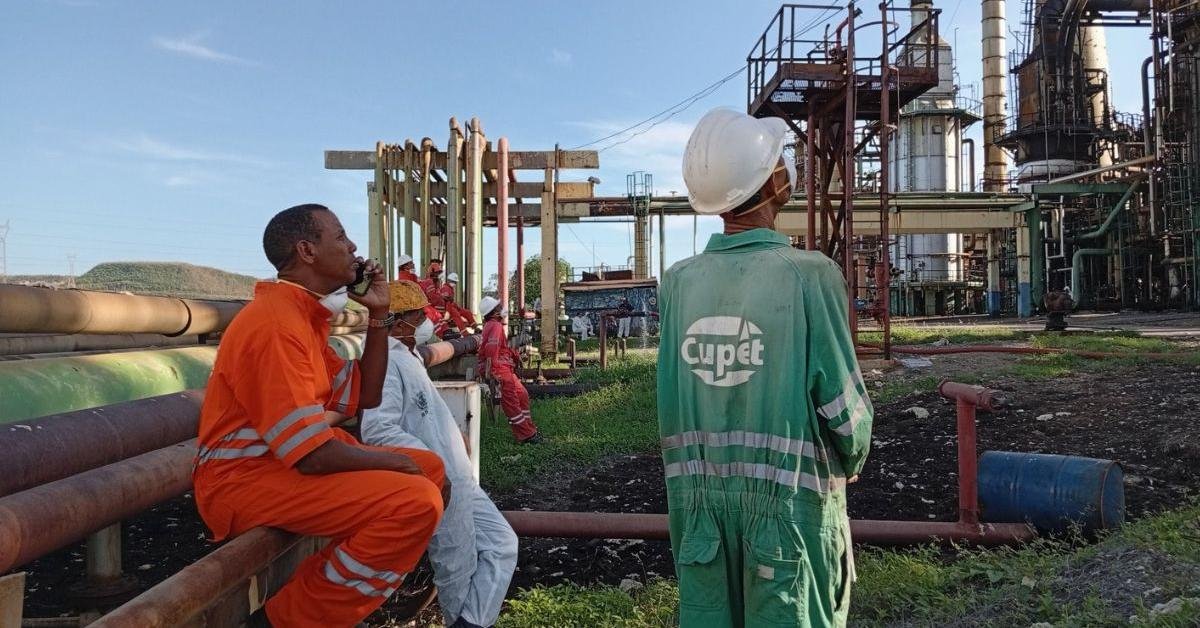
Havana/The United States sanctions against the state-run Cuba-Petroleum Union (Cupet) have already begun to have effects on foreign companies linked to the energy sector on the Island. The Australian oil company Melbana Energy announced this Thursday the immediate suspension of its financial, technical and administrative participation in Block 9, one of the most promising crude oil exploration projects, according to Cupet, although it never presented convincing data.
The company, which is listed on the Australian Stock Exchange, made the decision a week after Washington included Cupet on the list of Specially Designated Nationals of the Office of Foreign Assets Control (Ofac). The Cuban state company is Melbana’s contractual counterparty in the Block 9 production sharing agreement.
“Melbana has immediately suspended its direct participation” in those activities while it studies the legal consequences of the Ofac measure, the company reported to its shareholders, adding that Cupet had already been notified of the decision.
Block 9 covers about 2,344 square kilometers on land, along the northern coast of Cuba and about 140 kilometers east of Havana, in a geological strip near the Varadero deposit. For years, Melbana presented the area as the main asset of its international portfolio, but last November They were already beginning to fade the expectations of finding commercially profitable oil on the Island.
Last year, Melbana ordered the departure of all its expatriate employees and foreign contractors from Cuba.
By then, the project also accumulated another setback. Work has been paralyzed since the end of 2025 due to non-payments by Sonangol, the Angolan state oil company that formally retains a 70% stake in Block 9.
In the absence of the financial contributions committed by its partner, Melbana ordered the departure of all its expatriate employees and foreign contractors from Cuba last year. Since then, it only maintained minimal security and protection services for the facilities, provided by Cuban workers.
What changes now is that the firm also cuts the support it still provided as the project operator. The decision threatens to further complicate the eventual resumption of drilling and commercial development of the fields.
Melbana formally retains 30% of the contract, although in April it announced the start of the procedure to recover Sonangol’s participation for failure to meet its financial obligations. The transfer of the remaining 70% still depends on the approval of the Cuban authorities.
The Australian company has hired lawyers and specialist advisors to determine the extent of the sanctions and the possible risk to its shareholders, its operations and its contractual position. The oil company is also studying whether there is any way to request clarifications or authorizations from Ofac or the State Department that would allow it to resume its activity on the Island.
The project announced by the Australian company, in December 2024, to export Cuban crude oil for the first time is far away
The company warned that the sanctioning framework is “highly technical” and that its consequences are not simple. At the moment, no final decision has been made on the future of the project.
The United States Government included Cupet on the list of sanctioned entities on June 11. Washington accuses Cuban authorities of using fuel and other energy resources as mechanisms of social control and of favoring the ruling elite while the population endures blackouts and prolonged shortages. The measure blocks Cupet’s possible assets under US jurisdiction and prohibits citizens and companies from that country from maintaining relations with the entity.
Havana, for its part, denounced the sanctions as part of an attempt at economic “strangulation” and assured that they will worsen the difficulties of importing fuel and maintaining public services.
After more than a decade in Cuba, Melbana specified that its exploration projects in Australia are not affected. The future of its activities on the island, however, is caught between the US sanctions against Cupet, the non-payments of the Angolan company Sonangol and expectations about the oil potential of Block 9 that the regime contributed to fueling. The project announced by the Australian company, in December 2024, to export Cuban crude oil for the first time is far away.