The price of oil rose at the opening of this week’s trading after the failure of peace negotiations between United States and Iran and the announcement made by Donald Trump to impose a naval blockade on Strait of Hormuz.
Brent, a global reference, advanced 7.07%, quoted at US$ 101.93 at 9:45 am (Brasília time) this Monday (13). It reached US$103.88 at 8:30 pm this Sunday (12) in the first negotiations of the day.
The June contract has not exceeded US$100 since last Tuesday (7), when it reached US$111.80. Since the start of the war, Brent oil has already reached US$119.42 on March 9. Before the start of war in Iranthe barrel was traded at US$72.
The WTI (West Texas Intermediate) barrel, used in the United States, was also US$105.62 at 8:30 pm, but is now around US$104, quoted at US$104.18, for the May contract.
The main stock exchanges in Europe are falling between 0.5% and 1.5% this Monday, while the Asian indices had a division with some closing higher, but some falling. Last week, most stock markets around the world appreciated with the announcement of the two-week ceasefire and the proximity of an agreement between the USA and Iran.
“This is a complete reversal of any optimism that existed before the peace talks, with the dollar taking on a safe haven role, oil soaring and everything else selling off,” said Fiona Cincotta, senior market analyst at City Index.
“On the other hand, we’ve seen markets overreact at times. And I think especially in this scenario, the market is having a hard time pricing correctly because there’s a lot of uncertainty, a lot of unknowns.”
The moves early Monday dragged prices of many assets back to close to where they were trading in the middle of last week, before the two-week ceasefire.
“The market is now largely back to pre-ceasefire conditions, except now the US will also block remaining flows of up to 2 million barrels linked to Iran through the Strait of Hormuz,” said Saul Kavonic, an analyst at MST Marquee in Sydney.
“The main question that remains is whether the US will resume attacks on Iran, increasing the risk of attacks on energy infrastructure across the region, which could have a lasting impact beyond the duration of the war.”
Risk-sensitive currencies such as the Australian dollar and the British pound came under pressure, falling 0.7% and 0.5% respectively. The dollar rose 0.3% to 159.78 yen.
With growing expectations of a rebound in inflation, investors have priced in the possibility of several central banks, such as the European Central Bank and the Bank of England, leaning towards raising interest rates this year.
The rise in oil prices comes after a week of relief in prices. The barrel closed Friday’s trading session (10) at US$94, accumulating a weekly drop of 13% given the positive expectations of investors with Saturday’s meeting (11).
However, the meeting between American and Iranian representatives in Pakistan came to an end without an agreement. The failure brought uncertainty about the future of the ceasefire announced last week.
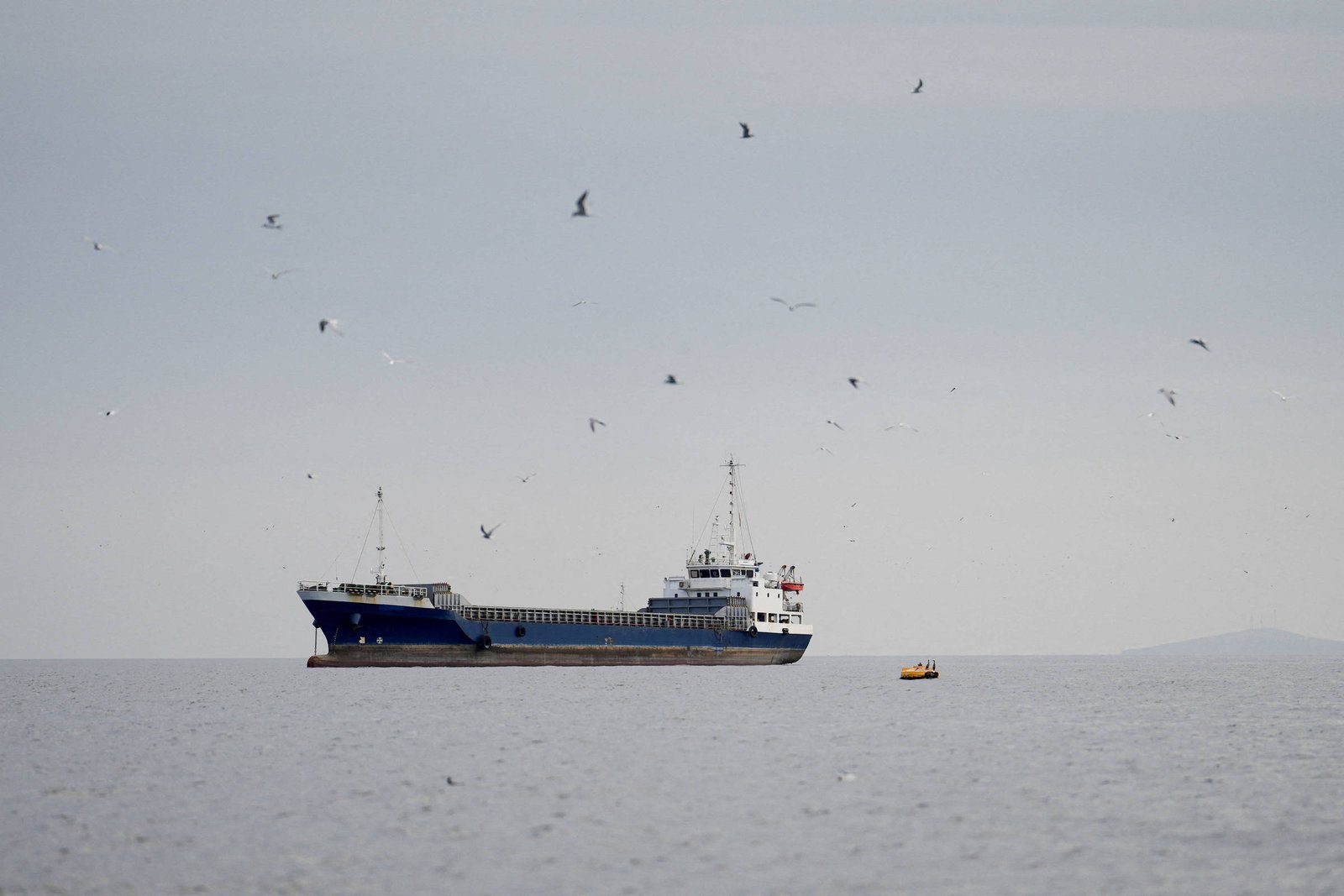
The plan announced by Trump for the Strait of Hormuz deepened the scenario of uncertainty and the prospects for rising fuel prices.
“From now on, the United States Navy, the best in the world, will begin the process of blocking any and all ships attempting to enter or leave the Strait of Hormuz,” Trump wrote on his social network. “I have also instructed our Navy to seek out and interdict all vessels in international waters that have paid a toll to Iran.”
If the blockage of the strait is confirmed, the flow of Iranian oil to other markets will be impeded.
“Until now, the US has allowed Iranian exports of crude oil and oil products, and even eased sanctions so that more buyers could import these cargoes, as the US was very focused on keeping oil prices low,” Amrita Sen, founder and director of Market Intelligence at Energy Aspect, told the Financial Times.
“But if there is a genuine blockage, that’s another 1.5 million to 1.7 million barrels per day (b/d) of oil exports that would be halted — on top of the more than 10 million b/d already halted.” he stated.
Before the war, about a fifth of all oil traded in the world passed through the strait, a sea passage between Iran and Oman.
Iran’s Revolutionary Guards responded with a statement, warning that military vessels approaching the strait will be considered a violation of the ceasefire and dealt with strictly and firmly, highlighting the risk of a dangerous escalation.
STOCK EXCHANGES FALL IN EUROPE
The main stock exchanges in Europe are falling this Monday due to the frustration of negotiations between North Americans and Iranians. The Euro STOXX 600 index, a reference in the European Union, registered a drop of 1.19%, at 9:40 am, in a trend followed in Frankfurt (-1.4%), London (-0.48%), Paris (-0.98%), Madrid (-1.7%) and Milan (-0.98%).
In Asia, Chinese indices closed higher with the CSI300, which brings together the main companies in Shanghai and Shenzhen, rose 0.21%, and the SSEC index, from Shanghai, gained 0.06%. The Tokyo, Hong Kong and Seoul Stock Exchanges fell 0.74%, 0.9% and 0.86%, respectively.