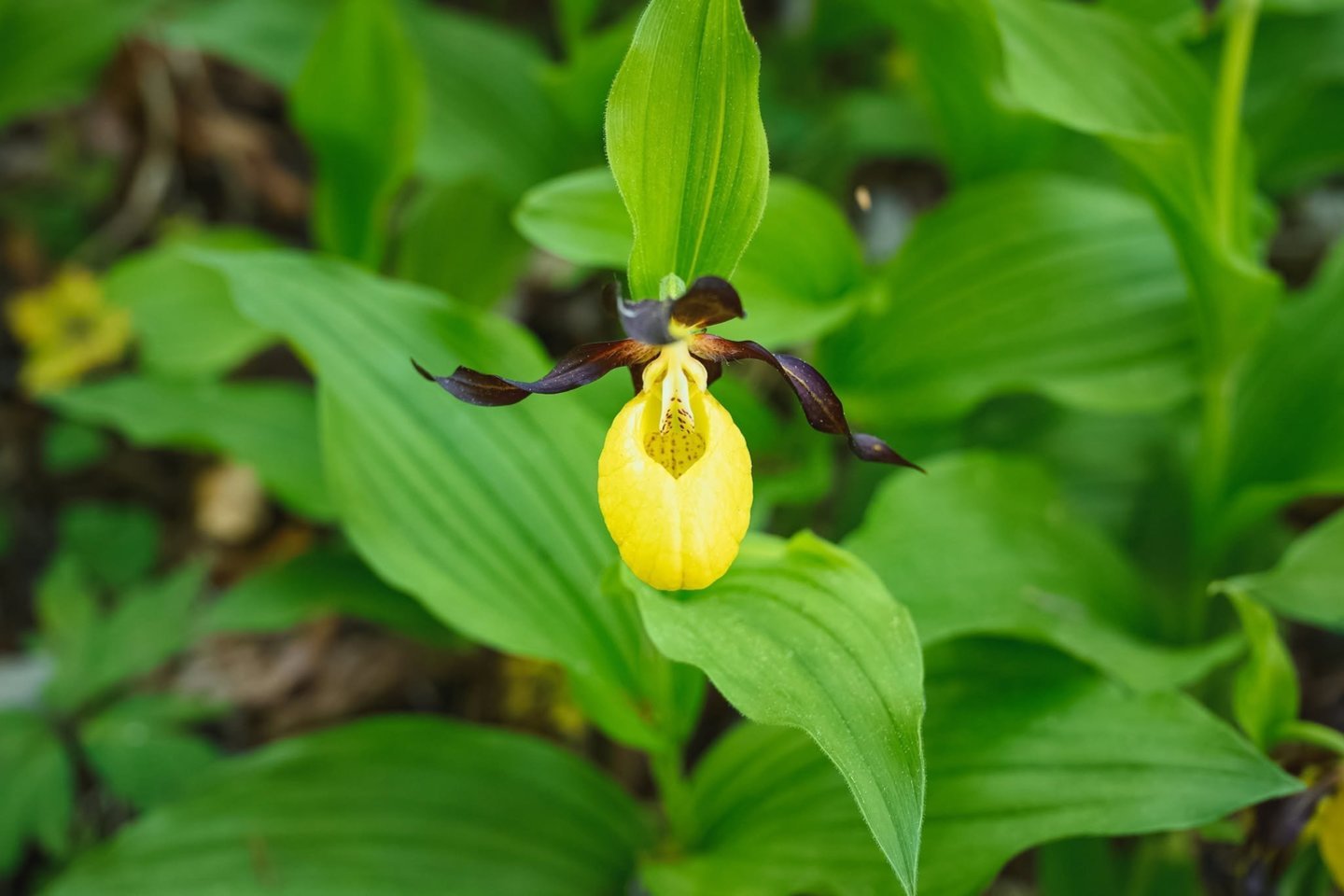
“It takes at least 12 years to produce these golden-yellow, clump-shaped flowers. It takes 6-10 years for the seeds to germinate at all. When they finally bloom, you can only admire them for a few weeks out of the year.”
But here’s the most interesting part: the clog-shaped ring is a trap. Once inside, the insect slides down and cannot get out the same way – it only finds a way out after collecting pollen. And they don’t learn from mistakes: they go straight to the next ring. This is how this orchid is pollinated.
This orchid in Verkių Park is one of the largest populations of the broad-leaved clog in Europe. The species is protected according to the Lithuanian Red Book, the EU Habitats Directive and the CITES Convention,” the park announced.
Specialists also remind that the plant’s growing area is fenced off for a reason – it is asked to admire it from the path, not to break it and especially not to dig it.
As the State Protected Areas Service (VSTT) previously wrote, this plant is etched in memory not only because of its unusual flower, which resembles a small clog, but also because of the variety of colors that attract insects.
The flowers of klumpaite are large, grow one or even three at the top of the stem. The outer leaves of the apiary are dark reddish brown. The lip is large, yellow, in the form of a blister. The rings are large and very ornate. Broad-leaved clog is one of the popularly known Lithuanian orchids.
The plant reaches a height of up to 50 cm with a creeping rhizome covered with scaly leaves. The stem and leaves are covered with dense hairs. Blooms in May – June. The seeds are very small and are carried by the wind. Grows in deciduous and mixed forests. Likes calcareous soils.
A rather rare species in Lithuania. Broad-leaved clogs are mostly disappearing due to inappropriate forestry use – intensive felling and the formation of homogeneous conifer stands. The species is adversely affected by dense scrub. In some areas, the plants are directly destroyed by people digging them up.
According to Dalytė Matulevičiūtė, a nature conservation expert at the Methodological and Analytical Center of the State Protected Territories Service, you should not have any illusions that it is possible to grow broad-leaved clogs near your home.
Attempts by people to dig up the plant and plant it in the flower garden end in failure, because it is practically impossible to create suitable growth conditions for the broad-leaved clog. It needs not only specific soil and lighting to grow, but also interactions with mycorrhizal fungi and other species.