By Yi Won-ju
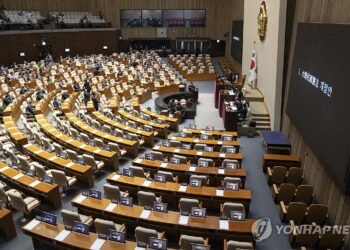
SEOUL, May 7 (Yonhap) — With less than a month remaining until the June 3 local elections, South Korea is gearing up for the pivotal event widely expected to reshape the country’s political landscape and determine the future momentum of President Lee Jae Myung’s administration, political observers here noted Thursday.
This year’s elections have drawn greater attention as 14 National Assembly seats are also up for grabs in parliamentary by-elections, adding to the significance of the polls as the first major nationwide test for the Lee administration since it took office last June following former President Yoon Suk Yeol’s ouster over his failed martial law bid.
The by-elections will be held in key battlegrounds, including Busan, Daegu and Gyeonggi Province, as well as Incheon, Gwangju, Ulsan, South Chungcheong, North Jeolla and Jeju to fill seats that mostly became vacant after lawmakers resigned to join the gubernatorial and mayoral races.

This composite file photo shows Ha Jung-woo (L), former presidential secretary for artificial intelligence policy and future planning, and Hang Dong-hoon, former leader of the People Power Party. (Yonhap)
Several political heavyweights are lined up for the upcoming race, transforming many districts into high-profile battlegrounds between the ruling and opposition parties.
Among them, the Buk-A constituency in the southeastern city of Busan has emerged as one of the most closely watched races nationwide, with Ha Jung-woo, former presidential secretary for artificial intelligence (AI) policy and future planning, set to run on the ruling Democratic Party (DP)’s ticket against independent Han Dong-hoon, former leader of the main opposition People Power Party (PPP), and former PPP lawmaker Park Min-shik, who previously headed the veterans ministry.
While Busan is a traditional conservative stronghold, the Buk-A constituency is the only district among the city’s 18 constituencies won by the DP in the last general elections, making the race a key battleground for both the liberal and conservative camps.
DP leader Jung Chung-rae stepped up efforts to woo voters in Busan earlier this week, labeling the PPP as an “insurrection party.”
“This year’s local elections are not simply about choosing local representatives,” Jung said during the party’s supreme council meeting Monday. “It is a historic judgment to prevent the return of the ‘Yoon Again’ forces that undermined the constitutional order through insurrection.”
Also drawing keen attention is the race in Pyeongtaek, where Cho Kuk, leader of the liberal Rebuilding Korea Party, is set to compete against Kim Yong-nam of the DP and Yu Eui-dong of the PPP, who is seeking a third term in the district.
Eyes are on whether Han and Cho, both widely considered as potential presidential contenders, will win their respective races.
Of the 14 assembly seats at stake, 13 were previously held by the ruling party. With its parliamentary majority dwindling to 152 seats following the resignation of lawmakers joining the local elections, the DP is expected to stage a fierce campaign to defend its turfs in an effort to retain its parliamentary dominance, while the PPP, too, will make all-out efforts to chip away at the ruling party’s majority in the 300-seat parliament, according to the experts.
For the embattled PPP, which currently holds 106 seats, the stakes extend beyond simple gains in parliamentary seats, they note.
Recent public surveys suggest a challenging path for the PPP following Yoon’s martial law crisis. A biweekly National Barometer Survey (NBS) poll showed that the approval rating for the PPP has continued to drop, plunging to as low as 15 percent in mid-April.
The ruling party, on the other hand, is seeking to clinch victories even in traditional conservative strongholds, on the back of President Lee’s high approval rating, which hit a record high of 69 percent in three consecutive NBS polls from late March.
The PPP, which had swept 12 out of 17 major gubernatorial and mayoral positions in the 2022 local elections held a month after Yoon took office, is expected to highlight what it sees as the Lee administration’s failures, particularly on housing and livelihoods, during its election campaign.
“The local elections will be a referendum to hold the DP, a criminal organization, and its ringleader, Lee Jae Myung, accountable,” PPP leader Jang Dong-hyeok wrote on his Facebook account Wednesday.
Winning more seats in the parliamentary by-election will also help the PPP stay comfortably above the minimum number of seats needed to prevent a constitutional revision currently pushed by the DP. The passage of a constitutional revision requires approval by at least two-thirds, or 200 votes, in the 300-member National Assembly.

Incumbent Seoul Mayor Oh Se-hoon (R) of the main opposition People Power Party and Chong Won-o of the ruling Democratic Party — the candidates for the mayoral race in the June 3 local elections — pose for a photo during a ceremony in Seoul on May 3, 2026. (Yonhap)
Also at stake are mayor and governor seats in 16 metropolitan cities and provinces, along with superintendents of education and chiefs of smaller administrative units. While 17 such posts were contested in the 2022 elections, the impending merger of Gwangju and South Jeolla Province has reduced the total to 16 in this year’s elections.
In Seoul, incumbent Mayor Oh Se-hoon of the PPP and ruling party candidate Chong Won-o are expected to continue a fierce battle over real estate issues to sway centrist voters.
Other key battlegrounds include the traditional conservative strongholds of Daegu and Busan. In Daegu, former Prime Minister Kim Boo-kyum of the DP will face off Choo Kyung-ho, a former finance minister who has also served as a floor leader of the PPP, while in Busan, Park Heong-joon, the incumbent mayor of Busan seeking a third term, will run against former Oceans Minister Chun Jae-soo from the DP.
Meanwhile in Gyeonggi Province, two female candidates are vying for the governorship, battling to become the nation’s first female provincial leader since the country began holding local elections in 1995.
Veteran DP lawmaker Choo Mi-ae, who served as justice minister under the administration of former President Moon Jae-in, will run against the PPP’s Yang Hyang-ja in the country’s most populous province with about 14 million people.
The upcoming elections are also marked by the entry of former presidential aides. Contesting seats under the DP banner include Ha, the former AI secretary, as well as former presidential spokesperson Jeon Eun-soo, running for a parliamentary seat in Asan, South Chungcheong Province, and another former presidential spokesperson Kim Nam-joon running for Incheon’s Gyeyang-B district, the constituency represented by Lee during his time as a lawmaker.
Whether or not Lee’s former aides secure victories in the elections will also be a focus of attention.
As the first nationwide assessment since Lee’s inauguration, a landslide victory for the ruling party may provide fresh momentum for the administration to push forward with its key policies and strengthen the ruling party’s legislative momentum.
A win for the PPP would help the party gain crucial momentum for rebuilding the conservative bloc amid deepening internal rifts in the aftermath of Yoon’s failed attempt to impose martial law.
Candidate registration will take place for two days from next Thursday, with official campaigning commencing on May 21. Early voting is set for two days from May 29.

Kim Boo-kyum (L) of the ruling Democratic Party and Choo Kyung-ho of the main opposition People Power Party — the candidates for the mayor of Daegu, a major conservative stronghold in the June 3 local elections — meet during a Labor Day ceremony in the southeastern city of Daegu on May 1, 2026. (Yonhap)
julesyi@yna.co.kr
(END)