Index measures fitness, learning, welfare and local safety
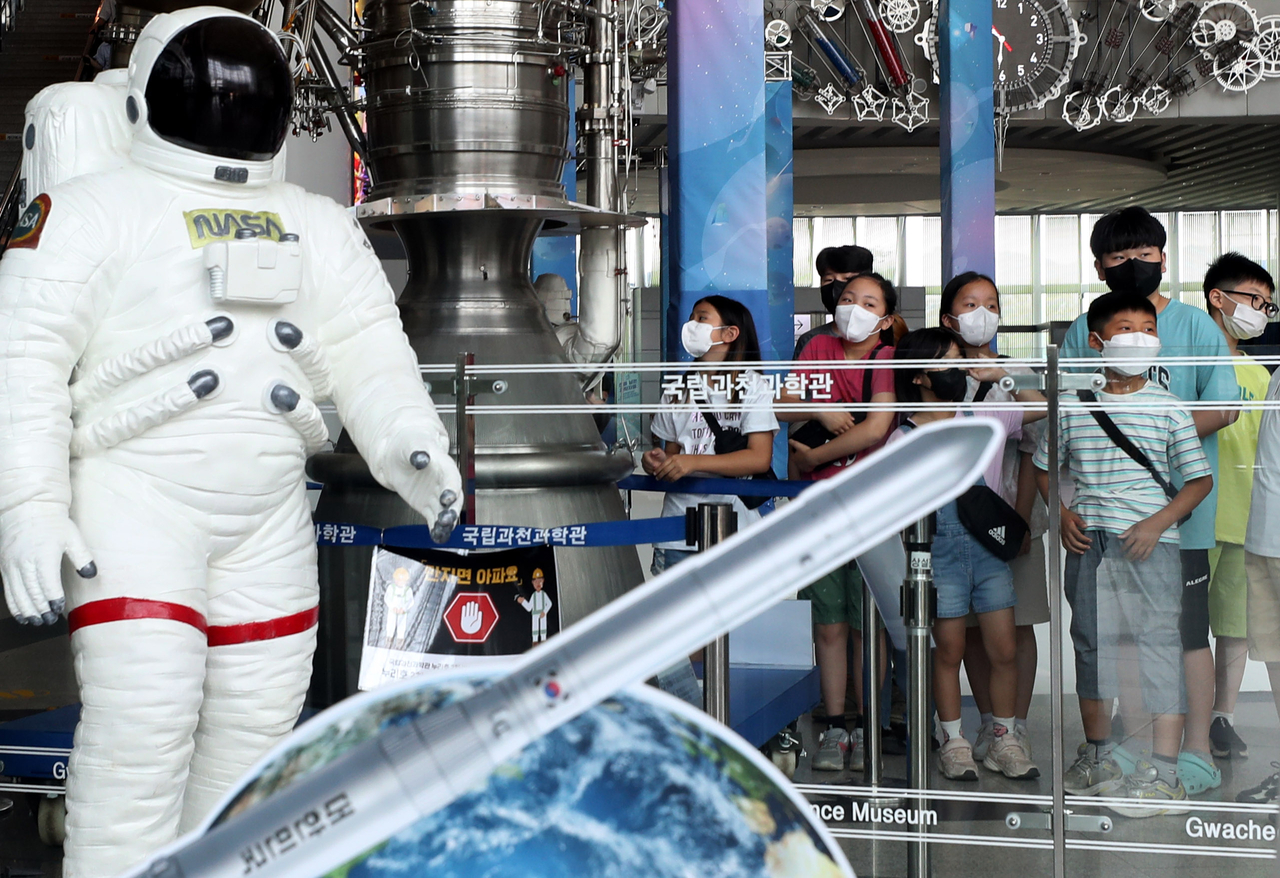
Gwacheon in Gyeonggi Province offers the best environment in South Korea for children to grow up, according to a new private-sector analysis that shows child development conditions remain heavily concentrated in Seoul and the surrounding metropolitan area.
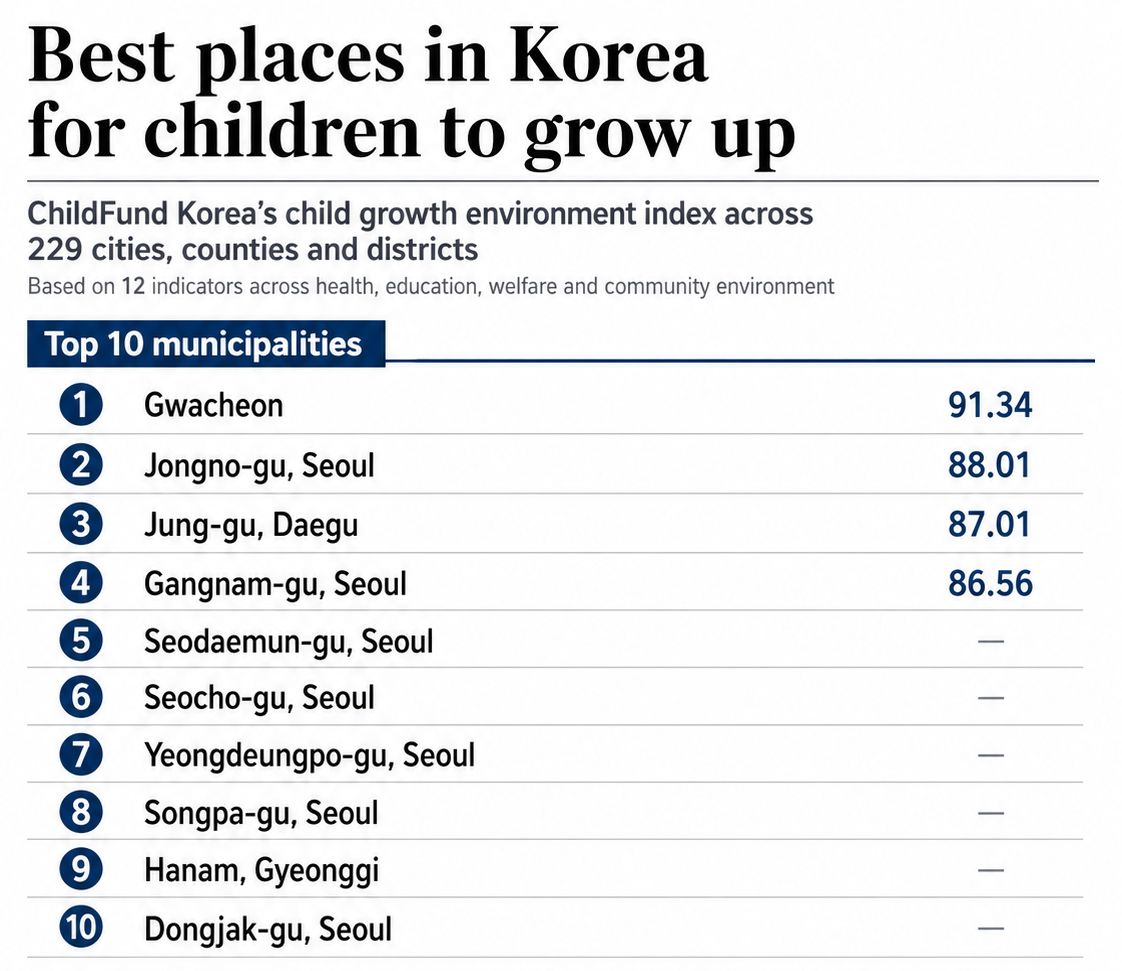
ChildFund Korea said Thursday it released the country’s first comprehensive private-sector index assessing child growth environments across 229 cities, counties and districts.
Nine of the top 10 municipalities were in Seoul or Gyeonggi Province, including Seoul’s three affluent Gangnam districts of Gangnam, Seocho and Songpa.
The index was compiled by ChildFund Korea’s Child Welfare Research Institute after a yearlong analysis of 87,851 sets of public data. The institute assessed 12 indicators across four categories: health, education, welfare and community environment.
Gwacheon ranked first with 91.34 points, followed by Jongno-gu in Seoul with 88.01 points and Jung-gu in Daegu with 87.01 points. Gangnam-gu ranked fourth with 86.56 points, followed by Seodaemun-gu, Seocho-gu, Yeongdeungpo-gu, Songpa-gu, Hanam in Gyeonggi Province and Dongjak-gu.
Busan’s Jung-gu had the lowest overall score at 61.03 points, more than 30 points behind Gwacheon. Dongducheon in Gyeonggi Province, Mokpo in South Jeolla Province, Boeun in North Chungcheong Province and Tongyeong in South Gyeongsang Province were also among the lowest-ranked areas.
A total of 24 municipalities were classified as vulnerable. South Gyeongsang Province had five such areas, followed by North Jeolla and South Jeolla provinces with four each. Incheon and North Chungcheong Province each had three, while Gyeonggi Province had two.
The study found wide gaps not only between regions but also within the same province. In Gyeonggi Province, for example, eight cities were in the top 20 percent, while five were in the bottom 20 percent.
The foundation said top-ranking areas tended to combine strong education, welfare and community conditions, creating stable environments for children. Lower-ranking areas often faced overlapping weaknesses in basic learning, living conditions and local infrastructure.
The index measured health through indicators such as the share of pediatric specialists, the rate of children receiving treatment for depression and the share of suicides among child deaths.
Education indicators included the share of elementary students falling below basic physical fitness standards and lower-tier achievement rates in math and English among middle school students.
Welfare indicators included the share of basic livelihood security recipients, single-parent households receiving benefits and regional school dropout rates.
Community indicators included child traffic accident casualties, kindergarten capacity for preschool children and changes in the child population.
ChildFund Korea called for child policies to be designed at the city, county and district level, where children’s daily lives take place.
“For regions with low overall scores, integrated support linking education, welfare and community conditions should be considered,” the foundation said.
The analysis also found that some areas, including Hwacheon in Gangwon Province, Namhae in South Gyeongsang Province and Yeongju in North Gyeongsang Province, posted relatively solid scores despite low fiscal self-reliance, suggesting that locally tailored policies can help offset financial constraints.
This article was produced with the assistance of AI. — Ed.
hnpark@heraldcorp.com