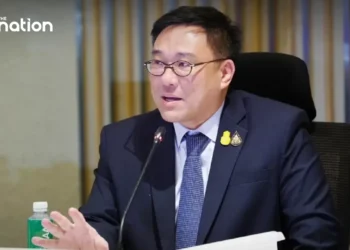
Rachada Dhnadirek, spokesperson for the Office of the Prime Minister, also outlined the key reasons behind the NSC’s decision to cancel MOU 44.
First, MOU 44, signed in 2001, was intended as a framework for negotiations on shared undersea interests between Thailand and Cambodia. However, over more than two decades, only five rounds of talks have been held, with no conclusion that benefited both countries.
Second, Cambodia has instead caused disputes over maritime boundaries, creating conflict between the two countries and offering no workable path towards the joint development and management of undersea resources.
Third, cancelling MOU 44 would end negotiations under the existing framework. If Cambodia still sees benefit in jointly developing and managing undersea resources with Thailand, it should express its intention or formally notify Thailand so that a new and more practical negotiation framework can be established — one that does not lead to maritime boundary disputes as before.
Fourth, it must be acknowledged that, over the past 25 years of conflict between Thailand and Cambodia, MOU 44 has been one of the factors preventing negotiations from moving forward or achieving their goals.
“If the conflict continues in this way, negotiations to jointly develop and manage undersea resources will be difficult, because the key principle is that the maritime boundary must first be agreed. Only then can both sides seek a path towards joint development and management based on sincerity and fair sharing. It is therefore appropriate to cancel it and set a new negotiation framework to reduce conflict and ensure the resources can genuinely be put to use,” Rachada said.
Following the decision to cancel MOU 44 and shift to UNCLOS, the Foreign Ministry will prepare a proposal for Cabinet consideration before notifying relevant agencies and state parties.
Using UNCLOS, a globally recognised framework, may implicitly cut through the issue of Cambodia’s maritime boundary line, which Thailand says runs through Koh Kut. Even so, it raises the question of what information Cambodia may have in hand that prompted it to finally ratify UNCLOS after holding off for so long.
Likewise, Sihasak has not disclosed Thailand’s legal strategy, while both sides appear likely to reserve their arguments for international mechanisms.