The case has once again put on the table the risks involved in ascending to the highest snow-capped mountain in Peru and one of the most demanding in the Cordillera Blanca. Specialists warn that climate change is modifying the conditions of glaciers.
The relatives of the missing mountaineers have launched a campaign on social networks to request support and expedite the search efforts. For its part, the Peruvian Air Force (FAP) announced the deployment of the MI-17 FAP 603 helicopter and a Search and Rescue Brigade (SAR), in addition to the mobilization of 12 troops, made up of four crew members and eight rescue specialists.

The climbers got lost on Monday afternoon and the last contact that was had with them was on Tuesday morning.
Despite this, the urgency increases as the hours go by due to the extreme conditions in the area. In Huascarán, temperatures can drop to -15 °C, while the presence of cracks and glacial terrain make both the survival of the missing and search and rescue efforts difficult.
Furthermore, this has not been the only incident recorded in Huascarán this week. Last Thursday, an avalanche in the La Canaleta sector left a porter dead and an Indian tourist injured.
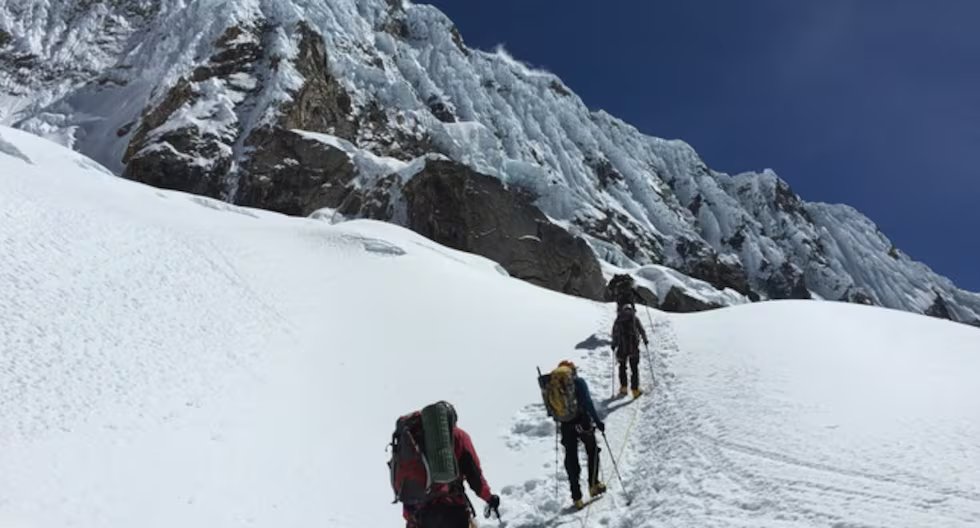
The snowfall was recorded around 7:30 am, at about 5,500 meters above sea level, when the group was ascending one of the most demanding routes of Huascarán.

An avalanche left a porter dead and an Indian tourist injured. Photo: GEC composition.
To explain how climate change and rising temperatures are modifying the conditions of the snowy Huascarán, Wilson Alfredo Suárez Alaiza, director of Innovation, Research and Development of the National Service of Meteorology and Hydrology of Peru (Senamhi) and cryosphere expertpointed to The Commerce that the analysis should not focus only on this snow-capped mountain, but on the entire Cordillera Blanca. “We must take into account all areas where water exists in a solid state, that is, the ice of glaciers,” he indicated.
The specialist explained that 30 years ago the 0 °C isotherm was located between 4,600 and 4,700 meters of altitude. However, due to rising air temperatures, it is currently among the 4,900 and 5,000 meters. “How is this related to the increase in temperature? Well, the snow capped ice no longer finds a temperature that gives it the necessary cohesion and hardness,” he said.
Suárez explained that, as the temperature increases, the ice begins to melt, turns into water and loses resistance. “In some cases, if that water enters through the cracks in the snow and reaches the rocks, it can cause a large avalanche, as we are already seeing. This is more likely in years with very high temperatures, like the current one,” he noted.
The expert warned that prolonged periods of high temperatures weaken the ice. “If you review the largest number of accidents that have occurred in mountain areas, you will see that they are not due to hypothermia, but to avalanches. This year, in particular, is being very warm and the air temperature is much higher than expected,” he warned.

As the temperature increases, the ice on the snow begins to melt, turns into water and loses resistance.
/ Globetrotter’s Corner
Luzmila Dávila, deputy director of Glacier Research at the National Institute for Research in Glaciers and Mountain Ecosystems (Inaigem)pointed to The Commerce that, in a “totally unpredictable” El Niño phenomenon scenario, the instability processes in the glaciers have increased and will continue to increase.
“The increase in temperature is further destabilizing areas that are already unstable. In the case of Huascarán, this is causing the loss of areas that were previously considered safe,” he stated.
“Definitely, the conditions are not optimal for climbing. What happens in Huascarán is also happening in other mountains, not only in the Cordillera Blanca, but in the other mountain ranges of Peru and even worldwide. Extreme climate phenomena are global,” he said.
Dávila specified that Inaigem monitors the Huascarán through the use of drones to collect photogrammetric information. “We also carry out measurements of the concentration of light-absorbing particles to reduce pollution. Likewise, we monitor glaciers with high instability located in areas of frequent access. So far this year we have registered eight highly significant avalanches in Huascarán,” he explained.

The increase in temperature is destabilizing the areas of Huascarán that were already unstable. Photo: Peru Travel.
Regarding the search for the three missing mountaineers, the Regional Manager of Disaster Risk Management of the Regional Government of Ancash, Gastone Rafael Macedo Menachoinformed this newspaper that on Wednesday he held a meeting with representatives of the Peruvian Air Force and the National Police to coordinate the deployment of helicopters from 5:30 am on Thursday. However, he explained that air operations had to be suspended at noon due to weather conditions that reduced visibility.
“Glacial behavior is very complex. Like any natural process, it is unpredictable. We, as a State, have taken steps to care for the families from the social aspect. We hope that next week, after the National Holidays, we can set up a working table with the different entities involved,” he said.
“We put ourselves in the position of the relatives and we understand their desperation, but they must also understand that both the Air Force and the Police have protocols to respect. In addition, we are implementing 29 community early warning systems and we have an agreement with the Geophysical Institute of Peru, which provides us with technical assistance,” he said.
Regarding the protocols for the entry of expeditions to Huascarán, the official acknowledged that “unfortunately, we do not have protocols designed for these cases. Therefore, we are proposing a working group with the different entities to develop these guidelines.”