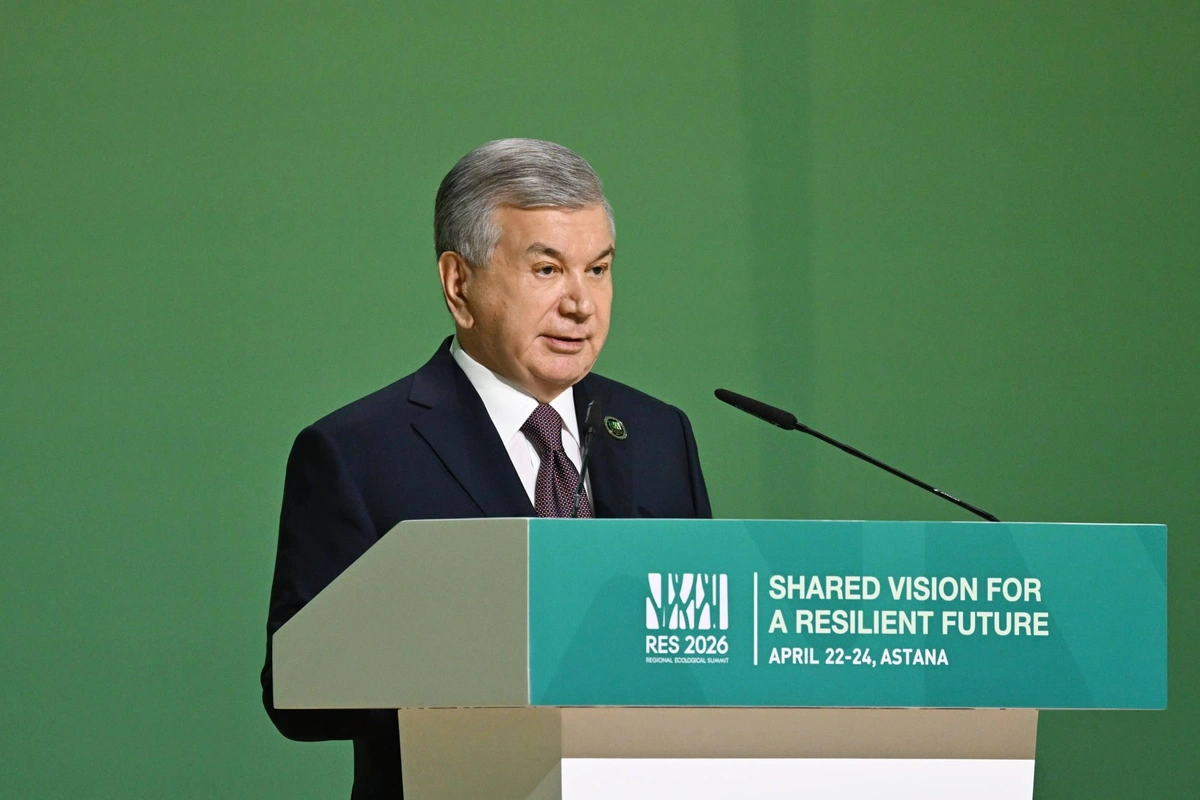
In Central Asia, the average annual temperature is rising twice as fast as the world. Almost a third of the region’s glaciers have been lost, precipitation is unstable, and the shortage of water resources is growing. Degradation has already covered 80 million hectares of land, said President of Uzbekistan Shavkat Mirziyoyev at a regional environmental summit in Astana.
He expressed concern about the decline in global environmental solidarity and stressed that developing countries must have equal access to climate finance, technology and innovation. writes Gazeta.uz.
“The weakening of global environmental solidarity is deeply concerning. Declarations and calls are not supported by resources. The countries that have had the least impact on global climate change are once again left alone with its consequences,” the President of Uzbekistan emphasized.
Mirziyoyev supported the adoption of the declaration “Ecological Solidarity of Central Asia” and the action program until 2030 with the participation of the United Nations.
The President spoke about the measures of Uzbekistan: as part of the Yashil Makon project, about a billion trees have been planted, more than 2 million hectares of forests have been created at the bottom of the Aral Sea, and up to 10 billion cubic meters of water are saved annually. The share of “green” energy has reached 30% and continues to grow. The country has also exceeded Paris climate agreement targets, cutting emissions by 35%, and plans to halve them by 2035. At the same time, waste recycling and energy production projects are being implemented.
Uzbekistan’s proposals to Central Asian countries to combat environmental challenges
1. Establishment of the interstate consortium “Clean Air of Central Asia”.
“The consortium can become a joint operator of green financing for the purpose of modernizing industry and introducing emission treatment systems,” said Shavkat Mirziyoyev.
2. Giving regional status to the Center for Combating Desertification, Drought Prevention and Early Prevention of Sand and Dust Storms operating in Uzbekistan at the Green University.
“Consolidation on the basis of the center of scientific potential will create a powerful system for monitoring land degradation and salt and dust emissions,” the president noted.
3. Formation of the “Green Trade Corridor of Central Asia”.
“The introduction of preferential customs regimes and mutual recognition of certificates for eco-products will allow us to quickly modernize production and make our products competitive,” said the leader of Uzbekistan.
4. Creation of a unified Investment portfolio of climate projects in Central Asia.
“This will allow us to come forward not with isolated initiatives, but with a holistic strategy for the development of the region, which will increase the interest of partners in its implementation,” the president said.
5. Creation of a Unified Regional Atlas of Environmental Changes in Central Asia.
“It will become a fundamental scientific and analytical base that clearly reflects the dynamics of desertification processes, land degradation and the state of water resources in the region,” Shavkat Mirziyoyev expressed his opinion.
6. Joint development of the “Red Book of Central Asia”. The regional office of the International Union for Conservation of Nature in Tashkent could become the coordinator of this work.
7. Environmental education and active involvement of youth.
Mirziyoyev proposed holding the World Youth Climate Forum in Uzbekistan in 2027.
In addition, from May 31 to June 5, the Eighth Assembly of the Global Environment Facility will be held in Samarkand, and the World Forum on Water Conservation will be held at the end of September. Shavkat Mirziyoyev called for active participation in these international forums.
Let us remind you that the President of Tajikistan Emomali Rahmon, speaking on April 22 at the Regional Environmental Summit “Shared Vision for a Sustainable Future” held in Astana, he emphasized the importance of preserving the mountain ecosystems of his country.
He noted that mountain ecosystems play a key role in ensuring water supply to Central Asia and maintaining sustainable development of the entire region.